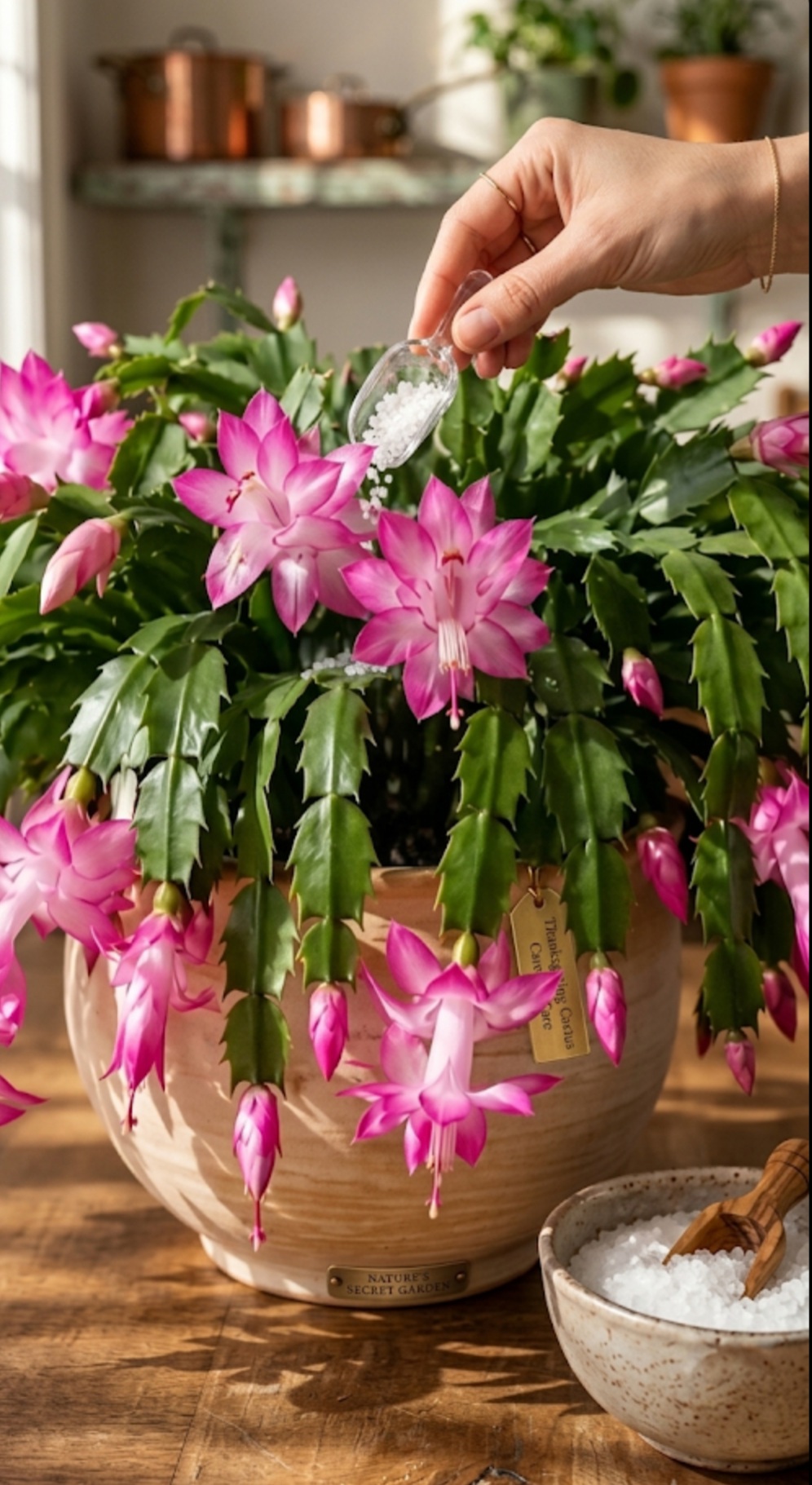
🟢The Christmas Cactus (Schlumbergera) and Thanksgiving Cactus (Schlumbergera truncata) are among the most beloved holiday houseplants, prized for their cascading stems and vibrant, trumpet-shaped flowers. While basic light and watering keep these tropical epiphytes alive, experienced indoor gardeners often turn to a simple, budget-friendly secret to trigger massive bloom explosions: Epsom salt (Magnesium Sulfate).
🟢Adding pure Epsom salt to your seasonal plant care routine provides essential mineral nutrients that standard indoor plant fertilizers often lack. In this ultimate professional guide, we examine why Epsom salt works, the exact science behind magnesium supplementation for holiday cacti, how to apply it safely, and best practices for year-round care! 🪴✨
The Science: Why Christmas Cacti Love Epsom Salt 🔬
🟢Epsom salt is not actually a salt, but a naturally occurring mineral compound consisting of Magnesium (Mg) and Sulfur (S)—two secondary macronutrients that play critical roles in epiphyte health:
- Magnesium (Mg): Forms the central atom in the chlorophyll molecule, enabling efficient photosynthesis. It helps leaves maintain a deep green color and prevents dull, yellowing stem segments. 🍃
- Sulfur (S): Aids in enzyme production, amino acid synthesis, and root absorption of primary nutrients like Nitrogen, Phosphorus, and Potassium (N-P-K). 🧪
- Bud & Flower Booster: During the autumn bloom-induction phase, magnesium acts as a catalyst for energy transport inside stem cells, promoting thick bud formation and vibrant petal pigmentation. 🌸
Comparing Epsom Salt with Other Household Soil Additives 📊
🟢Not all natural soil amendments affect soil chemistry in the same way. The table below outlines how Epsom salt compares to other popular DIY plant additives:
| Soil Addition / Mineral | Primary Nutrients Provided | Ideal Application Method | Impact on Soil pH 🧪 | Risk of Leaf Burn ⚠️ |
|---|---|---|---|---|
| Epsom Salt (Magnesium Sulfate) ⚪ | Magnesium (Mg) & Sulfur (S) | Dissolve in water (1 tbsp/gallon) or light soil sprinkle | Neutral (Does not alter pH) | Extremely Low |
| Crushed Eggshells 🥚 | Calcium Carbonate (CaCO_3) | Finely ground & mixed into potting substrate | Slightly raises pH (Alkaline) | Very Low |
| Used Coffee Grounds ☕ | Nitrogen & Organic Matter | Light top dressing or steeped as mild tea | Slightly Acidic | Moderate (if wet & moldy) |
| Banana Peel Tea 🍌 | Potassium (K) & Phosphorus (P) | Steeped liquid drench during budding season | Neutral | Low |
| Balanced N-P-K Fertilizer (20-20-20) 🧪 | Nitrogen, Phosphorus, Potassium | Water-soluble liquid diluted to 50% strength | Slightly Acidic | High if |
Step-by-Step Guide: How to Apply Epsom Salt Safely 👩🌾👨🌾
Step 1: Prepare the Magnesium Liquid Drench 💧
- Measure 1 tablespoon of pure Epsom salt (unscented, with no added essential oils or fragrances).
- Dissolve the granules completely in 1 gallon (3.8 liters) of lukewarm water.
- Mix thoroughly until the solution is completely clear.
Step 2: Drench the Soil Medium 🪴
- Ensure the terracotta or plastic pot has active drainage holes at the bottom.
- Slowly pour the dissolved Epsom salt solution over the soil surface, letting it soak deep into the potting medium until excess liquid drains freely into the saucer below.
- Empty the drainage tray after 15 minutes to avoid waterlogged roots.
Step 3: Foliar Spray Application (Optional) 💨
- For faster absorption, dilute 1 teaspoon of Epsom salt per quart of warm water in a spray bottle.
- Lightly mist the green stem segments (cladodes) once a month during spring and late summer. Avoid spraying directly onto open flower petals!
When to Use Epsom Salt: Seasonal Schedule 🗓️
🟢Timing is everything when feeding tropical holiday cacti. Matching your mineral supplementation to the natural growth cycle ensures optimal results:
- Spring & Early Summer (Active Growth): Apply the Epsom salt liquid solution once every 4 to 6 weeks alongside a balanced diluted fertilizer to encourage thick, vibrant new stem segments. 🌿
- Late Summer / Early Autumn (Pre-Bloom Preparation): Feed once in September to provide the extra magnesium energy needed for flower bud initiation. 🌸
- Late Autumn & Winter (Full Bloom): Pause all Epsom salt and fertilizer applications while flower buds are opening to prevent premature bud drop. ❄️
- Late Winter (Rest Period): Allow the plant to rest for 4 to 6 weeks after flowering finishes without adding extra nutrients. 💤
Top 4 Mistakes to Avoid ⚠️
- Using Scented Bath Salts: Always use 100% pure, unscented USP-grade Epsom salt. Bath salts containing perfumes, essential oils, or dyes will poison the root system! 🚫
- Over-Application (Salt Accumulation): While Epsom salt is gentle, using it too frequently causes magnesium toxicity and blocks calcium uptake (nutrient lockout). Stick to once a month max! ⚖️
- Applying to Dry Roots: Always moisten the soil mix slightly with fresh water before applying any nutrient solution to prevent root shock. 💧
- Neglecting Lighting & Temperature Needs: Epsom salt is a nutrient supplement, not a light substitute! A Christmas cactus still needs 12 to 14 hours of cool darkness per night in autumn to initiate flower buds. ☀️
Frequently Asked Questions (FAQ) ❓
Can I sprinkle Epsom salt granules directly on the soil surface?
🟢Yes, but dissolving it in water first ensures even distribution throughout the root zone. If sprinkling dry, use no more than 1/2 teaspoon for a 6-inch pot and water thoroughly immediately after.
Why are my Christmas cactus leaves turning limp or purple?
🟢Limp segments usually stem from root issues caused by overwatering or severe underwatering. Purple or reddish coloration is typically caused by excess direct sunlight exposure or cold temperatures.
What is the ideal potting soil mix for a Christmas Cactus?
🟢Combine 60% indoor potting soil, 20% perlite or pumice, and 20% orchid bark. This mixture drains quickly while retaining enough ambient moisture for rainforest epiphytes.