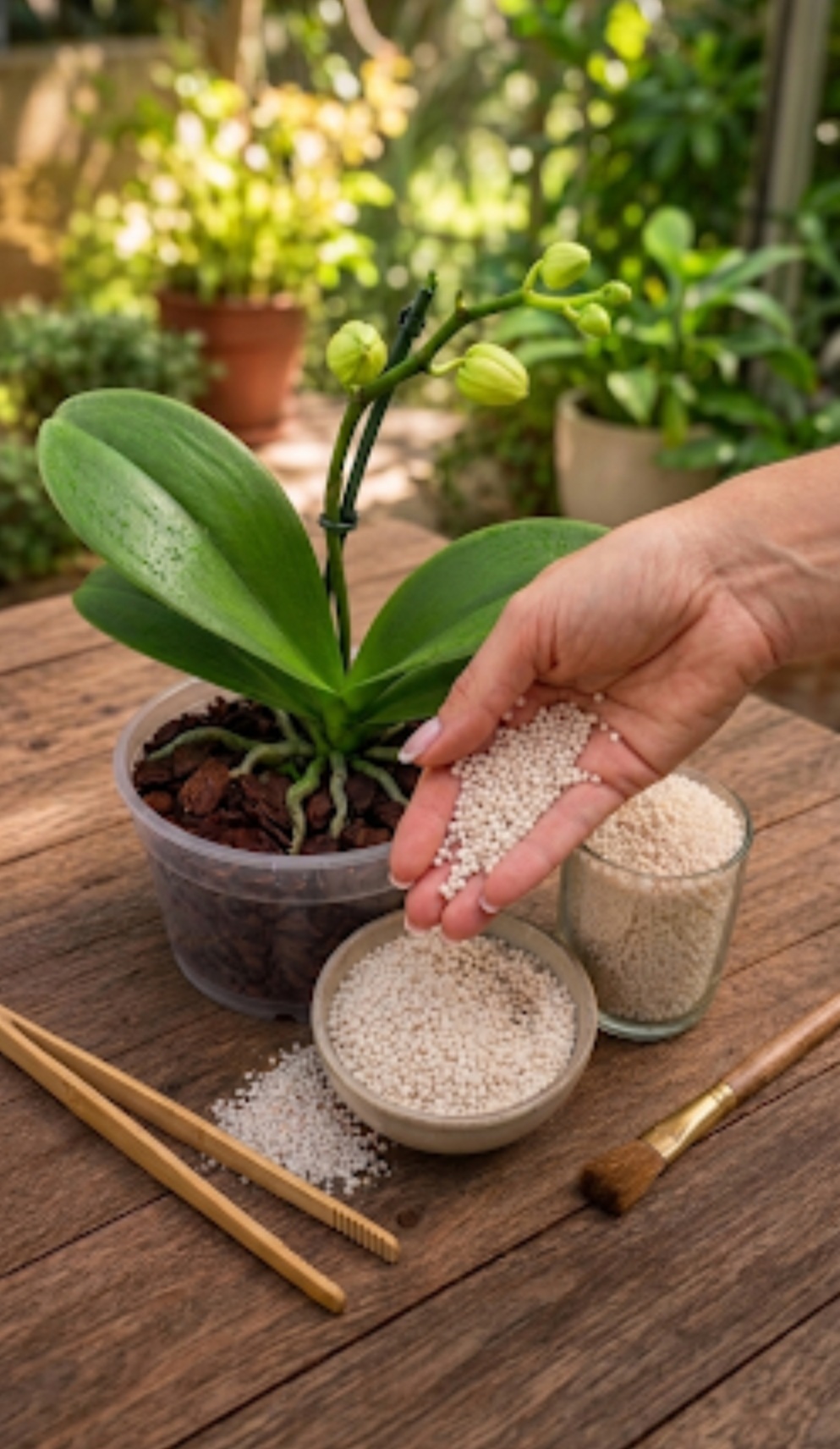
🟢Phalaenopsis orchids (commonly known as Moth Orchids) are among the most popular and rewarding indoor houseplants in the world. Known for their broad, leathery green leaves and long-lasting floral spikes, these tropical epiphytes bring elegance to any living space. However, when growers see closed flower buds forming on a spike, a crucial question arises: How, when, and with what should you feed your orchid to guarantee big, vibrant, long-lasting blooms?
🟢In this comprehensive guide, we examine the art and science of feeding orchids using slow-release fertilizer granules, mineral salts, and organic additives. You will learn the exact nutrients your orchid needs, how to apply them safely without burning sensitive aerial roots, and how to avoid common fertilizing mistakes! 🌿✨
Understanding Orchid Nutrition: What Do Orchids Really Need? 🔬
🟢Unlike standard garden plants that grow in dense mineral soil, Phalaenopsis orchids are epiphytes in their native tropical environments. They naturally grow attached to tree bark, absorbing rainwater, decaying organic matter, and airborne minerals through exposed aerial roots.
🟢When potted in orchid bark mixes or coconut husk chips, orchids require controlled nutrient supplementation to thrive. The three primary macro-nutrients essential for orchid health include:
- Nitrogen (N): Drives healthy vegetative growth, vibrant green leaves, and strong root cell development. 🍃
- Phosphorus (P): Stimulates flower spike formation, strengthens bud development, and encourages robust blooming. 🌸
- Potassium (K): Enhances disease resistance, regulates water retention, and improves overall plant stamina. 🛡️
Granular vs. Liquid vs. Slow-Release Fertilizers 📊
Selecting the right fertilizer format depends on your watering routine, pot medium, and growing conditions. Below is a detailed comparison of common orchid feeding options:
| Fertilizer Type | Primary Composition | Application Method | Best Usage Stage | Risk of Root Burn ⚠️ |
|---|---|---|---|---|
| Slow-Release Granules (Osmocote) ⚪ | Resin-coated N-P-K mineral beads | Sprinkle 4–8 granules onto bark surface away from stem | Repotting or early spring vegetative growth | Very Low (gradual release) |
| Water-Soluble Powder 🧪 | Concentrated mineral salts (20-20-20 or 10-30-20) | Dissolve in water (1/4 strength) and flush bark | Active leaf & flower spike development | Moderate (if applied undiluted) |
| Organic Bone Meal / Rice Fertilizer 🌾 | Natural calcium, phosphorus, & micronutrients | Light dusting on substrate edge or steeped as tea | Pre-blooming bud formation stage | Low |
| Foliar Spray Nutrients 💧 | Very low-concentration liquid mineral spray | Mist under-sides of leaves and aerial roots | Weekly maintenance during summer | Low |
Step-by-Step Guide: How to Apply Granular Nutrients Safely 👩🌾👨🌾
🟢Applying solid fertilizer granules or slow-release pellets requires precise technique to protect fragile orchid roots from direct chemical exposure. Follow these simple steps:
Step 1: Inspect Root Health & Substrate Moisture 🔍
- Check the clear plastic pot. Healthy roots should appear plump and silvery-green.
- Never apply fertilizer to bone-dry roots! Always water the orchid thoroughly with fresh, room-temperature water 15 minutes before applying nutrients to hydrate root tissues and prevent chemical shock.
Step 2: Measure the Correct Granular Dosage ⚖️
- For a standard 5-inch to 6-inch orchid pot, use only 1/2 teaspoon (approx. 6 to 10 beads) of slow-release fertilizer.
- If using organic powdered fertilizer or mineral granules, measure carefully—less is always safer when feeding epiphytes!
Step 3: Placement Near the Outer Edge 🪴
- Carefully place or sprinkle the granules around the outer rim of the plastic pot, keeping them at least 1 to 2 inches away from the main central stem and crown.
- Use a soft brush or wooden tweezers to gently press granules slightly into the top bark layer so they remain in place during watering.
Step 4: Water Lightly to Initiate Nutrient Release 💧
- Lightly trickle water over the substrate. As water passes over the slow-release granules, tiny amounts of balanced nutrients dissolve and wash gently over the root system.
Essential Rules for Fertilizing Orchids at Every Stage 🗓️
🟢Timing your fertilizer application to match the orchid’s natural growth cycle is the key to achieving continuous blooms year after year.
1. The Vegetative Stage (Spring & Summer) 🌿
- Goal: Encourage strong leaf expansion and thick root development.
- Routine: Feed weekly with a balanced 20-20-20 nitrogen-rich formula diluted to 1/4 strength (“weekly, weakly”).
2. Spike & Bud Development (Autumn & Early Winter) 🌸
- Goal: Boost flower production and ensure green flower buds mature without dropping (bud blast).
- Routine: Switch to a high-phosphorus “bloom booster” formula (such as 10-30-20) or apply slow-release granules once every 2 months.
3. Full Bloom Stage (Winter & Early Spring) ✨
- Goal: Enjoy long-lasting blooms.
- Routine: Pause or drastically reduce fertilizing while flowers are fully open. Over-feeding during full bloom can cause flowers to drop prematurely.
Top 4 Mistakes to Avoid When Feeding Orchids ⚠️
- Feeding Dry Roots: Direct contact between chemical salts and dry roots causes severe root burn, turning roots black and crisp. Always hydrate roots first! 💧
- Over-Fertilizing (Salt Buildup): White crusty deposits on top of the bark indicate mineral salt buildup. Flush the pot under running tap water for 2 minutes once a month to wash away excess salts. 🚿
- Poured Fertilizer in the Crown: Never allow liquid or granules to rest in the central leaf joint (the crown). Trapped moisture and nutrients lead to fatal crown rot. 🦠
- Using Standard Houseplant Fertilizer: Standard garden fertilizers often contain high levels of urea, which orchid roots cannot break down efficiently. Always choose urea-free or epiphyte-formulated nutrients! 🌿
Frequently Asked Questions (FAQ) ❓
Can I use slow-release fertilizer beads permanently in orchid bark?
🟢Yes! High-quality resin-coated slow-release granules (like Osmocote) break down slowly over 3 to 6 months based on ambient temperature, offering a steady, low-risk supply of micronutrients every time you water.
Why are my orchid flower buds turning yellow and falling off?
🟢Yellowing buds (bud blast) can be caused by sudden temperature drops, low ambient humidity, underwatering, or excessive fertilizer application during the early bud formation stage.
How often should I re-pot my Phalaenopsis orchid?
🟢Re-pot your orchid every 1.5 to 2 years when the bark medium breaks down into fine dust, or immediately after a blooming cycle finishes.