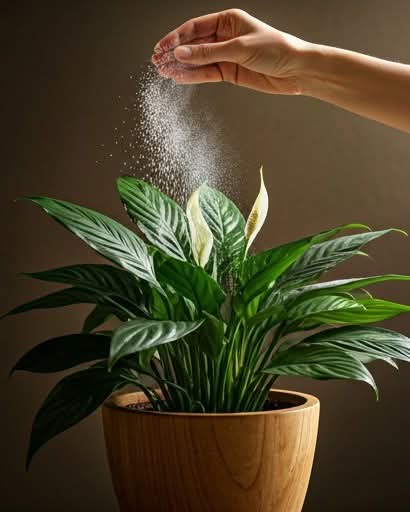
The Peace Lily (Spathiphyllum) is one of the most cherished, elegant, and air-purifying indoor plants in the world 🪴💖. Renowned for its deep emerald-green leaves and iconic white spathe flowers, it brings a serene botanical charm to homes, offices, and indoor gardens 🏠💫.
However, even the most dedicated plant parents occasionally face common Peace Lily frustrations: pale yellowing foliage, slow leaf development, or a complete refusal to produce those breathtaking white blooms 🥀🍂. While commercial liquid fertilizers are a popular go-to, they often contain synthetic chemical compounds that can easily burn delicate root systems 🧪⚠️.
Luckily, a simple, budget-friendly kitchen and bathroom staple holds the secret to revitalizing your plant: Epsom Salt (Magnesium Sulfate) 🤍✨!
In this comprehensive blog guide, we will explore why sprinkling or spraying magnesium sulfate works wonders on Peace Lilies, the science behind its nutrient absorption, how to apply it safely, and how it protects your plant against environmental stress 🌿🛡️!
🤍 The Science Behind Epsom Salt for Houseplants 🧪✨
Epsom salt is not actual table salt (sodium chloride); it is a naturally occurring mineral compound composed of bioavailable magnesium, sulfur, and oxygen molecules (MgSO_4 \cdot 7H_2O) 🔬🧬. Both magnesium and sulfur are critical secondary macronutrients that indoor foliage plants desperately require to flourish.
Key Active Components & Their Plant Roles:
- Magnesium Boost 💚: Magnesium forms the central core of the chlorophyll molecule, which gives leaves their rich dark green color. Without sufficient magnesium, plants suffer from interveinal chlorosis (yellowing leaves with green veins).
- Sulfur Synergy ⚡: Sulfur is essential for plant protein synthesis, enzyme activation, and vitamin production. It enhances nitrogen uptake from the soil, ensuring maximum nutrient efficiency.
- Cellular Water Transport 💧: Magnesium helps regulate water pressure and cellular nutrient transport within the stem and leaf tissues, keeping Peace Lily leaves turgid, upright, and glossy.
📊 Comprehensive Comparison: Epsom Salt vs. Standard Chemical Fertilizers
To help you decide the best feeding strategy for your Peace Lily, let’s look at how natural Epsom salt compares to standard synthetic fertilizers 📋👇:
| Feature / Benefit 🛡️ | Epsom Salt (Magnesium Sulfate) 🤍✨ | Synthetic NPK Fertilizer 🧪⚠️ |
|---|---|---|
| Nutrient Focus | Pure bioavailable Magnesium & Sulfur | High-concentration Nitrogen, Phosphorus, Potassium |
| Risk of Leaf Burn | Virtually Zero (100% gentle & natural) | High (if over-applied or improperly diluted) |
| Chlorophyll Production | Directly boosts green leaf pigmentation | General tissue expansion & cell division |
| Soil Salt Accumulation | None (does not build up toxic salts) | High risk of crusty fertilizer salt build-up |
| Environmental Safety | Eco-friendly, non-toxic, pet & human safe | Chemical runoff potential & synthetic additives |
| Cost & Availability | Extremely cheap & widely available in pharmacies | More expensive, requires specialized garden |
🛡️ Top Benefits of Using Epsom Salt on Peace Lilies 🪴✨
1. Reverses Yellowing Leaves & Restores Deep Green Pigment 🌿💚
If your Peace Lily foliage is fading to a pale green or yellow color, a magnesium deficiency is usually the culprit. Epsom salt provides an instant, highly bioavailable magnesium shot that stimulates intense chlorophyll production, restoring leaves to a glossy, dark forest-green hue ✨.
2. Stimulates Frequent & Abundant White Spathe Blooms 🤍🌸
Magnesium aids in the production of natural plant enzymes that encourage flowering tissue development. Regular seasonal application gives your Peace Lily the energy required to push out stunning, upright white spathes consistently throughout the spring and summer 🚀!
3. Improves Root Health & Nutrient Absorption 🪨🛡️
Sulfur and magnesium work together in the root zone to assist the plant in absorbing primary nutrients like nitrogen and phosphorus from the surrounding potting soil, making your entire fertilization routine twice as effective.
4. Strengthens Plant Resilience Against Shock 🌡️🛡️
Moving your Peace Lily, repotting it into fresh soil, or exposing it to dry indoor air causes environmental stress. Epsom salt acts as a stress-relief tonic, helping root systems recover rapidly from transplant shock.
🤍 Step-by-Step Guide: How to Apply Epsom Salt to Peace Lilies 📝💧
There are two highly effective methods to treat your Peace Lily with Epsom salt: a Foliar Spray for fast leaf recovery, or a Soil Drench for deep root feeding 📋👇:
Method 1: The Foliar Spray (Fastest Leaf Absorption) 💦🍃
- Dissolve the Crystals 🤍: Mix 1 teaspoon of pure Epsom salt into 1 liter of warm, filtered water. Shake or stir well until the white crystals fully dissolve.
- Fill a Spray Bottle 🍾: Pour the clear solution into a fine mist spray bottle.
- Mist the Leaves 🍃✨: Lightly spray the undersides and tops of your Peace Lily leaves once every 3 to 4 weeks. Leaves absorb magnesium directly through their microscopic stomata pores!
Method 2: The Soil Drenching Technique (Root Feeding) 🏺💧
- Prepare the Solution 🥣: Add 1 tablespoon of Epsom salt to 1 gallon (approx. 3.8 liters) of room-temperature water (or 3/4 teaspoon per liter of water).
- Water the Potting Mix 🪴: Pour the solution directly onto the potting soil around the base of the plant until water drains freely from the bottom drainage holes.
- Repeat Monthly 🗓️: Apply this gentle root drench once a month during the active growing season (spring and summer).
Method 3: Direct Soil Dusting (As Shown in Featured Photo) 🌾✨
- Dust Lightly 🤏: Take a small pinch (about 1/2 teaspoon) of fine Epsom salt crystals and sprinkle them evenly across the topsoil surface around the base of the stems.
- Water Immediately 💧: Water the plant lightly to dissolve the crystals and carry the essential minerals down into the root zone smoothly.
🗓️ Golden Rules & Pro-Tips for Success 💡🛡️
To keep your Peace Lily flourishing and avoid common care mistakes, keep these important tips in mind 🌟:
- Use Pure Epsom Salt Only 🚫🌸: Always select 100% pure Magnesium Sulfate with no added artificial fragrances, bath oils, or dyes!
- Don’t Over-Do It ⏰: Less is more! Apply Epsom salt once a month during active growth. Over-applying can disrupt calcium uptake in the root zone.
- Provide Bright, Indirect Sunlight ☀️🛋️: Peace Lilies love filtered light! Keep your plant near an east-facing window to maximize photosynthesis and flowering.
- Keep Soil Consistently Damp 💧: Peace Lilies are sensitive to drying out. Water when the top inch of soil feels dry to prevent drooping stems.
🌟 Final Thoughts
Transforming your indoor Peace Lily into a thriving, lush, and flowering masterpiece doesn’t require complex chemical treatments or costly products 🌿✨. By utilizing the power of pure Epsom salt, you provide your plant with gentle, bioavailable nutrients that prevent yellowing, boost vibrant foliage, and trigger breathtaking white blooms 🤍🌸🛡️. Try this easy organic trick today and watch your Spathiphyllum shine with vibrant health! 🪴🚀✨