If you are a home baker, pastry lover, or culinary enthusiast dreaming of golden, buttery, flaky French croissants with paper-thin crisp layers and a feather-light interior honeycomb structure, look no further 🥐✨! Making authentic croissants at home is the ultimate baking milestone. It transforms simple kitchen staples—flour, milk, sugar, yeast, and high-fat european butter—into an extraordinary artisanal viennoisserie piece right from your oven 🛡️🥐.
The magic behind every perfect croissant lies in lamination: the delicate process of folding cold butter inside supple yeast dough to create dozens of micro-thin alternating layers of butter and dough. When placed in a hot oven, water in the butter evaporates into steam, puffing up those dough layers into airy, flaky golden perfection. Let’s break down the complete ingredient matrix, step-by-step 4-stage master baking guide, equipment specifications, and professional pastry chef secrets for guaranteed success!
🛒 Master Ingredient Matrix & Equipment Specifications
Crafting world-class croissants requires balancing high-protein flour, cold European-style butter block, proper chilling tools, and precise baking temperatures 🥐🛡️. Here is your master specifications breakdown 📋✨:
| Recipe Component | Material & Tool Specifications | Culinary Function & Pastry Science Impact | Recommended Quality Substitutes |
|---|---|---|---|
| Pastry Flour Base 🌾 | Unbleached Bread Flour (12–13% Protein) | Builds strong gluten matrix required to stretch thin without tearing during dough rolling. | High-gluten All-Purpose Flour. |
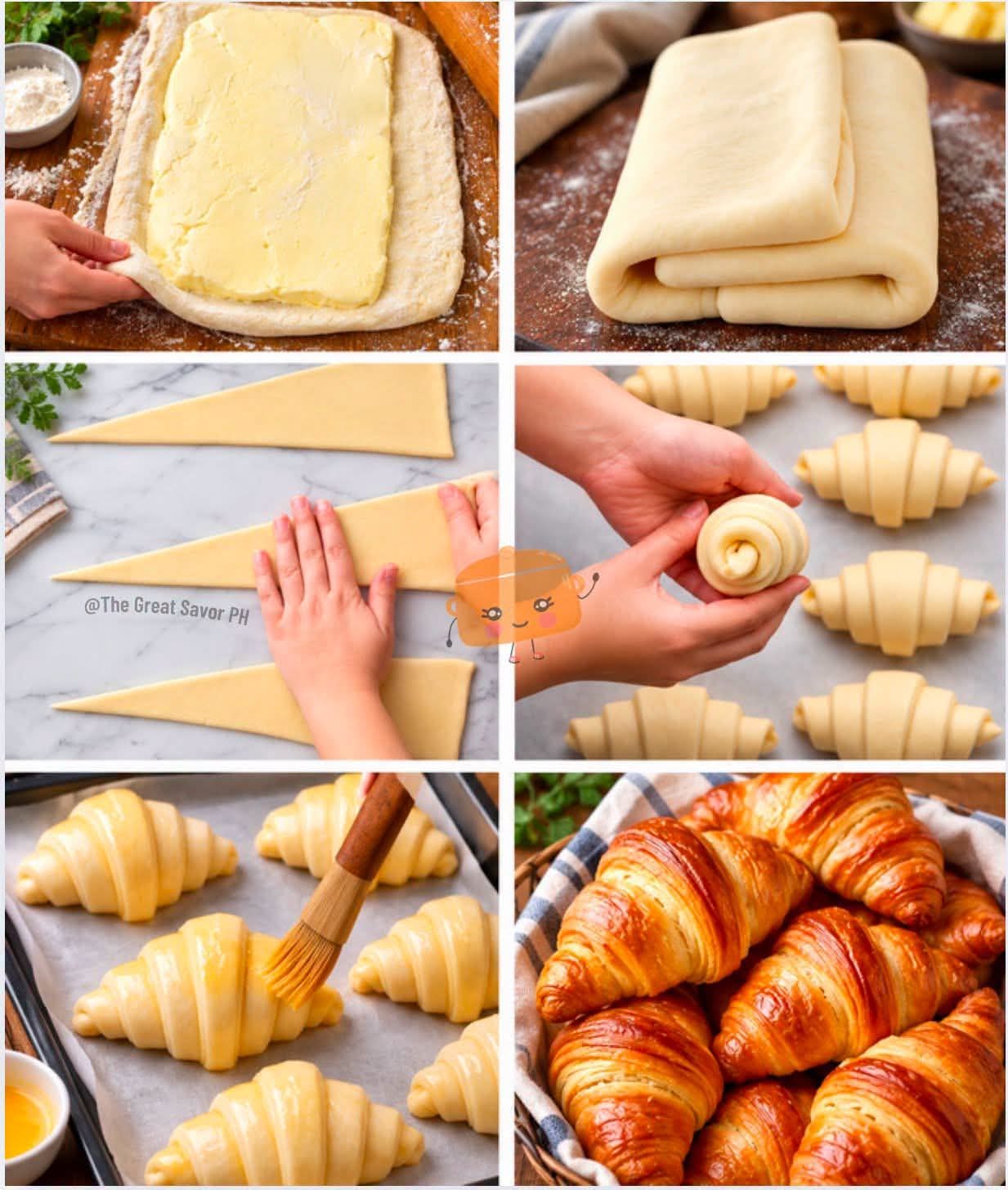
| Butter Block (Beurre) 🧈 | European Butter (82–84% Milkfat) | High fat/low water content creates distinct flaky layers without melting into dough (pictured top-left). | Plugra, Kerrygold, or French Tournage Butter. |
| Yeast & Liquid 🥛 | Instant Dry Yeast + Whole Cold Milk | Provides slow fermentation for deep buttery flavor and structure lift. | Active Dry Yeast diluted in lukewarm milk. |
| Rolling Pin & Board 🪵 | Heavy Wooden / Marble Rolling Pin | Applies even pressure across dough without heating up delicate butter laminations (pictured top). | Stainless Steel French Dowel Pin. |
| Egg Wash Glaze 🥚 | Whisked Whole Egg + Splash of Milk | Delivers a brilliant high-shine golden finish across flaky outer crescent ridges (pictured bottom-left). | Egg Yolk blended with Heavy Cream. |
| Baking Equipment 🥐 | Parchment-Lined Baking Sheet | Ensures uniform heat conduction and prevents croissant bottoms from scorching (pictured). | Silpat |
👩🌾 Step-by-Step Homemade French Croissant Masterclass
Follow this comprehensive 4-stage pastry guide to lock in butter layers, roll crisp triangle crescents, proof dough, and bake golden perfection, exactly as featured in the visual recipe workflow 🥐✨!
Step 1: Create Yeast Detrempe & Laminate Butter Block 🛠️🧈
- Prepare the yeast dough (détrempe) by mixing bread flour, sugar, salt, instant yeast, milk, and soft butter until a smooth dough forms.
- Shape the dough into a flat rectangle, wrap tightly in plastic wrap, and chill in the refrigerator for at least 2 to 4 hours.
- Prepare the butter block (beurre d’tournage) by pounding cold 82% milkfat European butter between parchment sheets into a neat rectangle.
- Roll out chilled yeast dough twice as long as your butter block. Place the cold butter block in the center (as shown in the top-left image).
- Fold dough edges over the butter, pinching seams tightly closed to lock the butter inside the dough envelope.
Step 2: Roll Single & Letter Folds (Lamination Process) 📐🥐
- Roll the butter-enclosed dough gently into a long rectangle using even downward pressure with a heavy rolling pin.
- Perform a “Letter Fold” (Turn 1): fold one-third of the dough over the center, then fold the opposite third over top (as captured in the top-right image).
- Wrap dough in plastic wrap and chill in the refrigerator for 30 minutes to cool the butter layers and relax gluten strands.
- Repeat this rolling and folding procedure two more times (for 3 total turns), creating dozens of alternating butter and dough sheets.
- Pastry Chef Secret: If the butter becomes too soft, chill immediately! Cold butter remains solid between dough layers, preventing greasy, dense croissants.
Step 3: Cut Long Triangles & Roll Classic Crescent Shapes 🔪🥐
- Roll laminated dough out on a lightly floured surface into a large, thin rectangle about 4 mm thick.
- Use a sharp chef knife or pizza wheel to cut long, sleek isosceles triangles with sharp pointed tips (as illustrated in the middle-left image).
- Cut a tiny 1/2-inch vertical notch in the middle of each triangle base to allow even spreading when rolling.
- Gently stretch each triangle length-wise, then roll tightly starting from the wide base up to the pointed tip (as demonstrated in the middle-right action shot).
- Place rolled crescent dough shaped onto parchment-lined baking sheets, keeping pointed tips tucked underneath to hold shape.
Step 4: Egg Wash, Proof Gently & Bake to Golden Perfection 🥚🔥
- Brush rolled raw croissants lightly with a smooth egg wash glaze using a soft pastry brush (as shown in the bottom-left image).
- Proof croissants at a cool room temperature (72°F to 78°F / 22°C to 25°C) for 2 to 2.5 hours until puffy, soft, and noticeably jiggly.
- Critical Caution: Never proof croissants in a warm area over 80°F (27°C), or laminated butter will melt out onto your sheet pan!
- Apply a second light layer of egg wash glaze right before baking to achieve maximum golden sheen.
- Bake in a preheated oven at 375°F (190°C) for 18 to 22 minutes until deep golden-brown with visible crisp flaky layers (as featured in the bottom-right basket display)!
💡 Pro Secrets for Flawless Bakery-Quality Croissants
- Temperature is Everything: Always keep dough and butter cool! If your kitchen feels warm, chill your dough between every single step to protect lamination 🧈.
- Use High-Fat European Butter: Standard American butter contains up to 18% water, which creates excess steam and destroys crisp flaky layers! Always use 82%+ milkfat butter for lamination 🥐.
- Cool Completely Before Slicing: Resist the temptation to cut hot croissants straight out of the oven! Letting them cool for 30 minutes allows internal butter steam to settle, preserving the delicate interior honeycomb structure 🌾.
Incorporate this detailed lamination technique into your weekend baking routine today to enjoy warm, buttery, flaky French croissants right from your own kitchen! 🥐✨🛡️🧈🌾