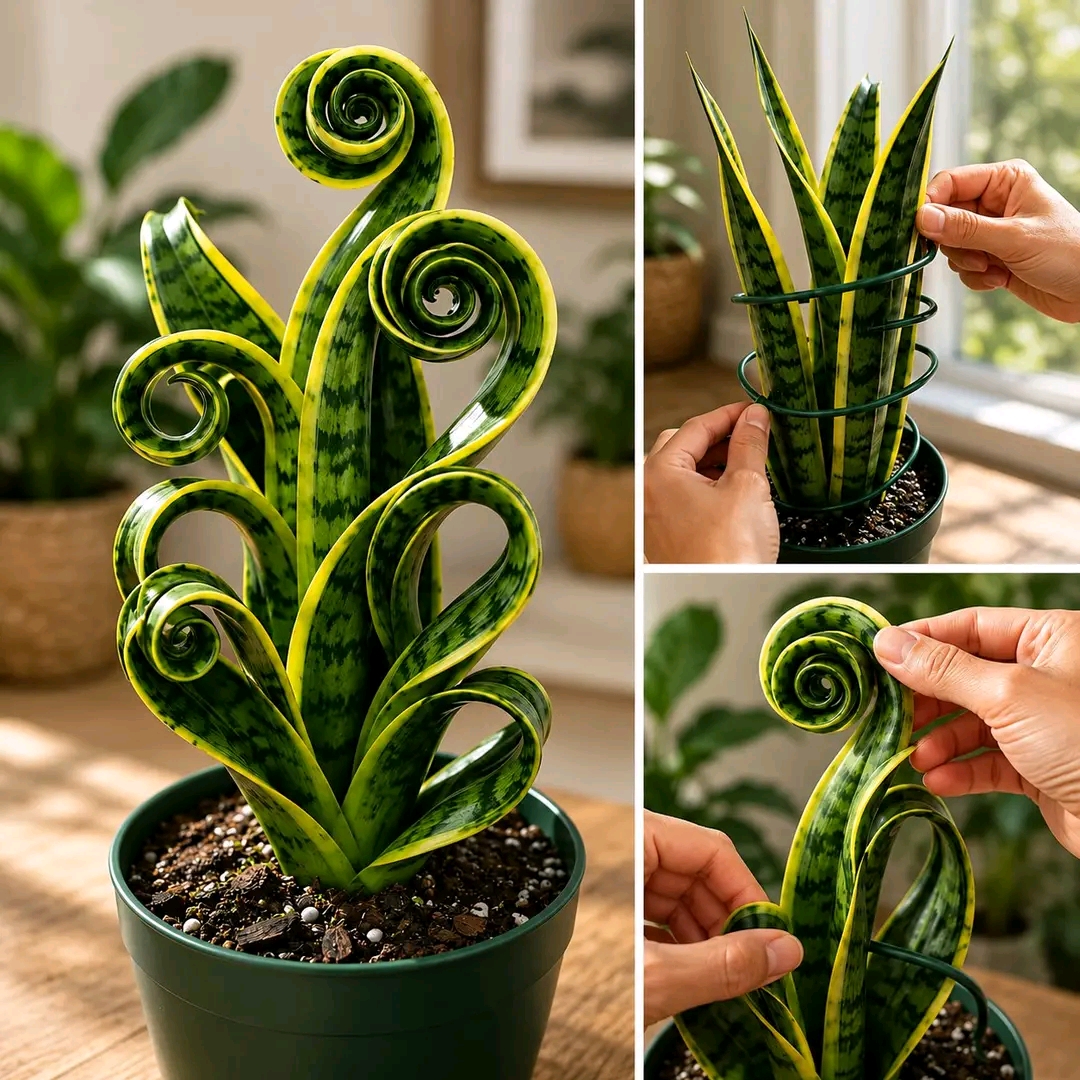
Have you ever looked at a Snake Plant (Sansevieria trifasciata) and wished you could transform its straight, vertical sword-like leaves into eye-catching, whimsical artistic shapes? 🌿✨ Known across the world for their indestructible nature and sleek air-purifying foliage, Snake Plants usually grow strictly upright. But with a bit of gentle leaf training, soft support wires, and patience, you can create a viral botanical masterpiece right inside your living room!
If you look at our featured image collage, you can see the fascinating process in action:
- Left Main Panel 🌀: A completely trained variegated Snake Plant displaying stunning, fern-like spiral waves curling outward from its center!
- Top Right Panel 🟢: A plant parent carefully placing a flexible green training coil or support hoop around straight, vertical leaves to begin shaping.
- Bottom Right Panel 🤏: Hands gently guiding a soft, pliable leaf around a curve to encourage a natural spiral arc!
Whether you want to train young, flexible leaves using plant wire or simply want to discover artistic ways to train and style your indoor succulents, this comprehensive blog guide will walk you through the science, techniques, care rules, and safety tips! 🏠🌱
🌟 The Art & Science of Leaf Training: How Does It Work? 🌿✨
Can you actually bend and curl Snake Plant leaves? Yes—if you do it correctly while the leaves are young, pliable, and growing! 🧪✨
Snake Plant foliage is thick and semi-succulent. Mature leaves are stiff and fiber-rich, making them prone to snapping if bent forcefully. However, newly emerging leaves (pups and young central shoots) contain high levels of moisture and flexible cellular structure. By applying gentle, continuous pressure over time using soft plant wire, floral rings, or supportive spiral guides, the plant adapts its growth direction toward light while forming smooth, dramatic curves! 🌀💪
Here is why leaf training and custom shaping are taking plant communities by storm:
- Botanical Living Art 🎨: It transforms a standard green houseplant into an extraordinary conversation piece that looks like an expensive designer centerpiece!
- Optimized Light Exposure ☀️: Spreading and curving leaves outward allows more ambient light to reach the inner base of the pot, encouraging new shoot pups to emerge faster!
- Stress-Free Customization 🛠️: Using gentle plant-safe wire or training rings allows you to guide growth without damaging leaf tissues or interfering with natural growth cycles.
📑 Plant Styling & Support Methods Comparison 📊
Before grabbing your gardening tools, let’s compare the most effective shaping methods used by succulent artists and indoor gardeners! 🛒👇
📊 Snake Plant Leaf Styling Techniques
| Training Technique 🛠️✨ | Tools Required 🧰 | Difficulty Level 📈 | Best For Leaf Stage 🌿 | Risk of Damage ⚠️ |
|---|---|---|---|---|
| Coil & Ring Shaping ⭕ | Flexible green coated garden wire / hoop rings | Beginner Friendly 🟢 | Medium to young flexible leaves | Very Low (Uniform support) |
| Spiral Wire Guide 🌀 | Soft bonsai training wire (2\text{mm}–3\text{mm}) | Intermediate 🟡 | Newly emerging, soft central shoots | Low to Moderate (Requires gentle hands) |
| Light-Direction Bending ☀️ | Rotating pot relative to window light | Easy / Natural 🟢 | All growth stages | Zero Risk (100% natural) |
| Braiding / Weaving 🧶 | Soft plant ties or jute twine | Intermediate 🟡 | Thin, cylindrical varieties (Sansevieria cylindrica) | Low (If done gently) |
🛠️ Step-by-Step Guide: How to Safely Shape & Train Leaves
Shaping your Snake Plant requires delicate handling and step-by-step care to avoid snapping the leaves. Follow these professional steps to achieve smooth curves safely! 🧰✨
Step 1: Select Young, Flexible Leaves 🌿
Examine your plant carefully. Look for newly emerged leaves that are soft to the touch and bright green in color. Rule #1: Never attempt to bend mature, stiff, dark green leaves, as their dense fibrous structure will crack! 🛑
Step 2: Prepare Soft Coated Garden Wire 🟢
Use smooth, PVC-coated green plant wire or soft aluminum bonsai wire (as seen in the upper-right image). Avoid thin, sharp, un-coated wires that can slice into the fleshy leaf edges.
Step 3: Anchor and Guide the Arc 🌀
Insert the wire securely into the potting soil near the base of the plant. Gently wrap or loop the soft wire around the young leaf, guiding it into a smooth, sweeping curve or wide spiral (just like in the bottom-right image!).
Pro-Tip 💡: Apply minimal pressure! Shape the leaf incrementally over 3 to 4 weeks by tightening or adjusting the wire curve by a few millimeters every few days rather than forcing a sharp bend all at once.
Step 4: Provide Bright, Directional Light ☀️
Place the wired plant near a bright window with indirect sunlight. Plants naturally bend toward light sources (phototropism), which reinforces the custom curve over time!
Step 5: Remove Wire Once Shape Sets 🔓
After 4 to 8 weeks of active growing season, the leaf cells will have set into their new curved position. Carefully unwind or snip the training wire away, leaving behind a magnificent spiral wave! 🌸✨
👑 Essential Care Rules for Healthy Variegated Snake Plants 🍃
No matter how artistic your plant looks, strong core care is essential to keep the foliage thick, colorful, and disease-free! ☀️✨
- Provide Bright Indirect Light 🌤️: High light maintains those brilliant yellow edges on variegated varieties (Sansevieria trifasciata ‘Laurentii’) and speeds up growth during leaf training.
- Never Overwater! 🚫💧: Succulents store water in their fleshy leaves. Always let the potting mix dry out 100% completely between waterings to protect against root rot.
- Use Porous, Well-Draining Soil 🌵: Plant in a cactus and succulent blend enriched with coarse sand, perlite, and pine bark to ensure rapid drainage.
- Feed Organic Scrap Teas 🥔🧅: Boost root stamina during training by feeding organic potato peel water or onion skin tea once every 3–4 weeks in spring and summer!
❓ Frequently Asked Questions (FAQ) 💬
Q1: Will leaf training hurt my Snake Plant?
Not if done gently! As long as you train young, soft leaves gradually and use soft-coated wire, the plant remains completely healthy and vibrant. 🌿✨
Q2: What happens if a leaf snaps or cracks during bending?
If a leaf accidentally snaps, clean the break with a sterile blade. You can cut the snapped portion off clean, or propagate the excised tip in moist soil to grow brand-new baby Snake Plant pups! 🪴✂️✨
💖 Final Thoughts & Indoor Botanical Design
Transforming ordinary houseplants into unique, living sculptures is one of the most exciting trends in indoor gardening! 🏡✨ With a little patience, soft training wire, and good light, you can turn your Snake Plant into a stunning spiral centerpiece that catches everyone’s eye.
Grab your gardening wire, select your softest young leaves, and unleash your creative plant design skills today! Happy planting! 🪴🌀✨🎉