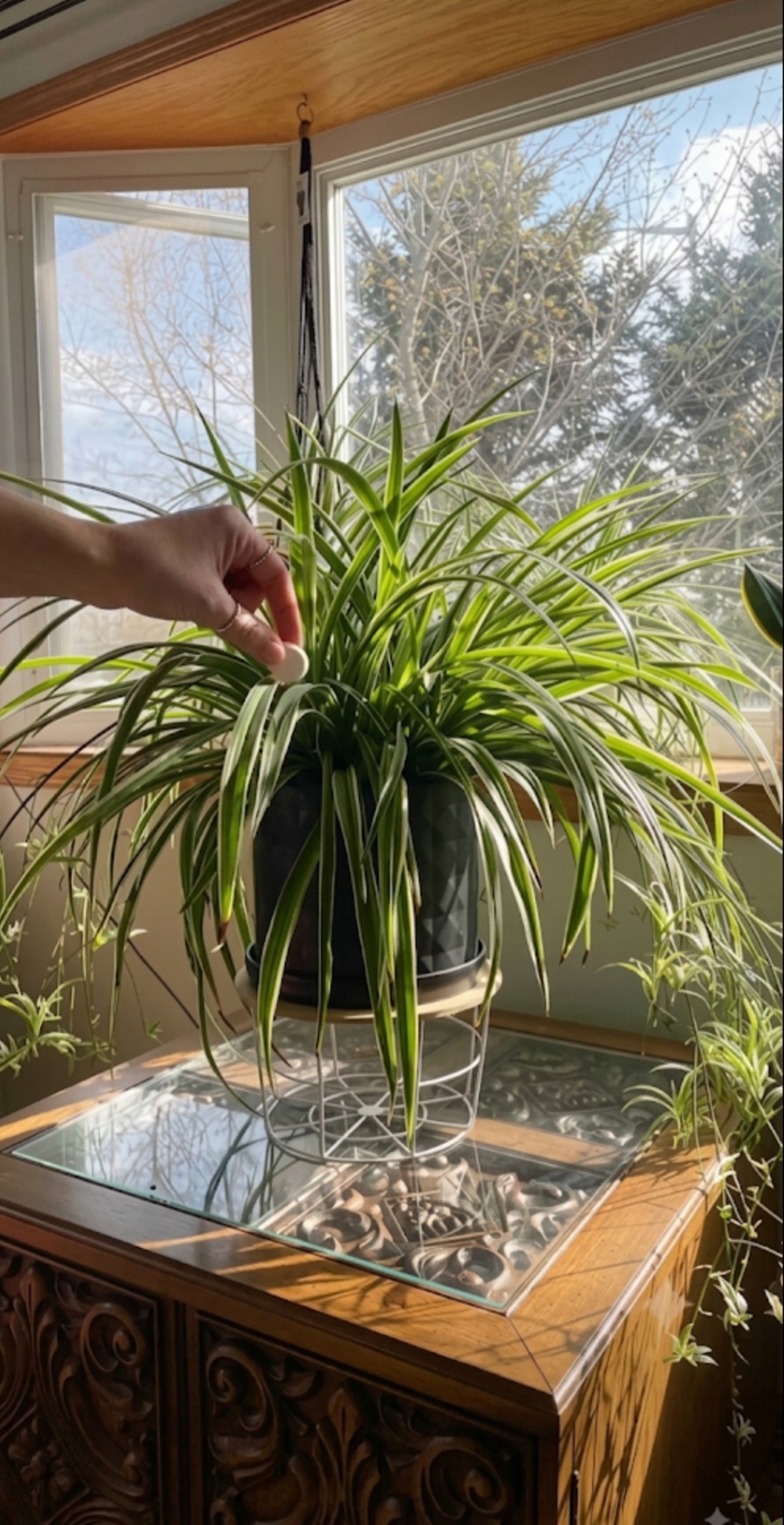
Spider Plants (Chlorophytum comosum) are some of the most resilient and popular houseplants around. But even the easiest plants sometimes need a little extra love to become true showstoppers. Whether your spider plant is looking lush and beautiful like the one in our image (sitting perfectly on its geometric stand! 🪴✨) or if it’s struggling with brown tips and no babies, this guide will turn you into a spider plant whisperer.
Look at the image above—it perfectly captures a gorgeous, bushy spider plant (Chlorophytum comosum ‘Vittatum’) positioned in a bright bay window. ☀️ Its leaves are vibrant, and the growth is full. But noticed the hand holding a little white pill? That looks like a slow-release fertilizer or a systemic insecticide tablet—a sure sign of careful, professional maintenance! This guide is about achieving that exact level of plant perfection. Let’s get growing!
📊 The Ultimate Spider Plant Care Master Table 📝
Before we dive into the details, here is a professional snapshot of the ideal growing conditions for your Chlorophytum. Print this out and tape it to your fridge—it’s your cheat sheet for success!
| Care Factor 💡 | Ideal Condition ✅ | Baker’s Notes & Expert Secrets 💡🌟 |
|---|---|---|
| Common Name | Spider Plant, Airplane Plant | Also sometimes called the “ribbon plant” because of its arching leaves. |
| Light ☀️ | Bright, Indirect (Filter Sun) | Essential for variegation! Too much direct sun burns leaves; too little light makes variegation fade. |
| Temperature 🌡️ | 18°C – 24°C (65°F – 75°F) | Likes typical indoor comfort. Avoid cold drafts or blast from heat vents. |
| Humidity 💧🌫️ | Moderate (40% – 60%+) | Thrives in a bathroom or kitchen. Secrets: Place nursery pots on a pebble tray with water. |
| Watering Frequency 💧 | Let top 2-3 inches dry out! | They are prone to root rot if kept too wet! Use a moisture meter 💧 or stick your finger ☝️ in the soil. |
| Soil Type 🪴 | Rich, fast-draining, and slightly acidic (pH 6-6.5) | Mix standard potting soil with perlite and orchid bark for perfect aeration. Pro-Tip: Make sure the pot has drainage holes! |
| Fertilization 🍽️✨ | Balanced liquid (20-20-20) 1/2 strength | Every 2-4 weeks during spring/summer. The little “pill” in the image is a perfect slow-release fertilizer! 💊 |
| Propagation 🤱🍼 | Rooting “Spiderettes” | Super easy! Cut the babies off and place them in water or soil. 💧🪴 |
| Pet Friendly? 🐾😺🐶 | YES! Non-Toxic 💖 | Safe |
Light: The Variegation Voodoo ☀️ Variegated vs. Green?
Let’s address the most crucial aspect of achieving a lush, variegated plant like the one in our image: LIGHT.
Bright Indirect is King ☀️👑
The spider plant in the photo is ideally positioned in a bay window, catching bright, filtered sunlight. Spider plants are epiphytes in nature, often growing on branches under a tree canopy. They do not want intense, direct desert sun (which will turn leaves paper-thin and brown). They need light that is strong enough to allow for photosynthesis, but diffused enough not to scorch the leaves. An eastern or shaded southern window is perfect.
The Light Trick for Variegation (Like the ‘Vittatum’)
If your plant is solid green with no stripes, it’s likely not getting enough light. The plant reduces its variegation (the non-green areas) to maximize the amount of chlorophyll (the green, light-capturing part) to survive. To restore that gorgeous white-green contrast we see in the photo, move it gradually to a brighter spot! The plant in our image has excellent variegation, which means its owner has mastered the light balance.
Humidity: Banishing the Brown Tips Forever! 🌫️ Banishing Those Pesky Brown Tips!
Brown tips are the number one complaint about spider plants. Let’s solve it. It’s almost always related to low humidity or water quality.
The Battle of the Tips (Low Humidity)
Spider plants come from tropical Africa—they LOVE moisture in the air. Typical indoor air, especially during winter with the heat blasting, is often way too dry (below 30%). When humidity is low, the plant transpires too quickly, causing the delicate tips of the long leaves to die. The plant in our photo has very clean, sharp tips, which tells us the humidity in this home is spot-on.
Water Quality Warning (Chlorine and Fluoride Build-up)
This is a pro-level tip. Spider plants are highly sensitive to minerals commonly found in tap water, specifically fluoride and chlorine. These chemicals accumulate in the leaf tips over time, eventually poisoning the tissue.
To prevent this, use only:
- Rainwater (Collected and stored!)
- Distilled water 💧
- Filtered water (Use a Brita or R.O. filter 💧)
The Mystery Tablet 💊 And Mastering Fertilization! 🌱✨
Let’s look again at that captivating little detail in the photo: the hand placing a small white tablet directly into the crown of the plant.
Systemic Care (Insecticide/Fertilizer Pills)
The image likely shows a systemic treatment tablet. Systemic insecticides are a brilliant, mess-free way to prevent pests like mealybugs and spider mites. The tablet is placed in the soil, dissolves over time with watering, and is absorbed by the roots. The entire plant becomes toxic to sucking insects, providing months of invisible protection!
Systemic fertilizer spikes work similarly—they slowly release nutrients directly into the root zone without you having to measure liquid fertilizer every watering. The plant in the photo looks extremely healthy, likely benefiting from this precise care.
Propagation: Creating Your Own Spiderette Army! 🍼🤱👶
Spider plants are famous for their babies! Look at the full, arching form in the image—it is preparing to push out several long runners, known as stolons or scapes. Along these runners, tiny baby spider plants (spiderettes or “pup-ets”) form. Here’s how to propagate them:
- Wait for the Best Moment: Let the spiderette develop tiny root nubs before you separate it. This guarantees success!
- Water Rooting: Cut the spiderette off the main runner, close to the baby. Place just the base (not the leaves) in a small glass of fresh rainwater or distilled water. 💧 Give it a week, and roots will explode! 💥
- Soil Rooting: Cut the baby and place it directly into moist, airy soil (just like the table recommends). Keep it warm and the soil slightly moist, and it will establish itself. You can also leave the baby attached to the runner and peg its base into a separate pot of soil; only cut the runner after it has rooted.
❓ Frequent Spider Plant FAQs 💬 (From You!)
Q: My spider plant is not producing babies. What’s wrong?
A: This is a classic question. The main reasons are maturity and root development. Spider plants often wait until they are root-bound (feeling crowded in their pot) to start producing stolons (runners). Make sure it’s in a appropriately sized pot (don’t pot it up too quickly!), gets bright indirect light, and is a mature plant. Fertilizing (with that balanced nutrient tablet 🍽️✨) during the growing season helps a lot!
Q: Why are my leaves turning a dull, gray-green and going limp?
A: This is a major warning sign. It almost always means you are under-watering. Those thick, arching leaves hold a lot of water. When they look dull and floppy, the plant is dehydrated. Check the soil! If it’s bone dry down to the root zone, give it a thorough soak until water flows freely through the drainage holes. The lush, vibrant leaves in our image show a perfectly hydrated plant.
Q: My plant is very leggy and has gaps between leaves.
A: This is a classic symptom of low light. The plant is “stretching” (etiolating) toward the closest light source, searching for more energy to grow fuller. Move it closer to a bright window. Look at how full and compact the leaves are in the bay window of our photo—this plant is perfectly light-satisfied.
💖 Final Thoughts: Reaching Pure Plant Perfection
There is something inherently joyful about a healthy, vibrant spider plant—especially one with its babies cascading down from a shelf or stand, just like the one in our featured photo. By following this guide and paying close attention to its specific light and humidity needs, you can transform your Chlorophytum from just “okay” to a truly magnificent specimen.
The plant in the photo—from its strategic bay window positioning to its meticulous systemic care—is a clear model of success. Take inspiration, use the cheat sheet table, and treat your plants like the queens (and kings) they are! Happy growing! 🌱🌸👋