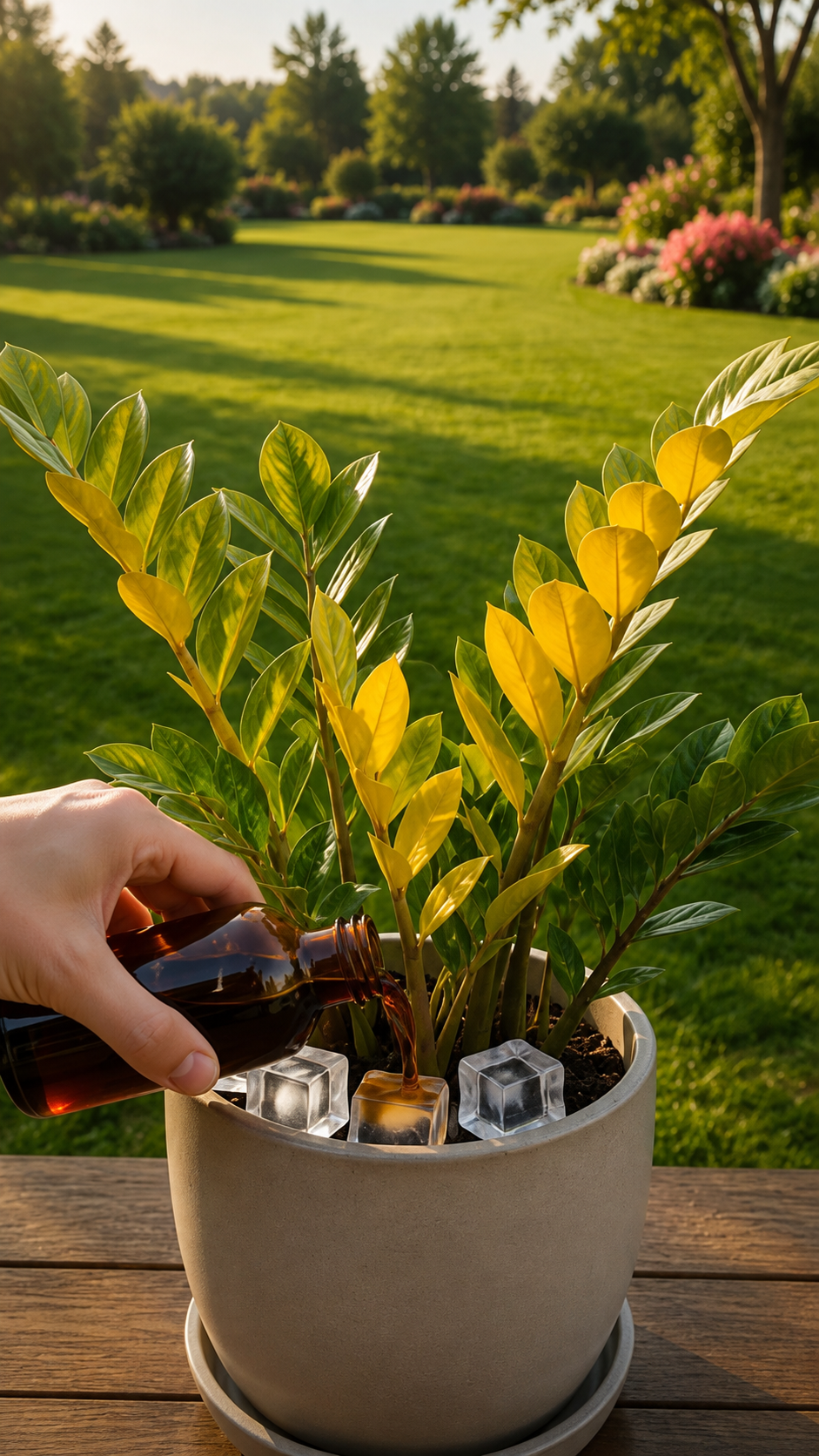
🌿 The Ice Cube & Compost Tea Method for ZZ PlantsThe Complete Guide to Growing a Stronger, Healthier Zamioculcas zamiifolia Naturally
Can a few ice cubes and nutrient-rich compost tea really help revive a struggling ZZ Plant? Thousands of gardeners have watched viral videos showing dramatic transformations, but what’s actually happening beneath the soil? In this complete guide, you’ll discover the real science behind this popular plant care method, when it works, when it doesn’t, and exactly how to use it safely for healthier roots, greener leaves, and stronger long-term growth.
🌱 IntroductionThe ZZ Plant (*Zamioculcas zamiifolia*) has become one of the world’s favorite indoor plants.Its glossy emerald leaves, elegant upright stems, and incredible drought tolerance make it perfect for beginners and experienced gardeners alike.
Yet even this nearly indestructible plant sometimes develops:🍂 Yellow leaves🌿 Slow growth💧 Soft stems🟤 Root stress😞 Drooping foliageNaturally, plant owners begin searching for solutions.One gardening trend that has exploded online combines two simple ingredients:🧊 Ice Cubes🟤 Compost TeaVideos often show a faded yellow ZZ Plant receiving ice cubes followed by a rich brown liquid before transforming into a lush green masterpiece within seconds.
While these dramatic transformations are obviously edited for entertainment, the gardening concept itself has attracted enormous interest.
Can compost tea actually improve soil biology?Can slow-release watering help certain situations?Can this combination become part of a healthy plant care routine?
This guide answers every one of those questions.You’ll learn:
✅ What compost tea actually is
✅ Why gardeners use it
✅ Whether ice cubes are beneficial
✅ How to prepare compost tea
✅ The safest application method
✅ Common mistakes
✅ Scientific facts
✅ Professional gardening recommendationsBy the end of this guide, you’ll know exactly how to help your ZZ Plant thrive naturally.
🌿 Meet the ZZ Plant Botanical Name**Zamioculcas zamiifolia** Native HabitatEastern AfricaSpecifically:- Kenya- Tanzania- ZanzibarIt naturally grows beneath tree canopies where rainfall is unpredictable.Because of these conditions, it evolved an incredible survival strategy.—# 🌱 Why ZZ Plants Are So ToughUnlike many houseplants, ZZ Plants store water underground inside thick structures called **rhizomes**.Think of these rhizomes as natural water tanks.Whenever the soil becomes dry, the plant simply uses the stored moisture.This explains why many ZZ Plants survive several weeks without watering.Their thick waxy leaves also reduce moisture loss.Together, these features make ZZ Plants among the easiest indoor plants to grow.
🌟 Benefits of Growing a ZZ PlantPeople don’t love ZZ Plants simply because they’re attractive.
They also offer several practical benefits.### 🌿 Low MaintenancePerfect for busy homeowners.
Even if you occasionally forget watering, the plant usually survives.
💚 Beautiful Glossy LeavesHealthy ZZ Plants produce naturally shiny leaves that brighten any room.They require almost no polishing.
🪴 Excellent for BeginnersMany houseplants require constant attention.ZZ Plants are forgiving.That makes them ideal for first-time gardeners.
🏡 Fits Every HomeWhether placed in:- Living rooms- Bedrooms- Offices- Hallways- ApartmentsThe ZZ Plant adapts beautifully.
🌞 Tolerates Lower LightAlthough brighter indirect light encourages faster growth, ZZ Plants tolerate lower light much better than many tropical plants.
🌡️ Drought ResistantIts underground rhizomes store enough moisture to survive dry periods.This is why overwatering—not underwatering—is usually the biggest problem.
🍂 Why ZZ Plants Turn YellowYellow leaves are one of the most common concerns.Understanding the cause is far more important than simply adding fertilizers.Let’s examine the most common reasons.
1. OverwateringThis is responsible for the majority of yellow ZZ Plants.Too much water fills the soil pores.
Roots lose oxygen.Eventually:🟡 Leaves yellow🟤 Roots rot🌿 Growth stops
2. Poor DrainageEven if watering seems reasonable, heavy compacted soil traps moisture.Healthy roots require oxygen.Without proper drainage, root problems develop quickly.–
3. Old LeavesSometimes yellow leaves are perfectly normal.Older stems naturally age and die while new growth replaces them.
4. Sudden Temperature ChangesCold draftsAir conditionersOpen winter windowsThese stress tropical plants.
5. Excess FertilizerMore fertilizer does NOT equal faster growth.Too many nutrients burn roots.Burned roots cannot absorb water efficiently.Yellowing often follows.
6. Root RotPerhaps the most dangerous issue.Signs include:🟤 Mushy stems🟤 Black roots🟡 Multiple yellow leaves💧 Constant wet soilRoot rot requires immediate action.
🌿 Understanding Healthy Root SystemsHealthy ZZ roots should appear:✔ Firm✔ Cream-colored✔ Thick✔ OdorlessUnhealthy roots become:
- ❌ Black
- ❌ Brown
- ❌ Mushy
- ❌ Slimy
- ❌ Foul smellingHealthy roots create healthy leaves.
🍂 What Is Compost Tea?
Compost tea is exactly what the name suggests.Instead of brewing tea leaves…Gardeners brew finished compost.The compost releases:
🌱 Beneficial microorganisms
🌱 Organic nutrients
🌱 Humic substances
🌱 Fulvic compounds
🌱 Trace mineralsThe resulting brown liquid becomes known as compost tea.
It has been used by gardeners for decades as a way to support healthy soil ecosystems.
🌎 Why Soil Biology MattersMany people think plants eat fertilizer.
Not exactly.Healthy soil contains billions of microscopic organisms.These include:🦠 Beneficial bacteria🍄 Helpful fungi🪱 Soil organismsThese organisms break organic matter into nutrients roots can absorb.Healthy soil biology supports healthier plants.Compost tea attempts to reinforce that living ecosystem.
🟤 What Compost Tea ContainsAlthough every batch differs slightly, quality compost tea commonly provides:- Nitrogen- Potassium- Phosphorus- Calcium- Magnesium- Iron- Zinc- Copper- Organic acids- Microbial populationsNotice something important.Compost tea is NOT concentrated fertilizer.Instead, it’s primarily a biological soil conditioner.
🌿 How Compost Tea May Benefit ZZ PlantsWhen properly prepared and used in moderation, compost tea may help:
✅ Improve microbial diversity
✅ Encourage healthier root zones
✅ Increase nutrient availability
✅ Support gradual new growth
✅ Improve overall soil qualityHowever…It will NOT magically transform a dying plant overnight.Healthy gardening is always a long-term process.
- 🧊 Why Do Some Gardeners Use Ice Cubes?
If you’ve watched gardening videos online, you’ve probably noticed people placing a few ice cubes around the base of their ZZ Plant before watering.This technique has become extremely popular on social media, but does it actually work?The answer is **it depends**.Some gardeners like the idea because the ice melts slowly, releasing water gradually into the soil. In theory, this can prevent pouring too much water at once.However, ZZ Plants are tropical plants that naturally grow in warm climates. Their roots are not adapted to prolonged exposure to freezing temperatures.For that reason, many horticulturists recommend watering with room-temperature water instead.If you decide to experiment with ice cubes:✔ Use only **1–2 small cubes**✔ Place them near the edge of the pot—not directly against the stems or rhizomes.✔ Use them only occasionally.✔ Allow them to melt naturally.Never cover the soil with ice or use it as your regular watering method.—# 🌱 Understanding the ZZ Plant’s Water NeedsOne of the biggest mistakes new plant owners make is assuming every plant needs frequent watering.The ZZ Plant is different.Its thick underground rhizomes act as natural reservoirs, storing water for weeks.This means the plant actually prefers periods of dryness between waterings.A good rule is:👉 Water only when the soil is completely dry from top to bottom.You can check this by inserting your finger 2–3 inches into the soil or using a moisture meter. 🟤 Ingredients You’ll NeedFor this plant care routine, gather:🧊 1–2 small ice cubes (optional)🟤 Fresh compost tea💧 Clean room-temperature water🪴 A healthy ZZ Plant in a pot with drainage holes🥄 A watering can or measuring cup
🧪 How to Make Compost Tea at HomeOne of the best things about compost tea is that it’s inexpensive and easy to prepare.## Ingredients- 2 cups of finished compost- 1 gallon (3.8 L) of non-chlorinated water- A clean bucket- A cloth bag or fine mesh bag (optional)
- Instructions
1. Fill the bucket with water.
2. Place the compost inside the mesh bag or directly into the bucket.
3. Let it steep for **24–36 hours**, stirring occasionally.
4. Strain the liquid if necessary.
5. Use the tea within 24 hours for best results.The finished liquid should have an earthy smell—not a foul odor.
💧 Step-by-Step Application
Step 1Inspect your ZZ Plant.If the soil is still damp, wait a few more days.Never water wet soil.
Step 2(Optional)Place **1–2 small ice cubes** around the outer edge of the pot.Avoid placing them directly on the rhizomes.—## Step 3Slowly pour approximately **½ to 1 cup (120–240 ml)** of compost tea evenly around the soil.Do not pour it onto the leaves.
Step 4Allow the liquid to soak into the potting mix naturally.Any excess water should drain freely from the drainage holes.Never leave the pot sitting in standing water.
📅 How Often Should You Use Compost Tea?Compost tea is a supplement—not a replacement for regular watering.For most indoor ZZ Plants:🌿 Apply compost tea **once every 4–6 weeks** during spring and summer.During autumn and winter, when growth slows, reduce or stop applications.Overusing compost tea can lead to nutrient buildup in the soil.
☀️ Best Light ConditionsAlthough ZZ Plants tolerate low light, they thrive in:☀️ Bright, indirect sunlightAvoid placing them in harsh afternoon sun, which can scorch the leaves.Signs of proper lighting include:✔ Upright stems✔ Deep green foliage✔ Steady new growth—# 🌡️ Temperature & HumidityIdeal temperature:**65–85°F (18–29°C)**Humidity:Average indoor humidity (40–60%) is perfect.Protect your plant from:❌ Frost❌ Cold drafts❌ Heating vents❌ Air conditioners blowing directly on the leaves—# 🪴 Choosing the Right SoilA ZZ Plant dislikes heavy, soggy soil.The ideal mix should drain quickly.A great blend is:- 2 parts indoor potting mix- 1 part perlite- 1 part coarse sand or pumiceThis combination provides airflow around the roots while preventing waterlogging.
🌿 Fertilizing Beyond Compost TeaCompost tea provides gentle organic support, but it doesn’t contain enough nutrients to replace a balanced fertilizer.During the growing season, you can use:✔ A balanced liquid houseplant fertilizer at half strength✔ Once every 6–8 weeksAvoid fertilizing during winter dormancy.
⚠️ Common Mistakes to Avoid
❌ Watering on a schedule instead of checking the soil.
❌ Using too many ice cubes.
❌ Applying compost tea every week.
❌ Letting water collect in the saucer.
❌ Using dense, poorly draining soil.
❌ Placing the plant in direct afternoon sun.
❌ Assuming viral “instant transformation” videos reflect real plant growth.
Healthy ZZ Plants improve gradually—not overnight.
🌿 How to Monitor Your ZZ Plant After TreatmentOne of the most important parts of successful plant care is observation.
Whether you’re watering with plain water or occasionally using compost tea, pay attention to how your plant responds over the following weeks.Healthy growth takes time, and small changes are often the first signs that your plant is recovering.Look for:🌱 New shoots emerging from the soil🌿 Leaves becoming deeper green✨ Increased natural leaf shine💪 Stronger, upright stems🪴 Firm rhizomes beneath the soilRemember, a healthy ZZ Plant grows slowly. Patience is one of the most valuable gardening skills.
🌱 Signs Your ZZ Plant Is HealthyA thriving ZZ Plant will display several encouraging signs:
✅ Glossy, dark green leaves
✅ Firm stems that stand upright
✅ New growth appearing from the base
✅ Dry soil between waterings
✅ No unpleasant smell from the pot
✅ Strong, cream-colored rootsHealthy ZZ Plants don’t need constant attention—they simply need consistent, appropriate care.
⚠️ Signs Something Is WrongIf your plant begins showing any of these symptoms, investigate the cause immediately.
🍂 Yellow LeavesPossible causes:- Overwatering- Poor drainage- Old natural leaf aging- Root stress
🟤 Brown Leaf TipsPossible causes:- Low humidity- Salt buildup- Overfertilizing- Inconsistent watering—### 🌿 Drooping StemsUsually caused by:- Root rot- Waterlogged soil- Physical damage
⚫ Mushy RhizomesThis is a serious warning sign.Remove the plant from the pot immediately.Trim away rotten tissue with sterilized scissors and repot into fresh, well-draining soil.
🌞 Seasonal ZZ Plant Care 🌸 SpringSpring marks the beginning of active growth.This is the best time to:✔ Repot if needed✔ Divide mature plants✔ Begin light fertilizing✔ Apply compost tea occasionally
☀️ SummerGrowth
continues during warm weather.Water only after the soil dries.Protect from intense afternoon sunlight. 🍂 AutumnGrowth begins slowing down.Reduce watering slightly.Avoid unnecessary fertilizing.—
❄️ WinterThe ZZ
Plant enters a resting period.Water less frequently.Do not fertilize unless the plant is actively producing new growth.
🪴Reporting Guide
Most ZZ Plants only need repotting every:**2–3 years**Repot sooner if:✔ Roots circle the pot✔ Soil remains wet for too long✔ Drainage slows✔ Rhizomes push against the containerChoose a pot only 1–2 inches larger than the previous one.Oversized pots hold excess moisture, increasing the risk of root rot.—# ✂️ How to Propagate a ZZ PlantOne of the most rewarding parts of growing ZZ Plants is how easy they are to propagate.
Method 1 – DivisionThe fastest method.1. Remove the plant from the pot.2. Separate rhizomes carefully.3. Plant each section individually.
Method 2 – Leaf Cuttings1. Cut a healthy leaf.2. Allow the cut end to dry for several hours.3. Insert into lightly moist, well-draining soil.4. Keep warm and bright.Be patient.Leaf propagation may take several months before producing a new rhizome.
🧽 Cleaning the LeavesDust blocks sunlight and reduces photosynthesis.
Every few weeks:✔ Wipe leaves gently with a soft damp cloth.Avoid using commercial leaf shine products.Plain water works perfectly.🐛 Common PestsAlthough ZZ Plants are resistant to most pests, they can occasionally attract: 🐞 MealybugsSmall white cotton-like insects.Treat with insecticidal soap or rubbing alcohol on a cotton swab. 🕷 Spider MitesTiny pests that leave fine webbing.Increase humidity slightly and wash the leaves.
🪲 Scale InsectsSmall brown bumps attached to stems.Remove manually and treat with horticultural oil.
🌿 Frequently Asked Questions
Can compost tea replace fertilizer?No.Compost tea supports soil biology but usually doesn’t provide enough nutrients to replace a balanced fertilizer.Can I water with compost tea every week?No.
Applying it too frequently may upset the balance of the potting mix.Once every 4–6 weeks is usually enough.Can I freeze compost tea?No.Fresh compost tea should be used shortly after brewing.Freezing or storing it for long periods reduces microbial activity.
Is compost tea safe for all houseplants?Most houseplants tolerate properly prepared compost tea, but always test a small amount first and avoid overapplication.
Should I mist my ZZ Plant?Generally, no.ZZ Plants do not require frequent misting and excessive moisture on the leaves may encourage fungal problems.-
Can compost tea fix root rot?No
Root rot must be treated by removing rotten roots, improving drainage, and correcting watering habits.Compost tea cannot reverse severe root damage.
Why isn’t my ZZ Plant growing?Possible reasons include:- Insufficient light- Winter dormancy- Pot-bound roots- Overwatering- Nutrient deficiencyHealthy growth is gradual, not rapid.
🌟 Expert Care Tips
🌿 Rotate your pot every few weeks so all sides receive even light.
🌿 Use filtered or rainwater if your tap water is extremely hard.
🌿 Keep leaves clean to maximize photosynthesis.
🌿 Always choose containers with drainage holes.
🌿 When in doubt, wait another day before watering.
The ZZ Plant is far more tolerant of dry soil than constantly wet roots.