Epsom Salt for Orchids: Supporting Healthy Roots, Green Leaves, and Beautiful Blooms
Discover the Benefits of Epsom Salt for Orchid Care
There is something truly special about caring for an orchid and watching its beautiful flowers, elegant leaves, and fascinating roots develop over time. Orchids are among the most admired indoor plants in the world, not only because of their delicate flowers but also because of their unique growing habits and impressive ability to produce new roots, leaves, and flower spikes.
One interesting gardening ingredient that often attracts the attention of plant lovers is Epsom salt. These small white crystals are commonly discussed in gardening because they contain two essential plant nutrients: magnesium and sulfur. When used correctly and only when needed, Epsom salt can help supplement the nutritional needs of certain plants.
But what exactly does it do for orchids? Can it help maintain beautiful green leaves, support healthy roots, and encourage new growth? Let’s explore its role in orchid care and understand how to use it responsibly.
What Is Epsom Salt?
Epsom salt is magnesium sulfate, a mineral compound that dissolves in water. Unlike ordinary table salt, it does not contain sodium chloride.
Its main nutritional contribution comes from magnesium and sulfur, two elements involved in important plant processes.
Magnesium is particularly important because it forms the central component of the chlorophyll molecule. Chlorophyll is the green pigment responsible for capturing light energy during photosynthesis.
Without sufficient magnesium, plants may develop nutritional deficiencies that affect their ability to maintain healthy foliage.
Sulfur is another essential nutrient. It contributes to the formation of certain amino acids, proteins, and enzymes that plants need for normal development.
Together, magnesium and sulfur support important biological functions, but they do not provide a complete source of plant nutrition.
Why Is Magnesium Important for Orchid Leaves?
Magnesium plays a major role in photosynthesis, helping plants capture the light energy they need to produce food.
When an orchid receives sufficient magnesium, it can maintain normal chlorophyll production and support healthy foliage.
Magnesium deficiency can sometimes appear as yellowing between the veins of older leaves, while the veins remain relatively green.
However, yellowing can also result from watering problems, damaged roots, natural leaf aging, or other nutritional imbalances.
Therefore, it is important not to assume that every yellow leaf indicates a magnesium deficiency.
Understanding the Beautiful Roots of Phalaenopsis Orchids
When it comes to Phalaenopsis orchids, proper care is especially important.
These beautiful orchids are epiphytes, meaning that in their natural environment they grow attached to trees rather than in ordinary garden soil.
Their roots are adapted to absorb moisture and nutrients from their surroundings. This is why orchids are generally grown in specialized, airy growing media such as orchid bark, rather than dense conventional potting soil.
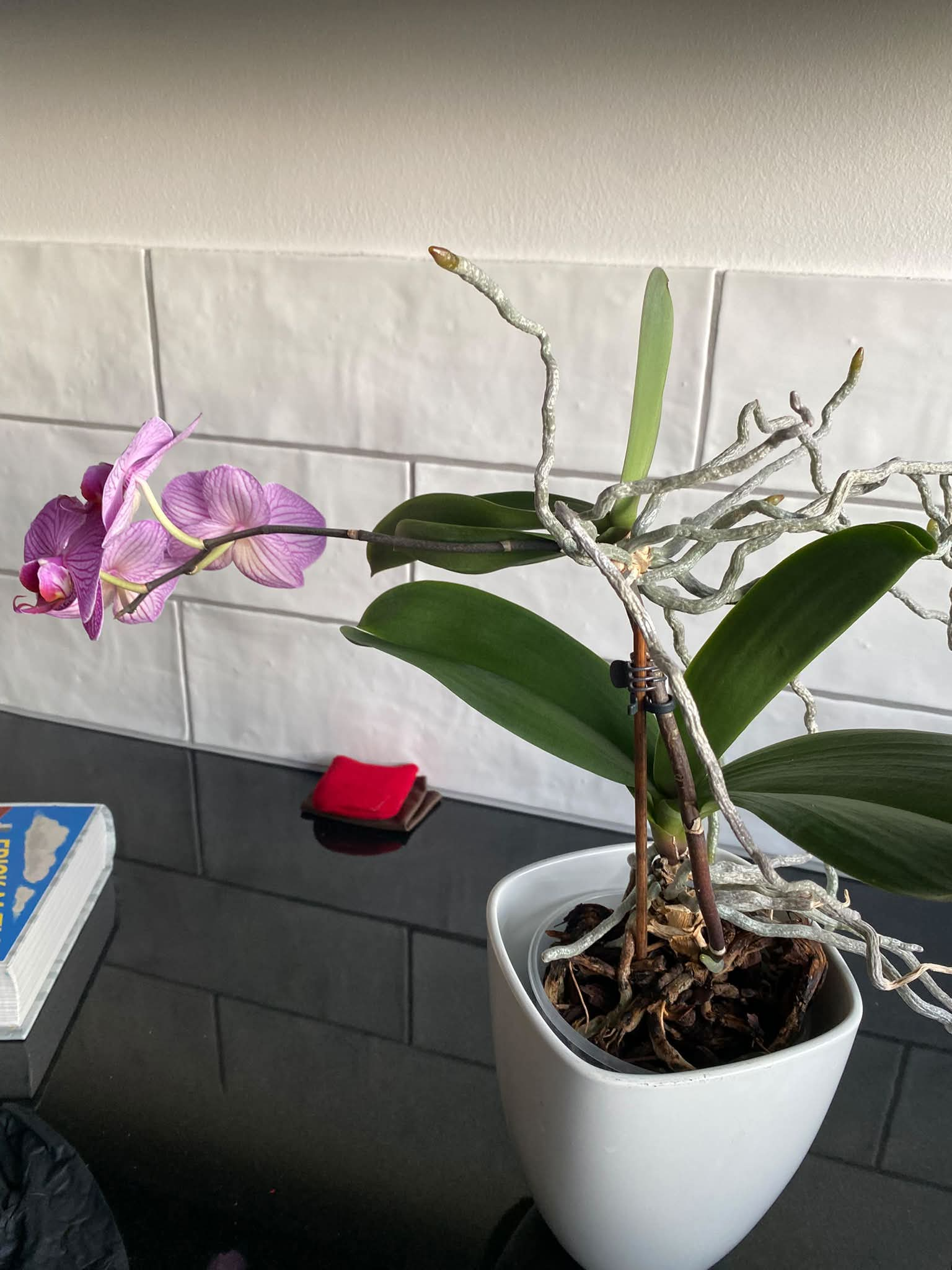
Looking at this beautiful orchid, we can see its broad green leaves, delicate purple flowers, and several long aerial roots.
These exposed roots are a normal feature of Phalaenopsis orchids. They help the plant absorb moisture from the surrounding air and are part of its natural growth habit.
Healthy orchid roots are essential for maintaining the plant’s ability to absorb water and nutrients.
They should generally feel firm rather than mushy. Their appearance can vary depending on moisture levels: many healthy roots look silvery when dry and become green after absorbing water.
Can Epsom Salt Encourage New Root Growth?
Magnesium plays an important role in plant metabolism and photosynthesis, but adding Epsom salt does not automatically make orchid roots grow faster.
Healthy root development depends on appropriate watering, good air circulation, suitable temperatures, and an airy growing medium.
If an orchid genuinely lacks magnesium, correcting that deficiency may help restore normal physiological functions and support healthy development.
However, adding extra magnesium to an orchid that already receives sufficient nutrients will not necessarily produce larger leaves, more flowers, or additional roots.
The goal should always be to maintain a healthy nutritional balance rather than forcing growth through excessive supplementation.
How Epsom Salt Supports Plant Nutrition
Epsom salt contains two important elements:
Magnesium: Helps plants produce chlorophyll and supports photosynthesis and several enzyme-related processes.
Sulfur: Contributes to amino acid and protein production, supporting normal plant metabolism.
These nutrients are important, but they do not replace the other essential elements orchids need, including nitrogen, phosphorus, potassium, calcium, and micronutrients.
A balanced orchid fertilizer is generally a more reliable way to supply a complete range of nutrients.
How to Use Epsom Salt Safely for Orchids
For Phalaenopsis orchids, Epsom salt should not be treated as a regular fertilizer or a guaranteed flowering booster.
If a magnesium deficiency has been identified, a suitable magnesium supplement may be considered.
The safest approach is to dissolve the product in water according to a reliable, plant-appropriate recommendation rather than pouring dry crystals directly onto the orchid’s roots or growing medium.
Avoid guessing the dosage, especially when caring for orchids in small pots. Their roots can be sensitive to excessive concentrations of dissolved salts.
Here are some important precautions:
- Never pour concentrated solutions directly onto orchid roots.
- Avoid scattering dry crystals over the growing medium.
- Do not use Epsom salt as a replacement for balanced orchid fertilizer.
- Avoid unnecessary repeated applications.
- Monitor the plant for signs of stress.
- Make sure the pot drains freely after watering.
Remember that more nutrients do not always mean better growth.
Why Epsom Salt Is Not a Complete Orchid Fertilizer
Although magnesium and sulfur are essential nutrients, orchids require many other elements to develop properly.
Nitrogen supports foliage and vegetative growth.
Phosphorus participates in energy transfer and root functions.
Potassium contributes to water regulation and plant metabolism.
Calcium supports cell walls and growing tissues.
Micronutrients such as iron, manganese, zinc, copper, and boron are also needed in smaller quantities.
This is why using a balanced fertilizer formulated for orchids is generally preferable to relying on Epsom salt alone.
Essential Orchid Care Tips for Beautiful Green Leaves
To keep your orchid beautiful and healthy, pay attention to its everyday growing conditions.
1. Provide Bright, Indirect Light
Orchids generally prefer bright light without harsh direct midday sunlight. Too much intense sunlight can scorch their leaves.
2. Water Correctly
Water thoroughly when appropriate, allowing excess water to drain completely. Never allow the inner pot to remain standing in accumulated water.
3. Choose the Right Growing Medium
Use an airy orchid potting mix that allows the roots to breathe. Orchid bark is a popular choice because it creates spaces for air circulation around the roots.
4. Maintain Good Air Circulation
Good air movement helps maintain a healthier environment around the leaves and roots.
5. Use Balanced Nutrition
Feed your orchid with a balanced orchid fertilizer at an appropriate concentration during active growth, following the product instructions.
6. Inspect the Roots Regularly
Healthy roots should generally be firm. Remove only roots that are clearly dead or rotten, using clean tools.
7. Keep the Leaves Clean
Gently remove dust from the leaves so they can receive light efficiently. Avoid leaving water sitting in the crown of the plant.
How to Encourage New Leaves and Beautiful Flowers
One of the most exciting moments for orchid lovers is seeing a new leaf emerge from the center of the plant.
New leaves are an encouraging sign of vegetative growth, while new roots indicate continued root development.
Flower production, however, depends on several factors, including plant maturity, light conditions, temperature, and overall health.
Do not expect Epsom salt to trigger immediate flowering.
Providing stable growing conditions and appropriate nutrition is much more important than applying a single mineral supplement.
After the flowers fade, the orchid may redirect its energy toward developing new roots, leaves, or another flower spike, depending on its condition and growing environment.
Common Mistakes to Avoid When Using Epsom Salt
Many plant lovers believe that adding more fertilizer or minerals will automatically produce faster growth.
Unfortunately, excessive or unnecessary supplementation can create nutritional imbalances.
Magnesium interacts with the absorption of other minerals, including calcium and potassium. Too much magnesium may interfere with the availability of these nutrients.
Other common mistakes include:
- Using Epsom salt without identifying a deficiency.
- Applying excessive concentrations.
- Treating every yellow leaf as a magnesium deficiency.
- Ignoring damaged or unhealthy roots.
- Keeping orchid roots constantly wet.
- Using ordinary garden soil instead of an appropriate orchid medium.
- Expecting immediate flowering after treatment.
Successful orchid care is about balance, not quantity.
Final Thoughts: Healthy Roots and Beautiful Blooms Begin with Proper Care
The beautiful purple flowers in this picture are a reminder of why orchid lovers dedicate so much attention to these extraordinary plants.
Every healthy leaf, every developing root, and every new flower spike represents the results of careful and consistent maintenance.
Epsom salt can have a useful nutritional role when magnesium supplementation is genuinely necessary, but it is not a miracle solution.
Healthy roots, appropriate light, balanced nutrition, and careful watering remain the foundations of successful orchid care.
With patience, observation, and the right growing conditions, your orchid can continue developing beautiful foliage, maintaining strong roots, and rewarding you with its magnificent flowers.
The real secret to growing beautiful orchids is not adding as many products as possible. It is understanding what the plant actually needs and providing those requirements in the right balance.
Every orchid has its own story, and every new leaf is another reason to celebrate the beauty of nature.
Frequently Asked Questions About Epsom Salt and Orchids
Can Epsom salt make orchid leaves greener?
It may help when yellowing is caused by magnesium deficiency. However, it will not correct yellowing caused by overwatering, root damage, aging, or other nutritional problems.
Does Epsom salt encourage orchid roots to grow?
Magnesium supports normal plant metabolism, but there is no guarantee that applying Epsom salt will stimulate additional root growth.
Can I use Epsom salt every time I water my orchid?
No. Routine application without an identified need is not recommended. Excess magnesium can contribute to nutritional imbalances.
Is Epsom salt the same as regular table salt?
No. Epsom salt is magnesium sulfate, whereas ordinary table salt is primarily sodium chloride.
Can Epsom salt make my orchid bloom again?
It is not a flowering stimulant. Orchid flowering depends on appropriate light, temperature, maturity, and overall plant health.
What is the best fertilizer for Phalaenopsis orchids?
A complete fertilizer formulated for orchids, used according to its instructions, is generally a better choice than relying on a single mineral supplement.
Share Your Orchid Care Experience
Do you enjoy discovering new ways to care for your orchids? Have you ever used Epsom salt to supplement magnesium for your plants?
We would love to hear about your experiences!
❤️ Like this article if you love orchids.
🌸 Follow our website and social media pages for more orchid-care advice, indoor gardening tips, and beautiful plant inspiration.
📢 Share this article with your friends, family, and fellow orchid lovers.
💬 Leave a comment and tell us how you encourage healthy roots, fresh leaves, and beautiful orchid flowers.
Thank you for supporting our gardening journey. Every like, comment, share, and follow helps us spread useful plant-care knowledge and inspire more people to discover the joy of growing beautiful plants.
Keep growing, keep learning, and let your home bloom with nature’s beauty!