The White Granule Gardening Secret: Using Epsom Salt for Beautiful Hanging Plants 🌿🤍
Hanging plants bring a special kind of beauty to any home or garden. Their cascading stems, delicate leaves, and elegant growth can transform an ordinary corner into a refreshing green space. But keeping trailing plants healthy, full, and vibrant requires more than regular watering.
One gardening ingredient that often attracts attention is Epsom salt. These small white crystals are widely discussed among gardening enthusiasts because they contain magnesium and sulfur, two elements that plants need in small amounts.
Some growers explore Epsom salt as part of their plant-care routine, especially when they suspect their plants may be lacking magnesium. However, there is an important detail that every plant lover should understand: Epsom salt is not a complete fertilizer, and adding it to every plant does not automatically create faster growth or more leaves.
Let’s explore what Epsom salt actually does, how magnesium supports plant health, and what to consider before using these white crystals on hanging plants.
1. What Exactly Is Epsom Salt?
Epsom salt is the common name for magnesium sulfate, a mineral compound containing two important plant nutrients:
- Magnesium: An essential element involved in chlorophyll production and photosynthesis.
- Sulfur: An essential nutrient involved in plant proteins and several important biological processes.
Magnesium is particularly important because chlorophyll, the green pigment responsible for capturing light energy, contains magnesium at its center.
When a plant has an actual magnesium deficiency, its leaves may develop characteristic yellowing patterns while some veins remain green. The symptoms can vary depending on the plant and the severity of the deficiency.
This is one reason Epsom salt has become a familiar topic in home gardening.
2. Why Magnesium Matters for Hanging Plants
Trailing and hanging plants depend on healthy leaves to capture light and support continued growth.
Magnesium contributes to several important plant functions:
Chlorophyll formation
Magnesium is essential for chlorophyll, which helps plants absorb light and carry out photosynthesis.
Photosynthesis
Healthy photosynthesis allows plants to convert light energy into chemical energy needed for growth.
Nutrient movement
Magnesium participates in several processes involved in plant metabolism and nutrient movement.
Overall plant development
When magnesium is available in suitable amounts, it helps support normal plant functions and healthy foliage.
However, adding extra magnesium to a plant that already has enough will not necessarily improve its appearance or growth.
3. What About the White Granules in the Gardening Method?
The white crystals shown in this gardening idea resemble Epsom salt.
Before considering any application, it is important to identify the product correctly. Ordinary Epsom salt should not be confused with complete plant fertilizer, white fertilizer pellets, or other garden products.
Different products contain different ingredients and have different application instructions.
If the product is confirmed to be pure Epsom salt, remember that it supplies magnesium and sulfur but does not provide the full range of nutrients plants need.
It does not replace a balanced fertilizer formulated for the particular plant.
4. Can Epsom Salt Make a Hanging Plant Fuller?
This is one of the most common claims associated with homemade gardening tricks.
The reality is more specific.
If a plant is genuinely suffering from magnesium deficiency, correcting that deficiency may help it return to normal growth. Healthy leaves can then perform their functions more effectively.
However, Epsom salt cannot independently guarantee:
- Longer trailing stems.
- More branches.
- Larger leaves.
- Faster growth.
- Additional flowers.
- A fuller hanging basket.
These characteristics depend on several factors working together.
Light exposure, root health, watering, temperature, pot size, pruning, growing conditions, and balanced nutrition all influence how a hanging plant develops.
A plant that receives insufficient light, for example, will not become fuller simply because magnesium is added.
5. How to Recognize Possible Magnesium Deficiency
One reason gardeners should inspect their plants before adding nutrients is that different problems can produce similar leaf symptoms.
Possible magnesium deficiency symptoms include:
- Yellowing between the veins of older leaves.
- Green veins that remain visible against yellowing tissue.
- Gradual changes in leaf color.
- Reduced growth when the deficiency becomes significant.
But yellow leaves do not automatically mean that a plant needs magnesium.
Other possible causes include:
- Excessive watering.
- Poor drainage.
- Damaged roots.
- Insufficient light.
- Natural aging of older leaves.
- Incorrect soil pH.
- Other nutrient deficiencies.
The most reliable approach is to investigate the growing conditions and, when necessary, use a soil or growing-medium test rather than guessing.
6. Important: Not Every Hanging Plant Needs Epsom Salt
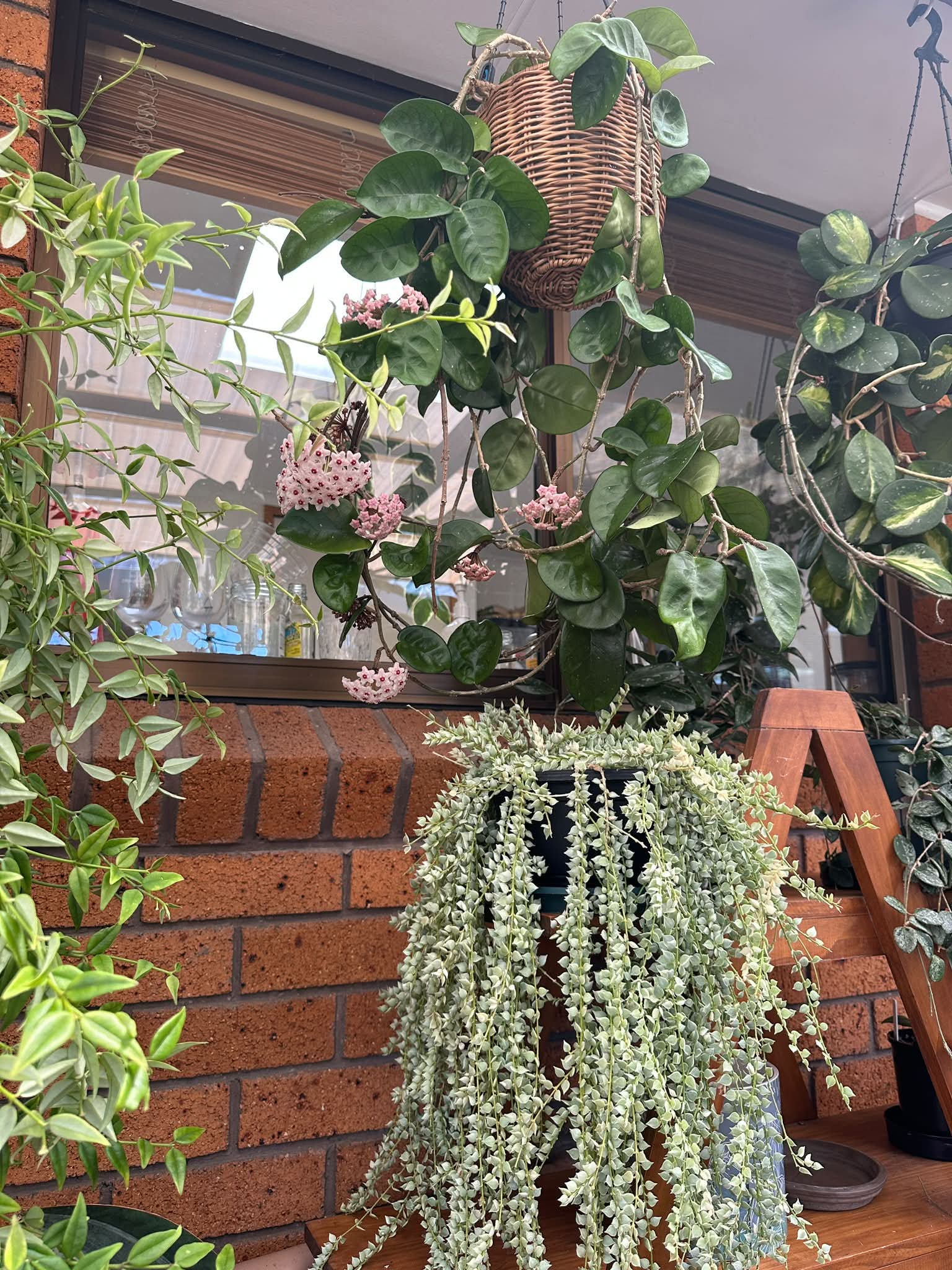
The image shows a collection of ornamental plants, including trailing foliage plants. Each species can have different nutritional requirements.
A feeding routine suitable for one plant may not be appropriate for another.
Before using Epsom salt, consider the following:
Plant identification: Different species have different nutrient requirements.
Growing medium: Soil composition and pH influence nutrient availability.
Water quality: Some water sources already contain significant amounts of magnesium.
Existing fertilizer: A regular fertilizer may already provide sufficient magnesium.
Root condition: Damaged or unhealthy roots may struggle to absorb nutrients properly.
These details matter much more than simply adding white crystals to the surface of the soil.
7. Should You Sprinkle Epsom Salt Directly on the Soil?
It is important not to assume that sprinkling dry Epsom salt around the base of a plant is automatically beneficial.
Concentrated applications can create an excessive amount of soluble salts in the growing medium. This may interfere with water uptake and nutrient balance, particularly in containers where minerals can accumulate.
For this reason:
- Do not apply Epsom salt simply because a plant looks small.
- Do not add extra crystals to encourage instant growth.
- Do not combine several homemade fertilizer treatments without understanding their ingredients.
- Do not use an arbitrary dosage for every plant.
- Follow reliable product guidance based on the plant and confirmed nutrient requirements.
If there is no evidence of magnesium deficiency, additional Epsom salt may be unnecessary.
8. Better Ways to Encourage Healthy Trailing Growth
For gardeners who want fuller hanging baskets and longer cascading stems, the everyday growing environment is the best place to start.
A. Provide Suitable Light
Most ornamental foliage plants need an appropriate amount of light to maintain healthy leaves.
Some prefer bright indirect light, while others tolerate lower-light conditions. Avoid assuming that all hanging plants have identical requirements.
B. Maintain Balanced Watering
Water according to the plant species, pot size, growing medium, and environmental conditions.
Allow the growing medium to dry to the appropriate level for that particular plant before watering again.
Constantly wet soil can reduce root health and encourage root problems.
C. Choose a Suitable Potting Mix
A good growing medium should provide the right balance of moisture retention and air circulation.
For many container plants, adequate drainage is essential because roots need oxygen as well as water.
D. Feed According to Plant Needs
A suitable complete fertilizer can provide a wider range of nutrients than Epsom salt alone.
Choose a product designed for the plant type and follow its label instructions. Avoid overfeeding, especially when a plant is growing slowly.
E. Prune When Appropriate
Some trailing plants respond well to careful pruning.
Removing damaged growth and selectively trimming suitable stems can encourage a more attractive shape, depending on the species.
F. Inspect Roots and Growing Conditions
Healthy roots support healthy foliage.
Check that the container drains properly, the plant is not sitting in excess water, and the growing medium has not become compacted.
9. Common Mistakes to Avoid When Using Epsom Salt
Even natural mineral products should be used thoughtfully.
Here are some common mistakes worth avoiding:
Mistake 1: Assuming more magnesium means more growth.
Plants need nutrients in balance. Extra magnesium is not necessarily better.
Mistake 2: Treating every yellow leaf as a magnesium deficiency.
Yellowing can have many different causes.
Mistake 3: Using Epsom salt as a complete fertilizer.
Magnesium sulfate does not supply all the nutrients required for normal plant development.
Mistake 4: Repeating applications without checking the plant.
Repeated unnecessary applications may contribute to mineral accumulation.
Mistake 5: Ignoring watering and drainage.
Even a well-fed plant can struggle when its roots are exposed to unsuitable moisture conditions.
10. The Secret Behind Beautiful Hanging Baskets
A beautiful hanging basket is the result of consistent care rather than one special ingredient.
Healthy roots, suitable light, balanced watering, appropriate nutrients, and occasional pruning all work together to support attractive foliage.
Epsom salt can have a role when magnesium deficiency is confirmed, but it should not be considered a universal plant-growth treatment.
For smart gardeners, the best approach is to understand the plant first, identify what it actually needs, and choose the right care method accordingly.
Final Thoughts 🌿
Those little white crystals may look like a simple gardening solution, but understanding their purpose makes all the difference.
Epsom salt provides magnesium and sulfur, two essential nutrients that support normal plant functions. When a genuine deficiency exists, correcting it can be helpful. When the plant already has sufficient magnesium, adding more is unlikely to produce the dramatic results often promised in viral gardening videos.
Remember: beautiful leaves, healthy roots, and fuller hanging plants begin with the right growing conditions—not simply adding more fertilizer.
Keep learning, observe your plants carefully, and let smart gardening decisions guide every feeding routine. 🤍🌱