🌿 Aspirin for Peace Lilies:
Peace lilies are among the most popular indoor plants for a reason. Their deep green leaves, elegant white flowers, and graceful appearance can transform almost any room into a peaceful, natural space. Whether displayed beside a bright window, placed in a living room, or grown as part of an indoor plant collection, a healthy peace lily can become a beautiful focal point in the home.
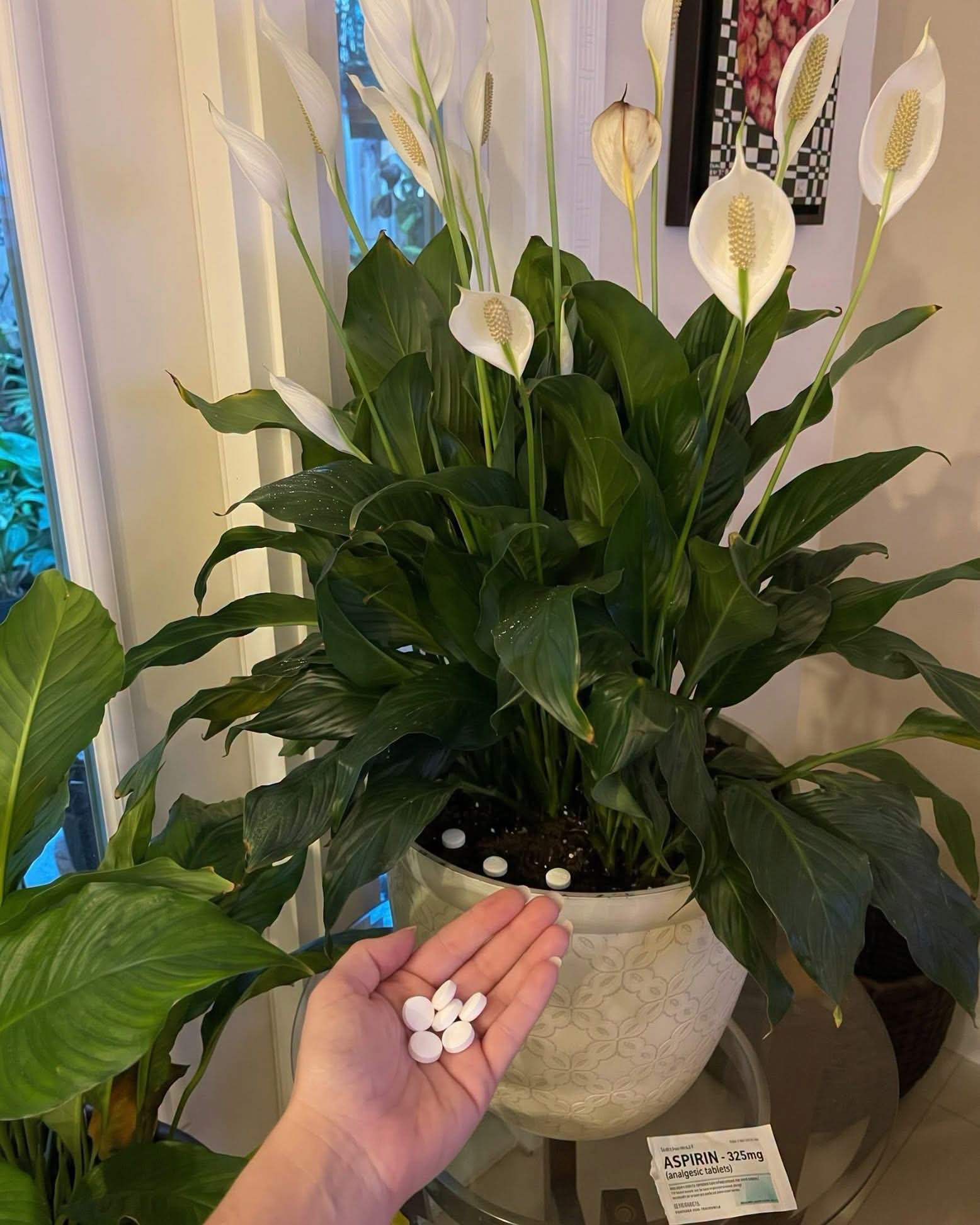
In this plant-care demonstration, a large peace lily grows in a decorative cream-colored pot, displaying glossy green foliage and numerous white flower-like spathes surrounding pale yellow flower spikes. A hand holds several white aspirin tablets near the plant, while additional tablets are visible on the soil. This raises an interesting question for gardeners: Can aspirin really help a peace lily grow better, produce more flowers, or recover when it looks unhealthy?
Aspirin is commonly known as a human pain-relief medicine, but it is also frequently discussed in gardening communities because it contains acetylsalicylic acid, a compound related to salicylic acid. Salicylic acid is involved in plant signaling and plays a role in how plants respond to certain stresses.
However, the relationship between aspirin and plant health is more complicated than many viral gardening videos suggest. Aspirin is not a complete fertilizer, and adding tablets to a plant pot does not guarantee greener leaves, stronger roots, or additional flowers. The effects of salicylic acid depend on the plant species, concentration, method of application, and growing conditions.
The most reliable way to maintain a beautiful peace lily is to understand its basic needs, recognize signs of stress, and provide suitable light, water, soil, and nutrition. This complete guide explains how to care for peace lilies, what scientific research says about salicylic acid in plants, why aspirin should be used cautiously, and which practical steps can help your plant thrive.
🌸 1. Understanding the Beauty of the Peace Lily
Peace lilies belong to the genus Spathiphyllum and are widely grown as ornamental houseplants. They are valued for their large, glossy leaves and distinctive white structures commonly mistaken for flowers.
What appears to be a single white flower is actually a specialized leaf called a spathe. The upright, cream-colored or yellowish structure in the center is the spadix, which carries the plant’s tiny flowers.
When a peace lily is healthy and growing under suitable conditions, it can produce several flower stalks above the foliage. The contrast between the white spathes and deep green leaves gives the plant its characteristic elegant appearance.
Peace lilies are tropical plants that generally prefer warm conditions, indirect light, and a growing medium that retains some moisture while draining excess water. They can tolerate lower light than many flowering plants, but very dim conditions often reduce flowering.
Although these plants are relatively adaptable, they are not indestructible. Excessive watering, poor drainage, prolonged dryness, insufficient light, pests, and unsuitable temperatures can all affect their appearance.
Understanding these basic requirements is important before experimenting with supplements or homemade treatments.
💊 2. What Is Aspirin, and Why Is It Discussed in Gardening?
Aspirin is a medicine whose active ingredient is acetylsalicylic acid. In the human body, it is used for certain pain-relief and anti-inflammatory purposes, depending on the dose and medical circumstances.
In plants, the related compound salicylic acid is a naturally occurring signaling molecule. Plants use salicylic-acid signaling as part of their responses to certain pathogens and environmental stresses.
Because of this connection, aspirin has attracted attention among gardeners who wonder whether it can influence plant defenses or growth.
The important distinction is that a compound having a role in plant biology does not mean that applying a human medication to the soil will automatically benefit a plant.
Plant responses to salicylic acid vary. The concentration, exposure, plant species, developmental stage, and environmental conditions can all influence the outcome. Some carefully controlled experiments have investigated salicylic acid and plant stress responses, but that does not establish a universal aspirin recipe for houseplants.
Aspirin tablets also contain inactive ingredients that may vary by product. They are formulated for human use, not specifically for watering ornamental plants.
For these reasons, aspirin should not be treated as a routine peace-lily fertilizer or a guaranteed flowering treatment.
🌱 3. Can Aspirin Make a Peace Lily Grow Faster?
The short answer is that there is no reliable basis for promising that aspirin tablets will make every peace lily grow faster.
Healthy growth depends on several interacting factors, including light, temperature, root condition, moisture, nutrition, and the plant’s natural growth cycle.
If a peace lily is growing slowly because it receives insufficient light, adding aspirin will not solve the underlying problem. If its roots are damaged by waterlogged soil, a tablet cannot restore the missing oxygen or repair the drainage system. If the plant lacks essential nutrients, aspirin is not a substitute for a balanced fertilizer.
Salicylic-acid research suggests that plant signaling can influence certain physiological processes under specific experimental conditions. However, laboratory findings cannot automatically be translated into a household treatment without knowing the appropriate concentration and application method.
A peace lily may also grow slowly because it is adjusting to a new location, experiencing seasonal changes, or approaching a period of reduced growth.
Instead of adding an unverified supplement, begin by checking the plant’s environment. Make sure it receives suitable indirect light, the soil is not constantly saturated, and the roots have enough room to function.
Consistent care is more dependable than expecting an immediate transformation from a tablet.
🌿 4. Understanding Salicylic Acid and Plant Defense
Plants cannot move away from stressful conditions, so they rely on a variety of internal signaling systems to respond to environmental changes and potential threats.
Salicylic acid is one of these signaling compounds. It plays an important role in certain plant defense responses, particularly those associated with some pathogens.
Researchers have studied how salicylic acid can influence plant responses to particular stresses, including some forms of disease pressure and environmental challenges. The results depend on the plant species, treatment concentration, and conditions of the experiment.
Too much of a biologically active compound can have effects different from those produced by a suitable concentration. This is one reason that research results should not be simplified into advice to crush a tablet and pour it into every plant pot.
A peace lily’s ability to resist stress depends on many processes working together. Healthy roots, appropriate watering, sufficient light, suitable temperatures, and balanced nutrition remain fundamental.
The presence of a compound associated with plant defense does not mean that aspirin can replace good growing practices or protect a plant against every disease.
💧 5. Watering a Peace Lily Correctly
Watering is one of the most important aspects of peace-lily care. These plants appreciate consistent moisture, but their roots also need access to oxygen.
The goal is to keep the growing medium from becoming completely dry for extended periods while avoiding prolonged waterlogging.
Before watering, check the upper portion of the soil with your finger. If the surface layer has begun to dry, water thoroughly enough to moisten the root zone. Allow the excess water to drain from the bottom of the pot.
Do not leave the pot standing in a saucer filled with water. Continually saturated soil can deprive the roots of oxygen and increase the risk of root rot.
Peace lilies are famous for drooping when they become thirsty. However, repeated severe wilting is not an ideal watering strategy because it places unnecessary stress on the plant.
The frequency of watering depends on the temperature, humidity, light level, pot size, soil composition, and plant size. A large peace lily in a warm room may use water differently from a smaller plant in a cool location.
Check the soil rather than following a rigid calendar. The plant’s needs can change throughout the year.
If the leaves droop while the soil is wet, do not automatically add more water. Investigate possible root problems and check whether the pot drains properly.
☀️ 6. Choosing the Right Light for Flowering
Peace lilies generally grow well in bright, indirect light. They can tolerate lower-light conditions, but flowering is often reduced when the plant receives too little light.
A location near a bright window can be suitable if the foliage is protected from harsh, prolonged direct sunlight. A sheer curtain may help filter strong sunshine.
If the plant is placed in a dark corner, it may continue producing leaves while rarely producing flowers. Moving it gradually to a brighter location may improve its growing conditions.
However, intense direct sunlight can scorch the leaves, leaving pale patches, brown edges, or dry areas. Peace lilies are usually better suited to filtered light than to harsh afternoon sun.
Observe the plant’s response to its location. New growth, healthy leaf color, and steady development are useful signs that the conditions are broadly suitable.
Remember that a healthy plant does not necessarily produce flowers continuously. Flowering depends on the cultivar, maturity, light, and overall growing environment.
Adding aspirin cannot compensate for a location that is too dark or too sunny.
🪴 7. Choosing the Best Soil and Pot
Peace lilies benefit from a well-draining potting mix that retains some moisture without becoming dense or waterlogged.
A quality indoor potting mix can provide a useful foundation. Depending on its composition, adding suitable aerating materials may improve the balance between water retention and drainage.
Avoid using heavy garden soil alone in a container. It may compact and restrict the movement of air around the roots.
The pot should have drainage holes. Decorative outer pots can be used, but make sure excess water does not accumulate around the inner container.
Choosing an appropriately sized pot is also important. A container that is much larger than the root system may retain excess moisture for too long, particularly when the plant is growing slowly.
If the roots have filled the container or the growing medium has deteriorated, repotting may be appropriate. Choose a pot only modestly larger than the root ball and handle the roots carefully.
Healthy roots help the plant absorb water and essential nutrients. If the roots are damaged, correcting the soil and watering conditions should take priority over adding supplements.
🌿 8. Does Aspirin Replace Fertilizer?
No. Aspirin is not a complete plant fertilizer.
A peace lily needs essential nutrients, including nitrogen, phosphorus, potassium, magnesium, calcium, sulfur, and various micronutrients. These nutrients support leaf development, energy transfer, root function, and other biological processes.
Aspirin does not provide the balanced nutrient profile required for normal plant growth.
If a peace lily is actively growing and needs additional nutrition, a balanced fertilizer formulated for indoor foliage plants is a more predictable option.
Follow the product’s instructions and avoid excessive feeding. Too much fertilizer can cause salts to accumulate in the soil, damage roots, and produce brown leaf tips or edges.
The correct feeding schedule depends on the fertilizer, the growing medium, and the plant’s growth rate. A plant growing slowly in low light may require less fertilizer than one actively producing new leaves.
If the plant looks unhealthy, do not automatically increase the fertilizer concentration. First investigate watering, drainage, lighting, pests, and root health.
Aspirin should not be used as a substitute for correcting a genuine nutrient deficiency.
🌼 9. How to Encourage More Peace Lily Flowers
If your peace lily has healthy green leaves but produces few flowers, start by reviewing its growing conditions.
Light: Ensure that the plant receives sufficient bright, indirect light. Very low light can reduce flowering.
Water: Maintain appropriate soil moisture without allowing the roots to remain waterlogged.
Nutrition: Use a balanced fertilizer according to its label when the plant is actively growing and needs additional nutrients.
Root health: Check for drainage problems, compacted soil, or signs of root rot.
Temperature: Protect the plant from cold drafts, extreme heat, and sudden temperature changes.
Maturity: Some plants need time to establish themselves before flowering reliably.
Season and variety: Flowering patterns vary, and a healthy peace lily may not produce new blooms continuously.
Avoid assuming that a lack of flowers indicates a need for aspirin. Flowering is influenced by the plant’s overall environment, and a tablet cannot guarantee new flower stalks.
When conditions improve, the plant may gradually produce healthier growth and, when ready, additional flowers.
🍃 10. Why Peace Lily Leaves Turn Yellow
Yellow leaves are a common concern among peace-lily owners, but the cause is not always a nutrient deficiency.
Overwatering is a frequent problem. When the soil remains saturated, roots may become damaged and lose their ability to absorb water and nutrients properly.
Underwatering can also cause stress. If the soil becomes excessively dry, leaves may droop, yellow, or develop brown edges.
Insufficient light, excessive direct sunlight, nutrient imbalances, pests, and natural leaf aging can also affect leaf color.
Begin by examining the entire plant rather than focusing on a single symptom. Check the soil moisture, inspect the drainage holes, and look for changes in the newest leaves.
Older leaves sometimes yellow and die naturally as the plant grows. If only an occasional older leaf is affected while new growth remains healthy, this may not indicate a serious problem.
However, widespread yellowing, persistent wilting, or a foul smell from the soil may indicate a more serious issue that needs attention.
Adding aspirin without identifying the cause may waste time and could make the growing conditions more complicated.
✂️ 11. Pruning and Cleaning Peace Lily Leaves
Regular maintenance helps peace lilies remain attractive and makes it easier to spot problems early.
Remove fully yellow or dead leaves using clean scissors. Cut the leaf stalk near its base without damaging nearby healthy growth.
Once a white spathe has faded and turned brown, the flower stalk can be removed near the base. This keeps the plant looking tidy.
Dust can accumulate on the broad leaves, especially indoors. Wipe them gently with a soft, damp cloth to remove dust without scratching the surface.
Avoid using aspirin solutions, coffee, oils, or other homemade mixtures as leaf sprays unless there is reliable evidence that the product and concentration are appropriate for the plant.
Inspect the undersides of the leaves for pests such as spider mites, mealybugs, and scale insects. Early detection makes it easier to address an infestation before extensive damage occurs.
Clean tools between plants when necessary, particularly if you suspect a disease problem.
🐛 12. Common Pests and Diseases
Peace lilies can occasionally be affected by pests, including spider mites, mealybugs, scale insects, and aphids.
Spider mites may produce fine webbing and tiny pale speckles. Mealybugs often look like small white, cottony clusters, while scale insects may appear as small bumps attached to stems or leaves.
Inspect the plant carefully if new growth becomes distorted, leaves develop unusual markings, or sticky residue appears.
If pests are present, identify them before choosing a treatment. Use a product appropriate for the pest and plant, following the label directions. Avoid mixing different treatments without verified compatibility.
Root rot is another important problem. It is often associated with prolonged waterlogging and poorly aerated soil. Damaged roots may become soft and dark, and the plant may wilt even when the soil is wet.
To reduce the risk of root problems, use a pot with drainage holes and water according to soil moisture rather than a fixed schedule.
Aspirin should not be relied upon as a universal pesticide or fungicide. Good growing conditions and appropriate pest-management methods are more dependable.
🧪 13. Should You Put Aspirin Tablets Directly into the Soil?
The safest practical recommendation is not to use human aspirin tablets as a routine soil amendment for peace lilies.
Aspirin tablets are made for medical use, and different formulations may contain different inactive ingredients. They are not standardized as houseplant treatments.
Simply placing tablets on the soil does not provide a controlled concentration of salicylic acid to the roots. Their dissolution and distribution may vary, and the resulting exposure is difficult to predict.
Research involving salicylic acid in plants typically depends on defined concentrations and experimental conditions. It does not establish that dropping tablets into the soil of an ordinary houseplant is effective or safe.
If you want to improve plant health, focus first on appropriate light, watering, drainage, and nutrition. If a plant-care problem persists, identify the likely cause before selecting a treatment.
Keep aspirin and other medicines away from children and pets. Peace lilies themselves are also considered toxic to cats and dogs if chewed, so place the plant where curious animals cannot reach it.
🌱 14. A Better Routine for a Healthy Peace Lily
A simple, consistent routine is more useful than frequently experimenting with unverified remedies.
Every few days: Observe the plant and check the soil moisture when necessary. Adjust watering according to the conditions.
Weekly: Inspect the leaves, stems, and soil surface. Look for pests, unusual yellowing, and signs of waterlogging.
During active growth: Provide balanced nutrition according to the fertilizer label when the plant needs it.
Periodically: Check whether the pot drains properly and whether the soil has become compacted or deteriorated.
When flowers fade: Remove old flower stalks and any fully dead leaves with clean tools.
When growth slows: Review light, temperature, watering, and root health before increasing fertilizer or adding supplements.
Consistency allows you to notice patterns and determine whether a change in care is actually helping.
🌿 15. The Real Secret to Beautiful, Healthy Peace Lilies
The peace lily shown in this demonstration has abundant green foliage and numerous elegant white spathes, creating the appearance of a thriving indoor plant. It is natural to wonder whether a simple tablet could help other peace lilies achieve a similar result.
However, there is no single ingredient that guarantees a dramatic transformation. Aspirin’s relationship to plant signaling is scientifically interesting, but it should not be confused with a proven, universal houseplant treatment.
A peace lily’s health depends on a combination of suitable light, balanced moisture, good drainage, adequate nutrients, and a stable growing environment.
If the leaves are yellowing, investigate the cause. If flowering is limited, review the light and overall care routine. If growth is weak, examine the roots and growing medium before adding supplements.
These steps address the conditions that directly influence the plant’s ability to grow and flower.
💚 Final Thoughts: Care for Your Peace Lily with Confidence
Peace lilies are beautiful indoor plants that can thrive for years when their basic needs are met. Their glossy foliage and elegant white spathes make them a rewarding choice for plant lovers, whether they are beginners or experienced gardeners.
Although aspirin is sometimes promoted as a gardening shortcut, it is not a complete fertilizer and should not be treated as a guaranteed solution for weak growth, yellow leaves, or poor flowering. Evidence about salicylic acid in plant biology does not automatically validate putting human aspirin tablets into a houseplant’s soil.
Instead, focus on the fundamentals: bright indirect light, appropriate watering, well-draining soil, balanced nutrition, and regular inspection. Correct problems at their source and give the plant time to respond.
The best plant-care routine is not necessarily the one with the most ingredients. It is the one that provides the right conditions consistently.
🌿 Love growing peace lilies? Save this guide for your next plant-care day, share it with another houseplant enthusiast, and explore more practical tips for keeping indoor plants healthy and beautiful.
Remember: Healthy roots and suitable growing conditions are the foundation of a beautiful peace lily. Aspirin is a medicine, not a miracle fertilizer.