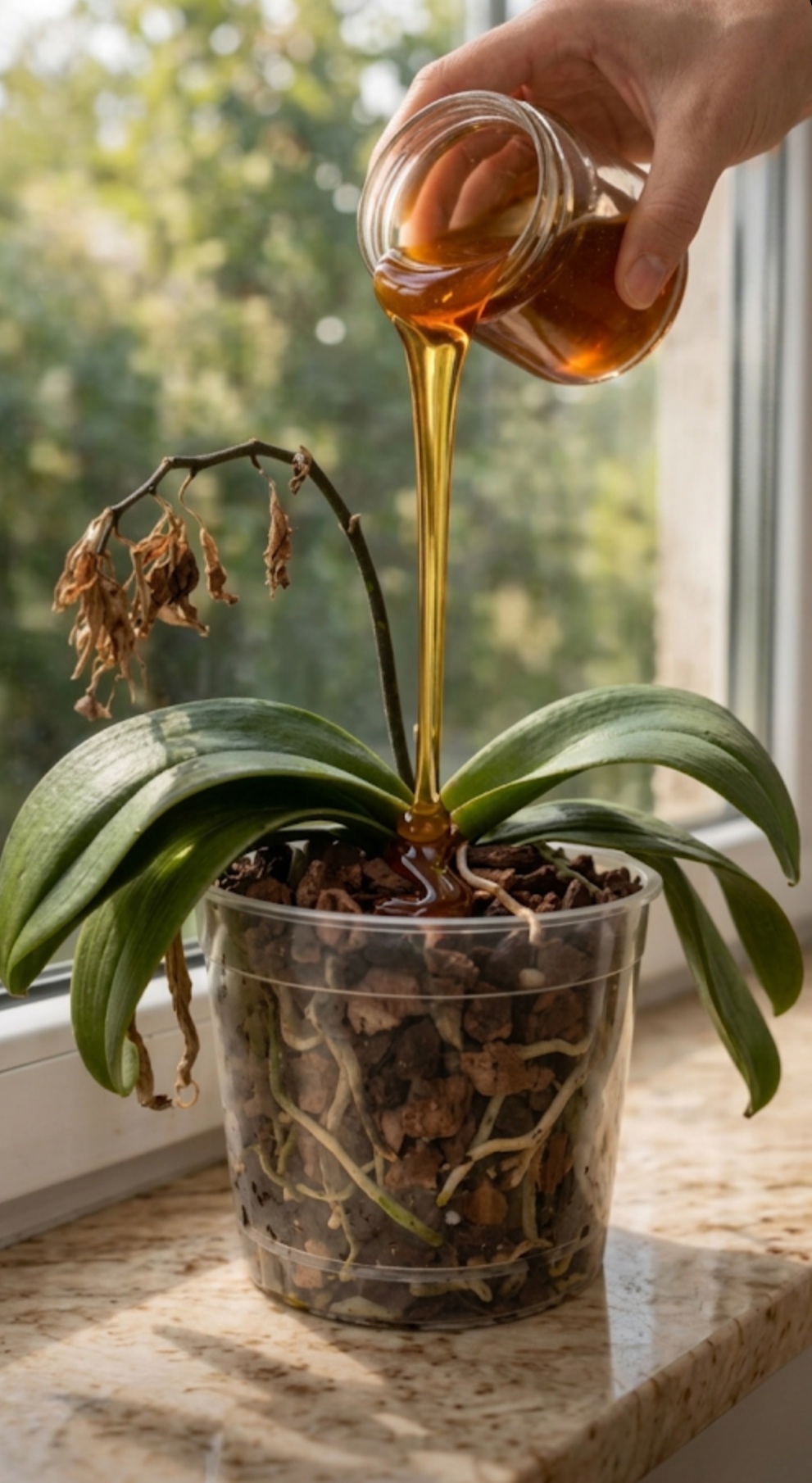
Moth Orchids (Phalaenopsis) are without a doubt the undisputed royalty of indoor flowering houseplants 🪴👑. Celebrated for their long-lasting blossoms, elegant arches, and sophisticated presence, they bring an exquisite touch of nature to any home interior 🏠✨. However, orchids are notorious for being delicate indoor companions. A sudden change in watering frequency, low ambient humidity, or poor potting aeration can quickly lead to dry, drooping leaves, withered flower spikes, and decaying root systems 🥀💧.
When an orchid begins to decline, standard synthetic fertilizers can often do more harm than good by burning damaged velamen tissue on sensitive aerial roots 🧪⚠️. Luckily, an extraordinary, natural liquid remedy exists right inside your kitchen pantry: Pure Honey Water 🍯💦!
In this comprehensive, step-by-step organic plant care guide, we will dive deep into the miraculous science behind honey for orchids, discover how it protects root systems from disease, and learn how to apply it correctly to rescue dying plants and trigger vibrant new flower spikes 🌸🛡️✨!
🍯 The Science Behind Honey Water for Orchids 🧪✨
Honey is far more than just a delicious natural sweetener; it is a complex biological mixture crammed with bioactive enzyme compounds, antioxidants, and anti-microbial phytochemicals 🐝🧬. For centuries, raw honey has been utilized in agricultural propagation as a natural rooting hormone and protective antibacterial agent.
Key Active Biochemical Properties in Honey:
- Antimicrobial & Antifungal Shield 🛡️: Honey naturally produces trace amounts of hydrogen peroxide through enzyme reactions (glucose oxidase). This creates a bio-protective barrier against pathogenic fungi like Phytophthora and root rot bacteria.
- Natural Rooting Phyto-Hormones 🌱: Honey contains trace organic enzymes that stimulate tissue regeneration, encouraging dormant nodes on orchid rhizomes to produce fresh, green root tips.
- Bioavailable Carbohydrates & Sugars ⚡: Simple sugars like fructose and glucose offer an easily absorbable energy source that helps stressed plants recover rapidly during critical rehabilitation phases.
- Essential Micronutrients 🪙: Packed with trace minerals like potassium, calcium, magnesium, iron, and zinc, honey feeds the root zone with essential structural building blocks.
📊 Comprehensive Comparison: Natural Honey Water vs. Synthetic Root Hormones
Before diving into preparation, let’s explore how a natural honey water solution compares to chemical rooting fertilizers for orchid rehabilitation 📋👇:
| Feature / Care Aspect 🛡️ | Pure Honey Water Solution 🍯💦 | Synthetic Chemical Hormones 🧪⚠️ |
|---|---|---|
| Primary Function | Root stimulation & antimicrobial protection | High-dose hormonal force growth |
| Risk of Tissue Burn | Extremely Low (Gentle & 100% natural) | Moderate to High (if over-concentrated) |
| Pathogen Defense | High natural antibacterial & antifungal power | None (unless combined with pesticides) |
| Eco-Friendliness | 100% Organic, non-toxic & zero chemical waste | Chemical synthesis & non-biodegradable packaging |
| Soil/Bark Microbe Safety | Preserves and nourishes friendly soil biology | Can disrupt beneficial microbial balances |
| Cost & Accessibility | Inexpensive kitchen staple in every household | Requires trips to specialized |
🛡️ Top Benefits of Honey Water Treatment for Orchids 🌸✨
1. Rescues Rotting & Dehydrated Roots 🩺💧
Overwatering is the primary cause of orchid mortality, turning firm green roots into hollow, squishy strands 🥀. Diluted honey water helps sterilize the affected bark substrate, prevents opportunistic rot from spreading to healthy tissues, and hydrates thirsty root structures smoothly.
2. Stimulates Fresh Aerial Roots & Leaf Growth 🌿🚀
When an orchid loses its root mass, it struggles to absorb moisture and nutrients. The natural enzymatic hormones present in honey signal the central stem (monopodial axis) to push out firm new root tips and fresh green leaves ✨.
3. Triggers New Flower Spikes (Keikis & Buds) 🌸👑
Once an orchid recovers its root health, the sugar boost provided by honey gives it the surplus metabolic energy required to emerge from dormancy and launch vibrant new flower stems loaded with flower buds 💖.
4. Stress Relief During Repotting 🏺✨
Repotting an orchid into fresh pine bark or sphagnum moss always causes root shock. Soaking the root ball in a mild honey bath prior to repotting acts as an anti-stress tonic, helping the plant adapt quickly to its new home 🏡.
🍵 Step-by-Step Guide: How to Prepare & Apply Honey Water 📝💦
Important Note: Never pour thick, undiluted honey directly onto your orchid pot! Undiluted honey is too dense, blocks air circulation in pine bark, and will attract unwanted household pests like ants. Always dilute honey in warm water using the following simple recipe 📋👇:
🧺 Ingredients & Supplies Needed:
- Raw Organic Honey: 1 tablespoon (unpasteurized raw honey works best) 🍯
- Warm Filtered Water: 1 liter (room temperature or lukewarm) 🚰
- Mixing Container or Pitcher 🫖
- Sterile Pruning Shears (if trimming dead roots) ✂️
👩🌾 Step-by-Step Application Instructions:
- Dissolve the Honey 🍯🔥: Add 1 tablespoon of raw honey into a cup of warm water. Stir thoroughly until the sticky liquid dissolves completely into a uniform golden liquid.
- Dilute to safe strength 💧: Mix the golden honey solution into a full liter of room-temperature filtered or rain water. The resulting mixture should be a faint, translucent tea color.
- Prune Dead Plant Parts First ✂️🥀: Trim away completely dry, brown flower stalks and soft, rotted black roots with clean shears before treating.
- Soak or Drench the Pot 🏺💦: Place your orchid’s transparent plastic inner pot into a basin filled with the honey water. Allow the bark mix and roots to soak in the solution for 15 to 20 minutes so the roots absorb nutrients thoroughly.
- Drain Completely 🕳️🍃: Lift the orchid out and let all excess water drain out of the bottom drainage holes completely! Orchids must never sit in standing water.
🗓️ Application Schedule & Pro-Tips for Long-Term Success 💡🛡️
- Treatment Frequency ⏰: Treat stressed orchids with a honey water soak once every 3 to 4 weeks during the spring and summer active growth seasons.
- Avoid Pest Attraction 🐜🚫: Always wipe away any accidentally spilled drops on the outer foliage with a damp cloth, and ensure the potting bark drains completely to keep ants and fruit flies away.
- Provide Bright Indirect Sunlight ☀️🛋️: Place your orchid near an east-facing window with gentle morning light. Direct burning sun will dry out delicate foliage, while deep shade prevents blooming!
- Maintain Ideal Airflow 💨✨: Orchids are air-loving epiphytes! Keep them in well-ventilated rooms with loose pine bark or clay pebbles to ensure maximum oxygen movement around the root zone 🪨.
🌟 Final Thoughts
Reviving a struggling orchid doesn’t require expensive chemical treatments or expert horticultural equipment 🌿✨. By unleashing the natural antibacterial, hormone-boosting power of pure honey water, you can heal damaged root systems, spark fresh foliage growth, and enjoy breathtaking blooms year after year 🍯🌸🛡️. Try this easy organic remedy today and watch your delicate orchids flourish with new life! 🪴🚀✨