Welcome to the green corner of the internet, plant parents! 🌿 If you’re like us, you’re always searching for that magic trick—that one secret ingredient that will turn your windowsill from merely “alive” to “downright vibrant.” Today, we’re peeling back the layers on a trend that has the orchid community buzzing: DIY Cucumber Water Fertilizer.
Yes, you heard that right. We’re taking that leftover cucumber from your spa water or your salad and turning it into a luxurious nutrient bath for your most prized Phalaenopsis. 🧖♀️🌵 In this article, we’re not just showing you a beautiful picture; we’re giving you the deep-dive science, the how-to guide, and a professional comparison that will change how you feed your indoor jungle.
Let’s get growing! 🚀🌱
📸 Deconstructing the Magic: Why Cucumber Water?
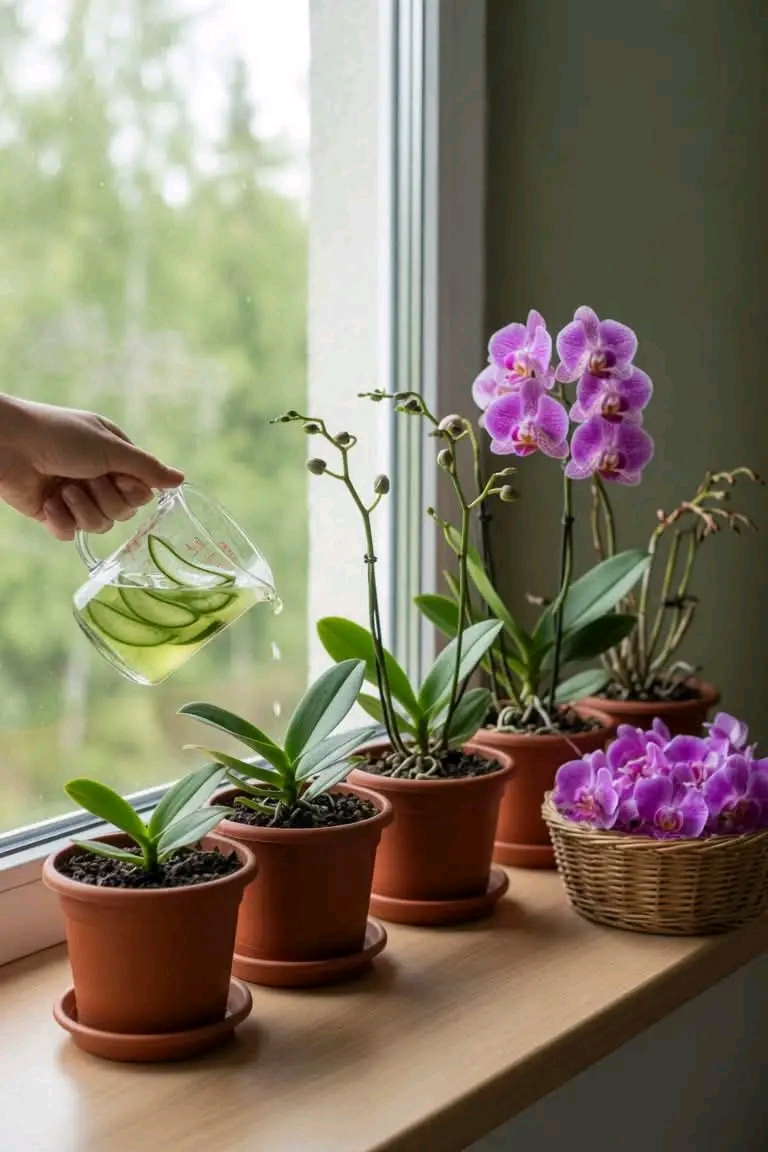
Let’s look closely at what’s happening in our feature image:
- The Technique: A steady hand pours a vibrant green liquid—water steeped with thin slices of fresh cucumber—directly into the pot. This is liquid organic fertilization. Instead of granules that need time to break down, the nutrients are already dissolved and ready for immediate root absorption.
- The Targets: The pots contain healthy orchids. Specifically, Phalaenopsis (Moth Orchids). These plants are epiphytic, meaning in nature, they grow on trees and get nutrients from decaying organic matter washed down by rain. They crave gentle, organic feeding.
- The Composition: The cucumbers aren’t just for show. They are packed with potassium (for bloom stimulation), phosphorus (for root health), and trace magnesium. When you soak them, these nutrients leach into the water, creating a mild, non-burning “nutrient tea.” 🍵
🧼 The How-To: Crafting Your Own Cucumber Nutrient Tea
You don’t need a degree in botany to pull this off. You just need a kitchen and some patience.
Necessary Materials: 🛠️
- 1 Fresh Cucumber: Preferably organic, to avoid pesticides.
- 1 Litre of Filtered Water: Tap water contains chlorine, which can harm sensitive orchid roots.
- A Jar or Pitcher: Something you can seal.
- A Strainer.
The Step-by-Step Recipe: 📖
- Slice thinly: You want maximum surface area exposure. You don’t even need to peel it—the skin holds many nutrients!
- Steep: Place the slices in your pitcher and fill with filtered water.
- Chill (or Don’t): Set it in the fridge for 24 hours. The cool environment slows bacterial growth while the nutrients leach out. Important: Let it come back to room temperature before watering. 🥶➡️🌡️
- Strain: Remove the slices to prevent mold from forming in your orchid pots.
- Water & Wait: Use this cucumber tea every second or third watering during the growing season (spring/summer). Watch for those vibrant blooms! 🌸 ✨
📊 Professional Comparison: Natural vs. Synthetic Feeding
Before you fully commit to the cucumber life, it’s essential to understand how natural DIY liquid fertilizers stack up against professional, store-bought synthetic options. Both have their place. Here is a breakdown:
| Feature/Criteria | DIY Cucumber Water (Natural) 🥒🌱 | Store-Bought Synthetic Liquid Fertilizer 🧪🫙 |
|---|---|---|
| Nutrient Origin | Natural plants, organic matter. | Chemically derived, refined salts. |
| Nutrient Profile | Gentle, low concentration, trace elements. | Concentrated, precise N-P-K ratios. |
| Speed of Action | Moderate (leaves become glossier in weeks). | Fast (visible growth burst within days). |
| Risk of Fertilizer Burn | Low (hard to overdo it).🛡️✨ | High (excessive salts can scorch roots).🔥🥵 |
| Soil Health Impact | Feeds soil microbiome, builds resilience. 🦠💚 | Can lead to salt buildup over time. |
| Preparation | Time-consuming, requires steeping. ⏳ | Instant (just dilute and pour). ✅🚀 |
| Storage Life | Very short (1-2 days). Must make fresh. 🤢 | Years (in proper storage). |
| Aesthetic Appeal | Looks beautiful in a clear pitcher! ✨ | Looks like chemistry in a bottle. |
The Verdict:
- Use Cucumber Water 🥒 if: You prioritize safety, love organic methods, have sensitive plants (like orchids/ferns), and enjoy the ritual of plant care. It’s the “daily multivitamin” approach.
- Use Synthetic Liquid 🧪 if: You need immediate results (e.g., a rescue plant), have heavy feeders (like Monstera), prefer convenience, and have many plants to feed. It’s the “performance steroid” approach.
🛡️ Beyond Cucumber: The Holistic Orchid Guardians 🛡️✨
Feeding is only one part of the orchid guardian’s creed. To get those massive, professional-looking blooms seen in our image, you need a full defense strategy.
- 🛡️ Shield of Light: Orchids love bright, indirect light. Direct sun will scorch their leaves (turning them yellow/brown), while too little light prevents blooming. Think “dappled sunlight,” not “desert heat.” ☀️🌤️
- 🛡️ Shield of Air: Orchids don’t grow in soil; they grow in bark and moss. Their roots need oxygen. If your orchid pot has no drainage, or if the mix is old and compacted, the roots will suffocated and rot. You must repot into fresh orchid bark every 1-2 years. 🌬️🪵
- 🛡️ Shield of Temperature: Phalaenopsis prefer the same temperatures humans do: 18°C–27°C. However, a slight drop in nighttime temperature (to around 15°C) in the autumn can trigger a new flower spike. 🌡️🥶
- 🛡️ Shield of Consistency: Plants hate drama. Establish a routine. Water when the top inch of the bark mix feels dry. Do not let them sit in standing water. The “ice cube method” is a myth—use room temperature water. 💧🧊➡️❌
Conclusion: Green is a Lifestyle 🌿💚
Whether you choose the meticulous path of making your own cucumber tea, or the efficient path of scientific refinement, the goal remains the same: a thriving, happy home. Plant parenting is a journey of trial, error, and magnificent, blooming success. 🌸✨
By adding these organic defense techniques to your routine, you’re not just keeping a plant alive; you are nurturing a living piece of art. Start steeping your cucumbers today!