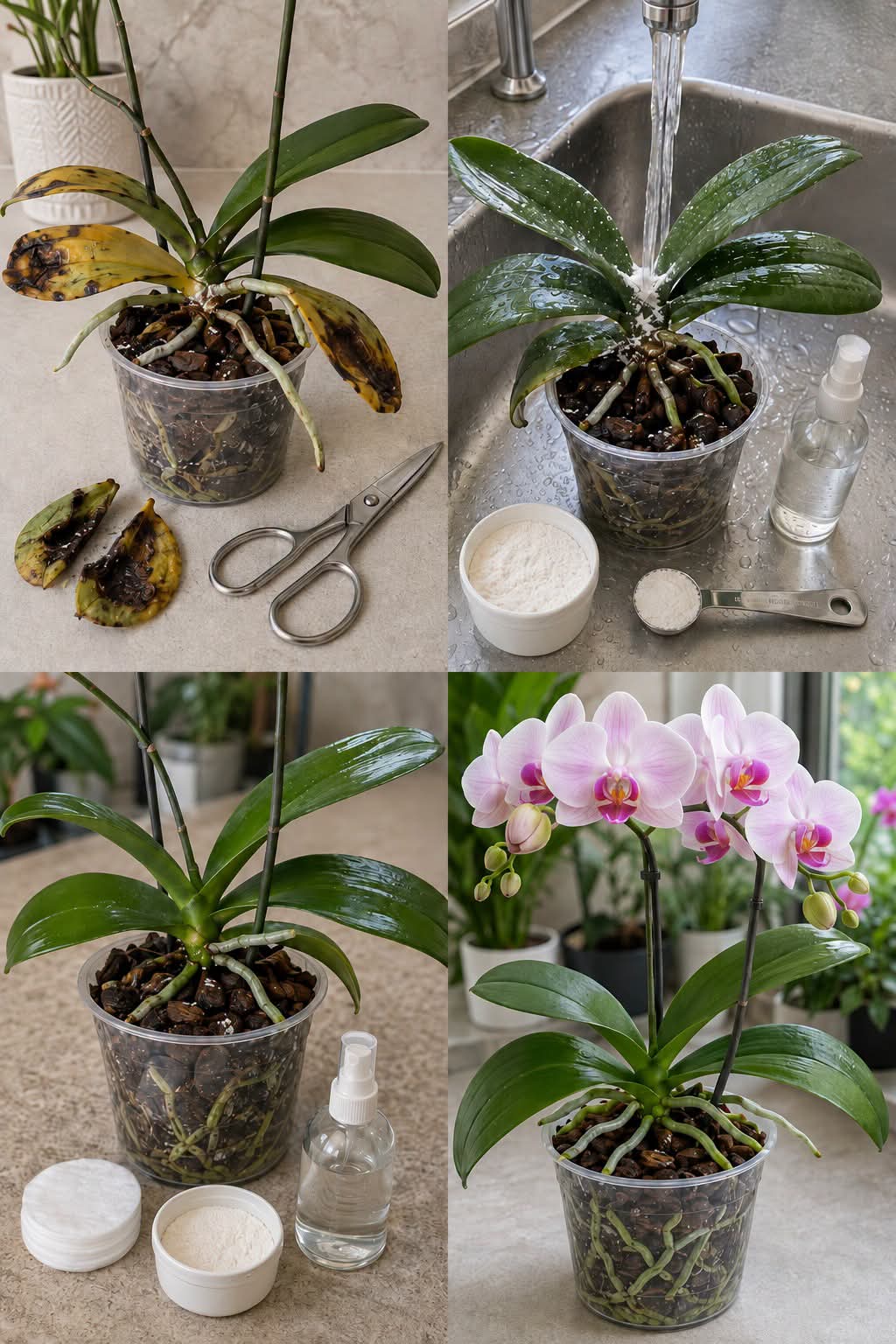
If you are an indoor plant lover, orchid enthusiast, or home gardener watching your Phalaenopsis Orchid (Phalaenopsis orchidaceae) develop yellowing leaves, dark fungal spots, or powdery mold around the crown, don’t panic 🌸🛡️! Seeing the bottom leaves of your favorite orchid turn bright yellow with brown necrotic patches is alarming, but it is often a treatable response to fungal infections, pest infestations, or excess moisture buildup around the leaf axils ✨.
Rather than throwing away a struggling orchid, executing a targeted rescue treatment—pruning diseased leaves with sterile tools, rinsing away surface pathogens, and applying a natural baking soda (sodium bicarbonate) solution—can eliminate fungal spores, protect healthy tissue, and restore your plant to full blooming health! Baking soda creates an alkaline surface environment that prevents fungal spores from germinating, making it one of the most effective natural fungicides available. Let’s explore the master treatment specifications, a detailed step-by-step 4-panel revival guide, maintenance parameters, and professional orchid care secrets!
🛒 Master Treatment Equipment & Botanical Specifications
Rescuing a Phalaenopsis orchid suffering from leaf yellowing, fungal leaf spot, or pest infestations requires balancing sterile surgical pruning, natural alkaline antifungal sprays, and controlled moisture management 🌸🛡️. Here is your master treatment breakdown 📋✨:
| Treatment Component | Visual Indicator & Specification | Botanical Function & Horticultural Impact | Recommended Tools & Materials |
|---|---|---|---|
| Symptom Diagnosis 🍂 | Yellowing Leaves with Black Fungal Spots | Signifies fungal leaf spot, bacterial rot, or scale infestation (pictured top-left). | Shears & Sterilized Rubbing Alcohol. |
| Pruning Tool ✂️ | Stainless Steel Precision Shears | Allows clean removal of infected leaf tissue to stop disease spreading (pictured top-left). | Alcohol Wipes or Flame Sterilizer. |
| Natural Antifungal Powder 🥄 | Baking Soda (Sodium Bicarbonate) | Shifts surface pH to an alkaline state, disrupting fungal cell walls (pictured top-right/bottom-left). | Pure Food-Grade Baking Soda. |
| Application Bottle 🧴 | Fine-Mist Spray Bottle + Cotton Pads | Ensures fine coverage over leaves and stem base without drowning roots (pictured top-right/bottom-left). | Glass or Plastic Spray Mister. |
| Clear Container Pot 🪴 | Clear Slotted Plastic Pot | Enables 360° visual inspection of root health and prevents water stagnation (pictured bottom-right). | Slotted Orchid Liner with Bark. |
| Target Outcome 🌸 | Deep Green Foliage & Vibrant Pink Blooms | Restores photosynthetic vigor, driving strong root growth and floral spikes (pictured bottom-right). | Filtered |
👩🌾 Step-by-Step Baking Soda & Pruning Rescue Guide
Follow this comprehensive 4-step professional guide to prune diseased yellow leaves, wash away surface pathogens under running water, treat the plant with a natural baking soda mister, and achieve full floral recovery, exactly as demonstrated in the featured 4-panel tutorial 🌸✨!
Step 1: Inspect Plant and Prune Diseased Yellow Leaves ✂️🍂
- Place your Phalaenopsis orchid on a clean workspace under bright light to assess leaf damage (as shown in the top-left panel).
- Sterilize your pruning shears thoroughly using rubbing alcohol or a flame to prevent cross-contamination.
- Make a clean cut at the base of any severely yellowed, spotted, or rotting leaves, removing them entirely from the main stem.
- Discard the cut diseased leaves immediately far away from your other houseplants!
- Horticultural Secret: Removing dead or infected bottom leaves redirects vital metabolic energy back into the healthy top leaves and central stem!
Step 2: Rinse Stem & Mix Baking Soda Antifungal Solution 🚿🥄
- Take the potted orchid to your kitchen sink and gently rinse the upper foliage under cold to lukewarm running tap water (as featured in the top-right panel).
- Gently wash away dust, mold spores, and scale pests from the leaf surfaces and stem base while keeping the potting media intact.
- In a small container, measure 1 level tablespoon of baking soda alongside 1 quart (1 liter) of clean warm water.
- Pour the mixture into a fine-mist spray bottle and shake vigorously until the powder dissolves completely.
- Add 1/2 teaspoon of mild liquid castile soap or horticultural oil to help the spray stick evenly to the waxy orchid leaves.
Step 3: Spray Foliage and Wipe Stem Base Clean 🧴🧽
- Generously mist the top and underside of all remaining healthy dark green leaves with your prepared baking soda spray (as demonstrated in the bottom-left panel).
- Moisten soft cotton pads with the baking soda solution and gently wipe down the upper stem axils and leaf joints to eliminate microscopic fungal spores.
- Crucial Rule: After spraying or rinsing, use a dry cotton swab or paper towel to gently dab away any standing water pooled inside the central leaf crown to prevent crown rot!
Step 4: Resume Care for Healthy Reblooming 🌸☀️
- Place your treated orchid in a bright location receiving indirect sunlight near an east or west-facing window (68°F to 78°F / 20°C to 26°C).
- Repeat the gentle baking soda misting once every 7 to 10 days for 3 weeks until all signs of yellowing or fungal spots disappear.
- As the plant recovers, its plump green roots will thrive inside the clear slotted pot, leading to brand-new foliage growth and vibrant, arching pink floral spikes (as captured in the bottom-right showcase)!
💡 Pro Secrets for Preventing Leaf Yellowing
- Distinguish Normal Aging from Disease: Natural aging causes only the single, lowest leaf to turn pale yellow slowly over several weeks before dropping off 🌿. If multiple leaves turn yellow rapidly with black or brown spots, fungal infection or overwatering is present!
- Maintain Air Circulation Around Foliage: Fungal spores thrive in stagnant, humid environments. Running a small, gentle room fan near your orchid collection keeps leaf surfaces dry and free from fungal colonization.
- Water Only the Root Medium: Avoid spraying plain water directly over orchid leaves during regular maintenance 🌸. Always apply water directly to the pine bark substrate, allowing excess moisture to drain out completely.
Apply this simple, powerful baking soda and pruning rescue routine today to cure leaf yellowing, stop fungal infections, and keep your orchids producing gorgeous pink blossoms year after year! 🌸🛡️✨