A Simple Natural Gardening Experiment for Healthier Succulents and More Beautiful Blooms!
Discover an Interesting Way to Care for Your Flowering Succulent
Have you ever wondered whether simple ingredients from your kitchen could play a role in your plant-care routine?
If you love succulents, unusual flowering plants, and natural gardening experiments, you will enjoy discovering this interesting approach to caring for one of the most fascinating plants in an indoor garden.
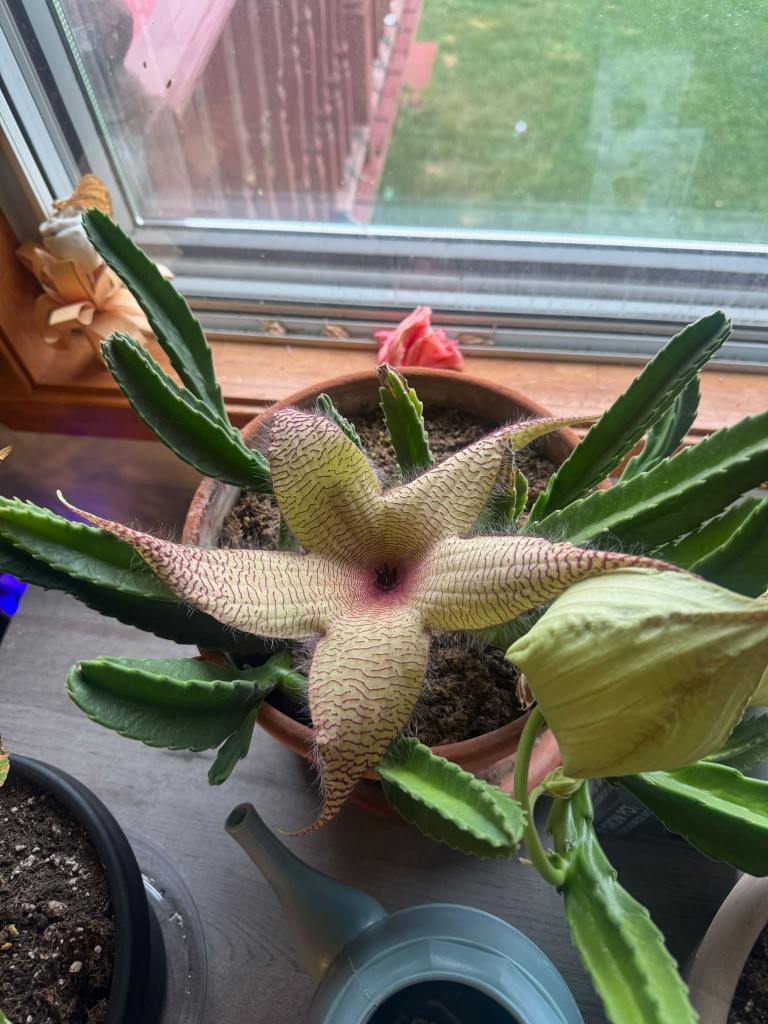
The photograph shows a spectacular star-shaped flower surrounded by long, green, fleshy stems. This plant appears to belong to the Stapelia or a closely related succulent group, famous for its extraordinary flowers and unusual appearance.
Its beautiful star-shaped bloom, delicate surface patterns, and distinctive center make it a real conversation starter.
In this gardening experiment, we explore adding a small quantity of uncooked rice grains to the surface of the growing medium.
Rice is often discussed in homemade gardening tips because it contains starch and small quantities of nutrients. But can adding rice grains really help succulents grow stronger, develop healthy roots, and produce more flowers?
Let’s explore the idea, understand what happens in the soil, and discover how to care for this beautiful flowering succulent.
Why This Flowering Succulent Deserves Special Attention
Stapelia plants are unusual succulents that belong to a group commonly known for their star-shaped flowers.
Unlike traditional flowering houseplants, these succulents have thick, fleshy stems that perform many of the functions normally associated with leaves.
Their stems store water, allowing them to survive periods of limited rainfall.
Some varieties produce spectacular flowers with intricate patterns, unusual textures, and colors ranging from pale yellow to reddish brown.
The flower in the photograph has a beautiful star-like shape with delicate markings and a darker center.
These plants are especially attractive to collectors who enjoy rare-looking succulents and unusual botanical specimens.
However, their care requirements are slightly different from those of ordinary tropical houseplants.
They need plenty of light, careful watering, and a growing medium that drains efficiently.
The Natural Gardening Experiment: Adding Rice Grains to the Soil
One popular homemade gardening experiment involves sprinkling a small amount of uncooked rice grains over the growing medium.
Rice contains starch, carbohydrates, and small quantities of minerals.
When rice comes into contact with moisture, its components can gradually become available as it breaks down.
However, this process does not mean that rice works as a complete plant fertilizer.
Plants require essential nutrients in appropriate proportions, including nitrogen, phosphorus, potassium, calcium, magnesium, and several micronutrients.
Uncooked rice does not provide these nutrients in a balanced or predictable way.
Furthermore, adding dry rice grains directly to a succulent pot may create problems if they remain wet for long periods.
For this reason, this method should be considered a gardening experiment rather than a proven fertilizer treatment.
What Happens When Rice Grains Come into Contact with Moist Soil?
When dry rice grains absorb moisture, their structure changes.
The starch inside the grains can become accessible to microorganisms that naturally exist in the growing medium.
These microorganisms participate in the decomposition of organic materials.
During decomposition, different biological processes take place.
Microbial Activity
Naturally occurring microorganisms can use available carbohydrates as an energy source.
Organic Matter Breakdown
As organic materials decompose, their components are gradually transformed through biological processes.
Changes in Soil Conditions
The decomposition process can influence microbial activity and the balance of organic material in the growing medium.
However, adding rice does not automatically improve soil fertility.
In a small indoor pot, excessive decomposing material can encourage mold, unpleasant odors, and unwanted insects.
This is particularly important for succulents because they prefer an airy growing medium rather than continuously moist soil.
Can Rice Grains Help Succulents Grow Faster?
Many gardening enthusiasts are interested in homemade fertilizers because they want their plants to develop stronger roots, healthier stems, and new growth.
Although rice contains carbohydrates and small quantities of minerals, uncooked rice grains are not a reliable source of complete plant nutrition.
The presence of starch does not mean that a plant can directly use it as fertilizer.
Plants produce their own carbohydrates through photosynthesis, using light, water, and carbon dioxide.
For healthy growth, succulents need suitable environmental conditions and access to essential mineral nutrients.
A complete fertilizer formulated for succulents is a much more dependable option than adding uncooked rice to the soil.
The Importance of Healthy Roots
Healthy roots are the foundation of a beautiful succulent.
They absorb water and mineral nutrients while anchoring the plant in the growing medium.
For Stapelia and similar succulents, roots need a balance between moisture availability and oxygen.
A compact growing medium can hold too much water, creating conditions that encourage root rot.
An appropriate succulent mix should allow excess water to drain quickly.
A mixture containing mineral materials such as pumice, perlite, or coarse horticultural grit can help improve drainage.
Adding excessive kitchen waste or decomposing food materials to the pot can interfere with this balance.
Therefore, protecting the roots is more important than experimenting with unnecessary soil additives.
How to Encourage New Stems and Beautiful Flowers
If you want your flowering succulent to produce healthy new stems and attractive flowers, focus on these essential care practices.
1. Provide Plenty of Bright Light
Stapelia plants generally appreciate bright light.
A location with several hours of suitable sunlight can encourage healthy stem development and flowering.
If the plant has been growing indoors in low light, introduce stronger sunlight gradually to avoid sunburn.
2. Use Well-Draining Soil
This is one of the most important factors in succulent care.
Choose a growing medium specifically designed for succulents and cacti.
Adding pumice or perlite can improve aeration and drainage.
Avoid heavy garden soil that remains wet for extended periods.
3. Water Only When Necessary
Although succulents store water in their fleshy stems, they still need occasional watering.
Allow the growing medium to dry substantially between watering sessions.
Water thoroughly when needed, then allow excess water to drain away.
Never leave the pot standing in water.
4. Feed During Active Growth
A balanced, diluted fertilizer suitable for succulents can provide essential mineral nutrients.
Apply it according to the manufacturer’s instructions during the plant’s active growing season.
Avoid excessive fertilization because too much nutrition can encourage weak growth and may interfere with the plant’s natural development.
5. Maintain Good Air Circulation
Good airflow helps the growing medium dry appropriately and reduces the risk of fungal problems.
Avoid placing the plant in a permanently damp, poorly ventilated location.
6. Give the Plant Time to Mature
Some succulents need to reach a certain size and maturity before producing flowers.
Patience is an important part of successful succulent gardening.
Healthy growth does not happen overnight, but consistent care can make a significant difference.
Can Rice Water Be Used Instead of Whole Rice Grains?
Rice water is another popular topic among people interested in homemade plant-care solutions.
Some gardeners collect the water used to rinse rice and use it to water their plants.
However, rice water is not a complete fertilizer either.
Its composition varies depending on the rice, the washing process, and the amount of water used.
It may contain starch and small amounts of dissolved substances, but it does not provide all the nutrients that plants need.
For succulents, regular use of starchy water may encourage microbial growth on the surface of the growing medium.
It is generally better to use clean water and a suitable succulent fertilizer.
Common Mistakes to Avoid When Using Homemade Fertilizers
Natural gardening experiments can be interesting, but not every kitchen ingredient is suitable for every plant.
Here are some mistakes to avoid:
- Adding large quantities of uncooked rice to a plant pot.
- Leaving food materials on constantly moist soil.
- Using homemade mixtures too frequently.
- Allowing mold to develop around the plant’s base.
- Watering succulents too often.
- Using compact soil with poor drainage.
- Applying several homemade treatments at the same time.
- Assuming that natural ingredients always provide balanced nutrition.
If you notice mold, unpleasant odors, or small insects after adding food materials, remove the remaining material and allow the growing medium to dry appropriately.
Understanding the Beautiful Flower in the Photograph
One of the most fascinating features of this plant is its extraordinary flower.
Stapelia flowers are famous for their unusual appearance.
Their star-shaped petals often have intricate surface patterns and a distinctive central structure.
Some species produce flowers with a scent that attracts flies, which act as pollinators in their natural environment.
This unusual adaptation is one reason Stapelia plants are so interesting to succulent collectors.
Although their flowers can look delicate, the plants themselves are generally quite resilient when their growing conditions are suitable.
A healthy plant with sufficient light, appropriate watering, and balanced nutrition has a better chance of developing strong stems and producing flowers when mature.
Final Thoughts: Healthy Succulents Begin with the Right Care
Growing unusual flowering succulents is a wonderful experience.
Their unusual stems, fascinating flowers, and ability to store water make them very different from ordinary indoor plants.
Adding rice grains to the soil may seem like an interesting natural gardening experiment, but it is important to understand that uncooked rice is not a proven fertilizer and does not guarantee stronger roots, faster growth, or more flowers.
In small succulent pots, decomposing rice may actually encourage mold and unwanted microbial activity.
The best approach is to focus on what these plants genuinely need: bright light, excellent drainage, careful watering, good airflow, and appropriate mineral nutrition.
Every healthy new stem and beautiful flower is a reward for understanding your plant and providing the right growing conditions.
Remember that successful gardening is not about adding as many ingredients as possible. It is about creating the perfect environment for each plant to thrive.
Join Our Gardening Community!
Do you love unusual succulents and spectacular flowering plants?
Have you ever tried natural gardening experiments using kitchen ingredients?
We would love to hear about your experiences!
❤️ LIKE this article if you enjoy learning about succulents and indoor gardening.
🌱 FOLLOW our website for more plant-care tips, natural gardening experiments, succulent propagation guides, and flowering plant inspiration.
📢 SHARE this article with your friends, family, and fellow plant lovers.
💬 LEAVE A COMMENT and tell us which succulent you would love to grow in your home.
Thank you for supporting our gardening community.
Let’s grow together, discover the beauty of nature, and enjoy every new stem and beautiful bloom!