Give Your Flowering Cactus the Care It Deserves: Discover the Secrets of Healthy Growth and Beautiful Blooms!
An Interesting Plant Care Experiment: Adding a White Liquid to Organic Soil Nutrition
Have you ever wondered whether simple ingredients from everyday life could play a role in keeping your favorite flowering plants healthy and beautiful?
Indoor gardening is full of interesting experiments, especially when it comes to organic soil amendments and natural plant nutrition.
In this gardening experiment, we explore adding a white liquid, such as milk, alongside organic fertilizer to support the growing environment of a beautiful flowering cactus.
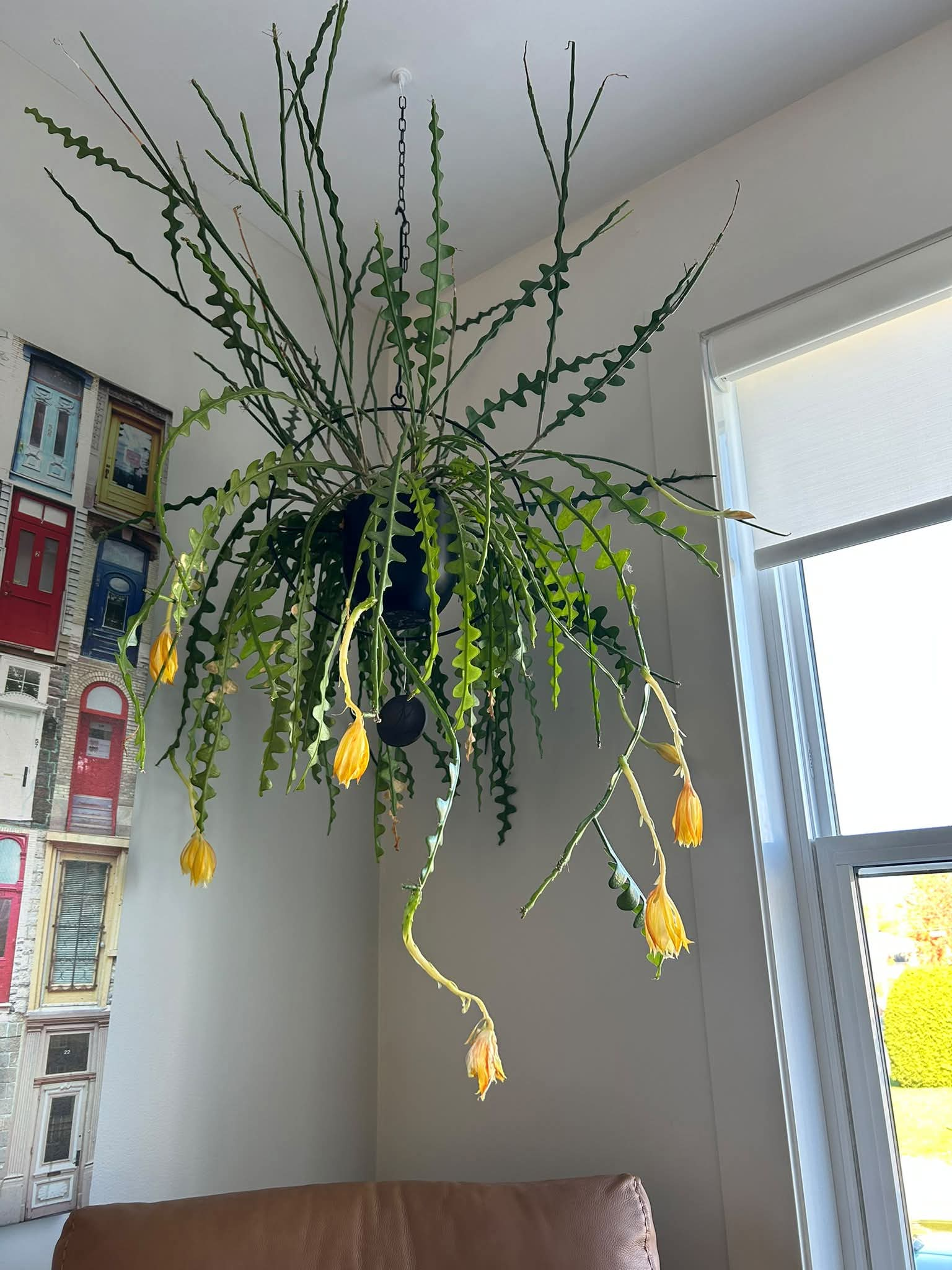
The plant in the photograph appears to be an epiphytic cactus, possibly an Epiphyllum or a related zigzag-stemmed variety. Its unusual cascading stems and delicate yellow flowers make it a spectacular addition to an indoor plant collection.
Unlike desert cacti, epiphytic cacti naturally grow in tropical environments, where they receive filtered light, organic material, and moisture without having their roots constantly submerged in water.
This makes understanding their growing conditions especially important.
But can milk and organic fertilizer really help this plant grow stronger, produce new stems, and develop more beautiful flowers?
Let’s discover the science behind this gardening experiment and explore the best ways to care for this extraordinary flowering plant.
Understanding the Beautiful Flowering Cactus
The plant shown in the picture has long, narrow, flattened stems with distinctive wavy edges.
These unusual stems are characteristic of several epiphytic cactus varieties.
Epiphytic cacti are different from the familiar desert cacti covered with spines.
In their natural environment, many grow on trees or among organic material accumulated in branches and crevices.
Their roots need moisture, but they also require plenty of oxygen.
This explains why they generally prefer an airy growing medium containing organic matter and materials that improve drainage.
Their beautiful flowers are another reason gardeners love them.
Depending on the species and variety, flowering may occur seasonally, and some flowers open for only a limited period.
Providing suitable light, moisture, and nutrition can help maintain a healthy plant capable of producing spectacular blooms.
What Is the White Liquid Being Added to the Plant?
The white liquid in this gardening experiment is milk.
Milk contains several naturally occurring nutritional components, including:
- Calcium.
- Potassium.
- Phosphorus.
- Proteins.
- Lactose.
- Small quantities of other minerals.
These components make milk interesting from a nutritional perspective.
However, plants cannot simply absorb milk as if it were a ready-made fertilizer.
Some of its organic components must first be broken down by microorganisms, and the nutrients must become available in suitable forms before roots can absorb them.
This process depends on soil conditions, microbial activity, moisture, and temperature.
Therefore, milk should not be considered a complete or reliable fertilizer for flowering cacti.
Can Milk Provide Calcium for Healthy Plant Development?
Calcium is an essential plant nutrient involved in several important biological processes.
It contributes to:
Strong Cell Walls
Calcium helps maintain the structure and stability of plant cell walls.
Healthy Growing Tissues
It is particularly important for developing roots, young leaves, and other actively growing tissues.
Normal Cellular Function
Calcium participates in signaling processes that help plants respond to environmental conditions.
Although milk contains calcium, adding it to potting soil is not a dependable way to correct calcium deficiency.
A suitable horticultural calcium supplement is generally a more predictable option when a deficiency has been identified.
The Importance of Organic Fertilizer
Organic fertilizers and mature compost can contribute valuable nutrients and organic matter to a plant’s growing environment.
Depending on their composition and degree of decomposition, they may contain nitrogen, phosphorus, potassium, and other essential elements.
These nutrients support different aspects of plant development.
Nitrogen for Healthy Green Growth
Nitrogen contributes to chlorophyll production, amino acid formation, and protein synthesis.
Phosphorus for Energy and Root Development
Phosphorus participates in energy transfer and several processes involved in root growth and plant metabolism.
Potassium for Water Regulation
Potassium helps regulate water movement, enzyme activity, and many essential physiological processes.
Organic Matter for Soil Health
Well-decomposed organic matter can improve the physical properties of suitable growing media and support beneficial microbial activity.
However, not all organic fertilizers are appropriate for every plant.
For epiphytic cacti, a heavy, moisture-retaining fertilizer or dense compost can create unfavorable conditions around the roots.
A mature, well-balanced organic fertilizer should always be selected according to the plant’s needs.
Can Milk and Organic Fertilizer Work Together?
This is an interesting question for anyone who enjoys experimenting with natural plant-care methods.
Milk and organic fertilizer have different characteristics.
Milk contains proteins, sugars, and minerals, while organic fertilizers provide nutrients through materials that are broken down by microorganisms.
However, combining them does not automatically create a better fertilizer.
Milk can decompose in the growing medium, potentially encouraging unwanted microbial growth, unpleasant odors, and mold.
Combining it with organic material may increase the amount of decomposing organic matter around the roots.
For indoor potted plants, this can create unnecessary problems, especially when drainage and airflow are limited.
For this reason, regularly pouring milk into an indoor flowering cactus pot is not recommended.
A mature organic fertilizer used according to its label is a safer approach.
How to Encourage New Stems and Beautiful Flowers
One of the most rewarding experiences in gardening is seeing a flowering cactus produce fresh growth.
New stems and healthy flowers are supported by several important growing conditions.
1. Provide Bright, Filtered Light
Epiphytic cacti generally prefer bright indirect light.
A location near a bright window can be suitable, provided the plant is protected from harsh midday sunlight.
2. Choose an Airy Growing Medium
Use a growing medium formulated for epiphytic cacti.
A mixture containing suitable organic material, orchid bark, and perlite or pumice can help maintain airflow around the roots.
3. Water Carefully
Water when the growing medium has partially dried.
Avoid keeping the roots constantly wet.
Good drainage is particularly important because excessive moisture can cause root damage.
4. Provide Balanced Nutrition
During active growth, use a suitable balanced fertilizer at the recommended concentration.
Avoid excessive nitrogen because it may encourage vegetative growth without necessarily improving flowering.
5. Maintain Suitable Temperatures
Protect the plant from extreme temperatures and sudden environmental changes.
Stable growing conditions help support healthy development.
6. Avoid Disturbing Flower Buds
When flower buds begin to develop, avoid unnecessary movement or changes in the plant’s environment.
Stable conditions can help reduce stress and support successful flowering.
Why Organic Matter Must Be Properly Decomposed
Organic fertilizers can be extremely useful when they are properly prepared.
However, fresh or unfinished organic material may contain substances that are unsuitable for delicate roots.
Mature compost is generally darker, crumbly, and has an earthy smell rather than a strong unpleasant odor.
For indoor epiphytic cacti, always use compost sparingly and as part of an airy, well-draining growing medium.
Too much compost can increase moisture retention and reduce airflow.
The goal is not to make the soil as rich and heavy as possible.
The goal is to create a balanced environment where roots can absorb moisture while still receiving sufficient oxygen.
Common Mistakes When Using Milk and Organic Fertilizer
Many gardening enthusiasts believe that combining several natural ingredients will automatically produce better results.
Unfortunately, this is not always true.
Here are some mistakes to avoid:
- Pouring undiluted milk into indoor plant pots.
- Using milk repeatedly as a fertilizer.
- Adding unfinished compost around delicate roots.
- Applying excessive organic fertilizer.
- Keeping the growing medium constantly wet.
- Using dense soil with poor drainage.
- Applying several homemade treatments at the same time.
- Expecting immediate flowers after fertilization.
Remember that more nutrients do not always mean healthier plants.
Excessive organic material and inappropriate treatments can disturb the balance of the growing medium.
What Is the Safest Way to Feed This Flowering Cactus?
For a beautiful epiphytic cactus like the one shown in the photograph, a suitable feeding routine should focus on complete nutrition and healthy roots.
Consider these options:
Balanced Liquid Fertilizer
A complete fertilizer suitable for epiphytic cacti can provide essential nutrients in more predictable proportions.
Mature Organic Compost
Small amounts of properly finished compost can contribute organic matter when incorporated into a suitable growing medium.
Good-Quality Growing Medium
An airy, well-draining mixture is essential for preventing root problems.
Appropriate Watering
Water management is just as important as fertilization.
Avoid leaving the plant standing in excess water.
Milk is not necessary for any of these steps and is best avoided as a regular soil treatment.
Final Thoughts: Natural Plant Care Begins with Understanding Your Plant
The beautiful cascading stems and delicate yellow flowers in this photograph remind us how extraordinary flowering cacti can be.
Their unusual appearance makes them fascinating plants to grow, and with the right care, they can reward us with spectacular seasonal displays.
Milk contains calcium, potassium, proteins, and other components, while organic fertilizers can provide valuable nutrients and organic matter.
However, milk is not a scientifically established fertilizer for indoor flowering cacti, and combining it with organic fertilizer does not guarantee faster growth or more flowers.
The real secrets to a healthy flowering cactus are suitable light, healthy roots, an airy growing medium, careful watering, and balanced nutrition.
When we understand the natural needs of our plants, we can make better decisions and avoid unnecessary treatments.
Every new stem, every developing flower bud, and every beautiful bloom is a reminder that successful gardening takes patience, observation, and consistent care.
Frequently Asked Questions
Can I pour milk into my flowering cactus pot?
It is generally not recommended. Milk can decompose in the growing medium and encourage unwanted microbial growth, mold, and unpleasant odors.
Does milk provide calcium to plants?
Milk contains calcium, but it is not a reliable calcium fertilizer. Suitable horticultural products are more predictable when calcium supplementation is needed.
Can organic fertilizer encourage new cactus stems?
Balanced nutrition can support normal growth when the plant has suitable light, moisture, and healthy roots. Excessive fertilization should be avoided.
Can organic compost help epiphytic cacti?
Yes, mature compost can contribute organic matter, but it should be used appropriately and should not make the growing medium too dense or moisture-retentive.
Does fertilizing make flowers bigger?
Proper nutrition supports healthy development, but flowering also depends on species, maturity, light, temperature, and seasonal conditions.
How often should I fertilize an epiphytic cactus?
Frequency depends on the species, growing season, and fertilizer formulation. Follow the product label and avoid feeding when the plant is dormant or stressed.
Join Our Gardening Community!
Do you love flowering cacti and unusual tropical plants?
Have you ever experimented with organic fertilizers or homemade plant-care treatments?
We would love to hear your experiences!
❤️ Like this article if you enjoy beautiful flowering plants.
🌿 Follow our website for more indoor gardening tips, organic plant nutrition, propagation guides, and flowering plant inspiration.
📢 Share this article with your friends, family, and fellow gardening enthusiasts.
💬 Leave a comment and tell us how you keep your flowering cactus healthy and encourage beautiful blooms.
Thank you for supporting our gardening community. Every visit, comment, share, and follow helps us spread gardening knowledge and inspire more people to discover the beauty of nature.
Let’s grow together and fill our homes with healthy plants and breathtaking flowers!