Coffee Grounds for Coleus Plants: How to Use Coffee Safely for Vibrant Pink and Purple Leaves
Introduction: Can Coffee Grounds Help Your Coleus Plant Grow?
Coleus plants are famous for their spectacular foliage, featuring dramatic combinations of deep purple, magenta, pink, red, lime green, and burgundy. Their colorful leaves can transform an ordinary indoor corner into a beautiful display of living color. To keep a coleus plant looking full, healthy, and vibrant, gardeners need to provide the right balance of light, water, nutrients, and regular pruning.
One popular gardening idea is using coffee grounds as a natural soil amendment. Coffee is commonly associated with morning routines, but the leftover grounds may also have a place in certain gardening practices when they are used carefully. Some gardeners sprinkle a small quantity of used coffee grounds over the soil around their houseplants, hoping to support healthier foliage and stronger growth.
However, coffee grounds are not a miracle fertilizer, and they do not automatically make leaves brighter or produce new growth. Their usefulness depends on how they are prepared, how much is applied, the condition of the soil, and the needs of the individual plant.
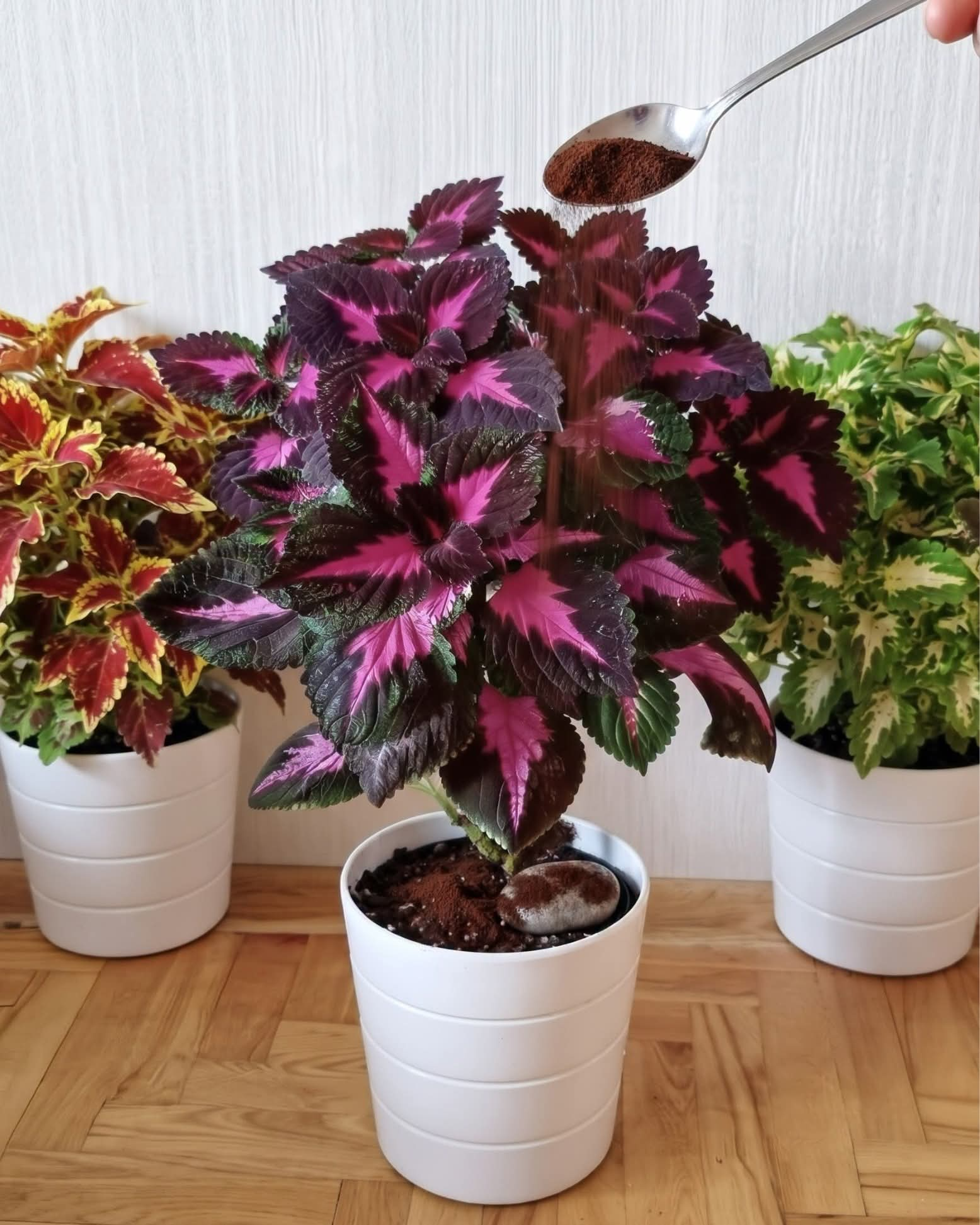
The image shows a beautiful coleus with dark purple foliage and vivid pink centers. A spoon is sprinkling a brown, coffee-like powder onto the potting soil. The powder appears consistent with coffee grounds, but an image alone cannot confirm its exact composition or whether it has already been used. Understanding what coffee grounds actually contribute—and what they cannot do—is essential before trying this method at home.
This guide explains the possible benefits of coffee grounds, the safest way to handle them, the importance of proper coleus care, and the common mistakes that can damage a plant instead of helping it thrive.
1. Understanding the Plant in the Picture
The central plant appears to be a coleus, a popular ornamental foliage plant grown for its richly patterned leaves. Coleus plants are valued primarily for their colorful foliage rather than for their flowers.
Depending on the cultivar, coleus leaves may display combinations of burgundy, deep purple, bright pink, red, yellow, lime green, and dark green. The plant in the image has particularly striking pink markings surrounded by very dark purple and green edges.
Coleus plants can grow well in containers indoors or outdoors, provided their environmental needs are met. They generally prefer warm conditions, consistent moisture, suitable light, and a growing medium that allows excess water to drain away.
A healthy coleus often produces new leaves from the growing tips of its stems. With sufficient light and regular pinching, it can develop a dense, bushy shape rather than becoming tall and sparse.
Although nutrition plays a role in plant development, the intensity of coleus leaf colors depends strongly on the variety and growing conditions. Adding coffee grounds cannot transform a green cultivar into a naturally pink one, nor can it guarantee the vivid colors shown in the photograph.
The best way to maintain attractive foliage is to start with a healthy plant and give it the conditions it needs to produce strong, well-colored leaves.
2. What Is the Brown Powder Being Added to the Soil?
The brown powder in the spoon resembles coffee grounds. If it is coffee, it may consist of used grounds left after brewing coffee, or it could be another coffee-based material. The photograph does not provide enough information to identify the powder with certainty.
This distinction matters because used coffee grounds and fresh coffee grounds are not identical in their practical use.
Used grounds have already been exposed to hot water during brewing. They still contain organic matter and some nutrients, but they should not be treated as a complete plant fertilizer.
Fresh, unbrewed coffee grounds may contain more of their original soluble compounds. They can also have different effects when added to potting soil, so they should not automatically be used in the same way as used grounds.
Coffee grounds contain organic material and small amounts of nutrients, including nitrogen. However, the exact nutrient content varies with the type of coffee and brewing process. The amount available to a plant also depends on microbial activity and conditions in the growing medium.
Most importantly, coffee grounds do not supply every nutrient a coleus needs in a reliable, balanced proportion. They should not replace a fertilizer formulated for container-grown ornamental plants.
If you want to experiment with coffee grounds, first make sure you know what the material is. Never apply an unidentified powder to your plant simply because it appears in a gardening photograph or video.
3. Why Do Some Gardeners Use Coffee Grounds for Plants?
Coffee grounds are often discussed in gardening because they are an organic material that can be recycled instead of thrown away. When managed appropriately, organic materials can contribute to soil improvement, particularly in outdoor composting systems.
Gardeners may use coffee grounds for several reasons.
They provide organic material
Coffee grounds contain organic matter that can be broken down by microorganisms. In a properly managed compost pile, used grounds can contribute to the mixture of materials being decomposed.
Finished compost can improve soil structure and help support a healthy growing environment. This is different from sprinkling fresh coffee grounds directly onto the surface of a small houseplant pot.
A container has a limited amount of growing medium. Its structure, air spaces, drainage, and nutrient balance can be affected by anything added to it. For that reason, coffee grounds are generally better incorporated into a suitable composting process than applied repeatedly in thick layers to a houseplant.
They contain some nitrogen
Nitrogen is an essential plant nutrient. It contributes to the production of chlorophyll and proteins and supports the development of leaves and stems.
Because coffee grounds contain nitrogen, they are sometimes described as a natural nitrogen source. However, the total nitrogen present is not necessarily available to the plant immediately.
Much of the nitrogen in organic materials must be processed by microorganisms before plants can use it. The rate of this process depends on temperature, moisture, oxygen, and other conditions.
Consequently, adding coffee grounds to a coleus pot does not provide the same predictable result as using a balanced liquid houseplant fertilizer according to its label.
They can be recycled
One of the clearest benefits of used coffee grounds is that they can be reused rather than discarded.
If you drink coffee regularly, collecting the used grounds for a compost pile can be a practical way to reduce household waste. They can be combined with other appropriate compost materials instead of being applied directly to every indoor plant.
This approach focuses on recycling organic material while avoiding the assumption that every household waste product is automatically beneficial to every plant.
4. Can Coffee Grounds Make Coleus Leaves More Colorful?
The colorful leaves in the image may lead people to wonder whether coffee grounds can make a coleus develop brighter pink or purple patterns.
There is no reliable basis for claiming that coffee grounds directly create these colors.
Coleus foliage coloration is primarily determined by genetics and the plant’s production of natural pigments. Light exposure, temperature, nutrition, and overall plant health can influence how a particular cultivar looks, but coffee grounds are not a guaranteed color-enhancing treatment.
If your coleus is losing its color, consider the following factors before adding anything to the soil:
- Light: Insufficient light may contribute to weak, stretched growth and less attractive foliage.
- Cultivar: Some coleus varieties naturally have stronger pink, purple, or burgundy markings than others.
- Nutrition: A plant that lacks essential nutrients may grow poorly, but excessive fertilizer can also damage roots and foliage.
- Watering: Both prolonged dryness and waterlogged soil can affect plant health.
- Temperature: Coleus plants generally grow best in warm conditions and may suffer when exposed to cold.
- Pruning: Pinching growing tips can encourage a fuller shape and more branching.
A healthy growing environment is a more dependable way to preserve colorful foliage than relying on a homemade powder.
5. The Possible Benefits of Used Coffee Grounds
Used coffee grounds can be useful in some gardening situations, but their benefits depend on how they are handled.
Benefit 1: Recycling organic waste
The most straightforward benefit is recycling. Coffee grounds can become part of a composting system rather than going directly into household rubbish.
Benefit 2: Contributing to compost
When mixed with other appropriate materials, coffee grounds can contribute organic matter and nutrients to a compost pile. The resulting mature compost can then be used as part of a suitable potting mix or garden soil amendment.
Composting allows the material to decompose before it is introduced into the growing environment. This is generally a more controlled approach than repeatedly placing coffee grounds directly around a plant’s roots.
Benefit 3: Supporting soil improvement through finished compost
Finished compost can help improve soil structure and biological activity. For container plants, however, it must be used in moderation and in a mix that continues to drain and hold air properly.
Coleus roots need access to both moisture and oxygen. A growing medium that stays excessively wet can contribute to root problems, even if the material added to it is organic.
Benefit 4: Making use of a readily available material
Coffee grounds are easy to collect in many households. Reusing them can be inexpensive, but free does not necessarily mean suitable for direct application to a plant.
The quantity, preparation, and growing conditions all matter.
6. What Coffee Grounds Cannot Do
There are several claims about coffee grounds that should be treated cautiously.
First, coffee grounds cannot guarantee rapid growth. Plant growth depends on many factors, including light, temperature, root health, watering, and nutrient availability.
Second, coffee grounds cannot guarantee bigger leaves. A coleus’s mature leaf size is influenced by its cultivar and growing conditions.
Third, coffee grounds cannot guarantee new branches. Pinching and pruning are more direct ways to encourage branching in coleus.
Fourth, coffee grounds cannot guarantee stronger roots. Root health depends on an appropriate growing medium, adequate oxygen, correct watering, and the absence of harmful conditions.
Finally, coffee grounds should not be described as a proven treatment for every plant problem. If a coleus is wilting, yellowing, or developing brown leaf edges, the cause should be identified before any amendment is applied.
Using an unsuitable material can make the original problem harder to diagnose.
7. How to Use Coffee Grounds More Safely
If you want to reuse coffee grounds in your gardening routine, the most cautious approach is to use them as part of a composting system rather than applying a thick layer directly to the coleus pot.
Step 1: Identify the material
Make sure the material really is coffee grounds. Do not use unidentified powders, flavored coffee products, sweetened coffee mixtures, or materials containing unknown additives.
For composting, ordinary used coffee grounds are the more practical choice.
Step 2: Avoid applying a thick layer
A thick layer of fine organic material can form a compact surface covering. Depending on the conditions, this may interfere with water movement and air exchange at the soil surface.
Small indoor pots have limited space and are particularly easy to over-amend.
Do not bury the base of the stems or cover the plant’s growing points with coffee grounds.
Step 3: Consider composting first
Instead of placing the grounds directly on the coleus soil, combine them with a balanced mixture of compostable materials. Allow the compost to decompose properly.
Use only mature, suitable compost, and do not add so much that the potting mix becomes dense or remains wet for too long.
Step 4: Monitor the plant
After any change to the growing medium, observe the plant’s leaves, stems, and soil moisture.
Look for signs of stress, including yellowing, wilting despite wet soil, leaf-edge browning, an unpleasant smell from the potting mix, or a persistent surface layer.
If the plant deteriorates, stop the experiment and review the growing conditions.
Step 5: Do not repeat the application automatically
A plant does not need a new homemade treatment every week. Repeated additions can accumulate organic material or disturb the growing medium.
If your goal is to nourish your coleus, a suitable houseplant fertilizer used according to its instructions is more predictable than repeated applications of coffee grounds.
8. Is Coffee Water Better Than Coffee Grounds?
Some gardening videos recommend pouring leftover coffee or coffee-infused water onto the soil. This should not be assumed to be safer or more effective than using grounds.
Brewed coffee can contain caffeine, dissolved organic compounds, and varying levels of acidity. Its composition depends on the coffee, preparation method, and dilution. Plants differ in how they respond to these substances.
Coffee prepared for human consumption is not formulated as a plant fertilizer. Adding it to a pot can make the growing environment less predictable, especially if it is used repeatedly.
Never assume that coffee is beneficial simply because it is liquid. A liquid can still contain substances that are unsuitable for roots, and a liquid amendment can affect the soil’s chemical balance.
For routine watering, clean water suitable for the plant is the better choice. For routine feeding, use a fertilizer designed for houseplants and follow its directions.
If you are trying a new gardening method, test cautiously rather than treating a social-media demonstration as proof of effectiveness.
9. What Is the Best Fertilizer for a Coleus Plant?
For most container-grown coleus plants, a balanced, water-soluble fertilizer formulated for houseplants or foliage plants is a more dependable option than coffee grounds alone.
Look for a product whose label explains its nutrient content and provides directions for container plants. Nitrogen, phosphorus, and potassium are commonly listed as N-P-K on fertilizer packaging. Plants also require smaller quantities of other essential nutrients.
There is no single fertilizer ratio that is perfect for every coleus in every situation. The best choice depends on the product, the potting mix, the plant’s growth, and whether it is growing actively.
Use the product label
Follow the dilution and application instructions on the fertilizer package. Do not assume that a stronger mixture will produce faster growth.
Excess fertilizer can cause salt accumulation around roots, damage root tissue, and contribute to brown leaf edges or other symptoms.
Feed when the plant is actively growing
Coleus plants generally benefit most from feeding during active growth, when light and temperature support the production of new leaves.
During periods of slow growth, reduce or pause feeding as appropriate for the product and conditions. A plant receiving little light or experiencing stress should not automatically receive more fertilizer.
Avoid combining several treatments at once
Do not add coffee grounds, coffee water, household fertilizers, and other homemade mixtures simultaneously. If the plant develops a problem, it will be difficult to identify which change caused it.
A simple care routine is usually easier to manage and evaluate.
10. Watering: The Foundation of Healthy Coleus Growth
Watering has a major influence on the health of a coleus plant.
The goal is to keep the root zone appropriately moist without leaving the roots in continuously saturated soil.
Coleus plants can wilt when the potting mix becomes too dry. However, wilting can also occur when roots have been damaged by excessive moisture and cannot absorb water effectively.
This is why checking the soil is more useful than watering according to a rigid daily schedule.
Check the soil before watering
Feel the upper portion of the potting mix. If it is beginning to dry, assess whether the plant needs water based on the pot size, temperature, light, and moisture deeper in the pot.
When watering is needed, water the mix thoroughly and allow excess water to drain away.
Use a pot with drainage
A decorative outer pot may be attractive, but the plant should not sit in trapped water.
Choose a container with drainage holes or use an inner nursery pot with holes placed inside a decorative cover pot. Empty collected water rather than allowing the roots to remain submerged.
Watch for overwatering
Possible signs of excessive moisture include persistently wet soil, yellowing leaves, soft stems, and an unpleasant smell from the growing medium.
These symptoms are not exclusive to overwatering, so examine the plant and its roots when necessary.
Adding coffee grounds will not solve a watering problem. Correcting the moisture balance and improving drainage are more important.
11. The Ideal Soil Mix for Coleus
Coleus grows best in a potting mix that retains sufficient moisture while allowing excess water to drain and air to reach the roots.
A good-quality indoor potting mix designed for container plants can be a useful starting point. Depending on the product and conditions, it may contain materials such as peat or coir, composted organic matter, bark, perlite, or other components that influence water retention and aeration.
The exact formula is less important than the result: the mix should not become a dense, permanently soggy mass.
Why drainage matters
Roots need oxygen as well as water. When the spaces between soil particles remain filled with water for too long, oxygen availability can decline and roots may become stressed.
A suitable potting mix helps maintain a balance between moisture retention and air movement.
Why coffee grounds are not a substitute for potting mix
Coffee grounds are not designed to provide the physical structure required by a container plant. They do not replace a well-formulated growing medium.
Avoid turning the surface of the pot into a thick layer of grounds or mixing large quantities into the soil without understanding their effect on the mix.
For a healthy coleus, stable drainage and aeration are more valuable than adding an untested material.
12. Light Requirements for Vibrant Pink and Purple Leaves
Light is one of the most important factors affecting the appearance of coleus foliage.
Many coleus varieties grow well in bright light, but their tolerance of direct sun varies. Some cultivars can handle more sun when properly acclimated, while others may scorch during intense afternoon exposure.
For indoor plants, a position near a bright window with suitable filtered light is often a practical starting point.
Signs of insufficient light
A coleus receiving too little light may develop long, stretched stems, widely spaced leaves, and less compact growth.
Its color may also appear less intense, depending on the cultivar and conditions.
Signs of excessive direct sunlight
Too much intense direct sun can cause bleached patches, dry brown areas, or scorched leaf edges, particularly if the plant has not been gradually acclimated.
Adjust gradually
If the plant needs more light, move it gradually rather than immediately placing it in harsh sunlight.
Observe new growth over time. Healthy new leaves and compact branching are better indicators of success than expecting an instant color change after applying a fertilizer or soil amendment.
13. Humidity and Temperature
Coleus generally prefers warm growing conditions. Cold temperatures and sudden environmental changes can slow growth or damage the plant.
Indoor plants may also experience dry air, particularly near heating or air-conditioning vents.
Keep the plant away from cold drafts, sudden temperature changes, and direct blasts of hot or cold air.
Although coleus does not always require unusually high humidity, excessively dry conditions can contribute to leaf-edge problems in some environments. Consistent watering and suitable room conditions are more useful than repeatedly spraying the foliage or adding substances to the soil.
If you increase humidity, ensure that the plant still has adequate airflow and that the leaves are not left wet for prolonged periods.
14. How to Encourage a Fuller, Bushier Coleus
If your coleus is growing tall with only a few stems, pruning and pinching can be more effective than adding coffee grounds.
Coleus plants often respond well to removing the growing tip of a healthy stem. This can encourage branching and help the plant develop a fuller shape.
Pinch the growing tips
Using clean fingers or suitable pruning scissors, remove the tip of a growing stem just above a leaf pair or node.
New side shoots may develop from the nodes below the cut. The exact response depends on the plant’s condition, cultivar, and growing environment.
Remove damaged leaves
Remove dead or badly damaged leaves with clean tools. This improves the plant’s appearance and makes it easier to monitor new growth.
Do not remove large amounts of healthy foliage unnecessarily, because leaves are important for photosynthesis.
Keep the plant growing actively
Adequate light, appropriate watering, and suitable nutrition help the plant recover and produce new branches.
Pruning does not replace proper care, but it gives you a more direct way to shape the plant than relying on homemade soil treatments.
15. Common Mistakes When Using Coffee Grounds on Houseplants
Coffee grounds are widely discussed online, but several mistakes can make their use counterproductive.
Mistake 1: Applying too much
A large quantity of grounds can accumulate on the soil surface or alter the physical characteristics of the growing medium.
Use composting rather than repeated heavy applications directly to a small pot.
Mistake 2: Assuming all coffee products are the same
Used coffee grounds, fresh grounds, brewed coffee, instant coffee, and sweetened coffee mixtures differ in composition.
Do not use flavored or sweetened products as plant treatments, and never apply a substance whose ingredients you cannot identify.
Mistake 3: Expecting immediate results
Plant growth occurs over time. A plant will not necessarily produce larger leaves, more branches, or brighter colors after one application.
When a gardening video shows an immediate transformation, remember that the visible result may be staged, edited, or caused by factors unrelated to the material being added.
Mistake 4: Ignoring the real cause of a problem
Yellow leaves, brown edges, and wilting may be associated with watering, light, temperature, pests, root damage, or nutrition.
Adding coffee grounds without investigating the cause may delay the appropriate response.
Mistake 5: Using coffee grounds instead of fertilizer
Coffee grounds do not provide a reliable, complete nutrient supply. If your plant needs feeding, use a suitable fertilizer according to its instructions.
Mistake 6: Forgetting drainage
No homemade amendment can compensate for a pot that traps excess water and leaves the roots constantly saturated.
Drainage should be checked before experimenting with soil additives.
16. What to Do if Your Coleus Has Yellow Leaves
Yellowing leaves can have several causes, and the pattern of symptoms can help guide your investigation.
If the soil is constantly wet, check drainage and review how often you water. If the plant is dry and the leaves are drooping, it may need water. If the plant is stretching toward a window, it may need more suitable light.
Older leaves sometimes yellow naturally as a plant grows, but widespread or sudden yellowing deserves closer inspection.
Check for pests, damaged stems, unusual spots, and changes in the potting mix. If you suspect fertilizer injury, stop adding fertilizers or homemade treatments while you assess the problem.
Do not respond to yellow leaves by automatically adding coffee grounds. The correct solution depends on the cause.
17. What to Do if the Leaf Edges Turn Brown
Brown edges can develop because of inconsistent watering, excessive fertilizer salts, unsuitable environmental conditions, or other stresses.
Start by examining the moisture level of the potting mix and checking that water can drain freely.
Consider whether the plant has recently received a strong fertilizer mixture or several different soil additives. If so, discontinue those treatments until you understand what is happening.
Use water appropriate for the plant and follow the instructions on any fertilizer you apply. Do not keep adding homemade products in the hope that one of them will correct the problem.
Damaged leaf edges generally do not return to their original condition, so evaluate the plant by the health of its new growth.
18. A Simple Weekly Coleus Care Routine
A consistent routine is often more useful than a complicated collection of homemade remedies.
At the beginning of the week: Check the soil moisture, inspect the leaves, and look for signs of pests or damage.
When the soil begins to dry appropriately: Water thoroughly and let excess water drain away. Adjust the timing to the plant’s needs rather than following a fixed schedule.
During active growth: Observe new leaves and branches. Use a suitable houseplant fertilizer only when needed and according to its label.
As the plant grows: Pinch selected stem tips if you want a bushier shape. Remove dead or badly damaged leaves with clean tools.
At the end of the week: Check the pot’s drainage, remove standing water, and ensure that the plant is receiving suitable light.
Coffee grounds are not a required part of this routine. If you choose to reuse them, composting them separately is a more controlled option than repeatedly sprinkling them onto the pot.
19. Can You Use Coffee Grounds Every Week?
There is no universal weekly schedule for applying coffee grounds to coleus, and routine direct application is not necessary.
A plant’s needs change with the season, growth rate, pot size, temperature, light, and condition of the potting mix.
Repeatedly adding coffee grounds can cause organic material to accumulate, while repeated fertilizer applications can lead to excess nutrients or salt buildup if they are not managed correctly.
A better approach is to keep the growing medium stable and provide nutrition when the plant is actively growing and needs it.
If you want to recycle coffee grounds weekly, collect them for an appropriate composting process rather than assuming every pot needs a weekly dose.
20. How Long Does It Take to See New Coleus Growth?
The time required for new growth depends on the plant’s condition and environment.
A healthy coleus growing in warm conditions with sufficient light and suitable moisture may produce new leaves relatively quickly during its active growing period. A stressed plant or one growing in poor conditions may take longer to recover.
No specific timeline can be guaranteed after adding coffee grounds because they are not a predictable, complete fertilizer.
To evaluate progress, take note of the plant’s current condition and observe it over several weeks. Look for healthy new leaves, sturdy stems, and continued branching.
If growth remains weak, review the basics—light, moisture, drainage, temperature, and nutrition—before adding another treatment.
21. Is This Coffee-Ground Method Suitable for Every Houseplant?
No. Houseplants have different needs, and an amendment that is tolerated in one growing system may be unsuitable in another.
Some plants prefer a very airy, fast-draining mix. Others need more consistent moisture. Certain plants are particularly sensitive to accumulated salts or changes in soil chemistry.
Even plants within the same broad category may respond differently depending on their cultivar and growing conditions.
Coffee grounds should not be treated as a universal plant food. Before using any amendment, consider the plant species, the growing medium, and the amount being added.
For most houseplants, a suitable potting mix, clean water, appropriate light, and a properly used fertilizer are a more dependable foundation than an unverified homemade recipe.
22. A Better Way to Think About Natural Plant Care
Natural gardening does not mean that every natural material is automatically beneficial. Organic substances can still be unsuitable when they are used in the wrong amount or in the wrong environment.
The most effective plant-care practices begin with understanding what the plant needs.
For a coleus, that means providing appropriate light, warm conditions, consistent moisture, adequate drainage, and balanced nutrition. It also means learning to recognize signs of stress rather than assuming every problem can be solved by adding a household ingredient.
Coffee grounds can have a useful role in recycling and composting. However, they should not be promoted as a guaranteed method for producing dramatic pink leaves, stronger roots, or rapid growth.
The most responsible gardening advice explains both the possible uses and the limitations of a material. That allows growers to experiment thoughtfully without risking the health of their plants.
23. Frequently Asked Questions
Are coffee grounds good for coleus plants?
Coffee grounds contain organic matter and some nutrients, but they are not a complete or predictable fertilizer. For a coleus in a pot, composting used grounds before using the finished compost is generally a more controlled approach than applying thick layers directly to the soil.
Can coffee grounds make coleus leaves pinker?
No reliable method has established that coffee grounds directly produce brighter pink or purple markings. Leaf coloration is largely determined by the cultivar and influenced by growing conditions.
Should I use fresh or used coffee grounds?
Used grounds are the more practical material for composting. Fresh grounds have not undergone the brewing process and should not automatically be applied in the same way. Neither should be considered a complete fertilizer.
Can I pour leftover brewed coffee onto my coleus?
It is better to use clean water for routine watering. Brewed coffee is not formulated as plant food, and its composition varies. Repeated application can make the growing conditions less predictable.
How often should I fertilize coleus?
Follow the instructions on a suitable houseplant fertilizer and adjust feeding to the plant’s active growth and environmental conditions. Do not automatically fertilize every week or combine several homemade treatments.
Why is my coleus losing its color?
Possible causes include insufficient light, environmental stress, nutrient problems, watering issues, or the natural characteristics of the cultivar. Check the growing conditions before adding amendments.
Do coffee grounds attract pests or cause mold?
Organic material left damp on the surface of a pot may develop fungal growth under some conditions. Thick, persistently wet layers can also create an unsuitable surface environment. Avoid heavy applications and keep the potting mix appropriately aerated.
Can I mix coffee grounds directly into potting soil?
It is not advisable to add large amounts of coffee grounds directly to a small houseplant pot. Their effect on the growing medium is difficult to predict. A suitable potting mix and properly prepared compost are more controlled choices.
What is the safest way to feed a coleus?
Use a fertilizer intended for houseplants or foliage plants, follow the label, and avoid overfeeding. Pair appropriate nutrition with suitable light, watering, and drainage.
Conclusion: Healthy Coleus Growth Starts with the Right Care
The striking coleus in the image demonstrates why these plants are so popular: their dark purple leaves and vivid pink markings create a dramatic display without requiring flowers.
The brown powder being sprinkled onto the soil looks like coffee grounds, but its exact identity cannot be confirmed from the photograph. If it is coffee, it may be useful as a compost ingredient, but it should not be treated as a miracle fertilizer or a guaranteed color-enhancing trick.
For the best results, focus on the fundamentals: bright, suitable light; warm conditions; consistent but not excessive watering; a well-draining potting mix; and balanced fertilizer when the plant is actively growing.
If you want to recycle coffee grounds, composting used grounds with other appropriate materials is a sensible option. Avoid thick layers, unknown mixtures, and repeated applications that could interfere with the growing medium.
A beautiful coleus does not need a complicated secret recipe. It needs the right environment, careful observation, and a consistent care routine. By understanding what you add to the soil—and why—you can make better decisions and give your plant a much better chance of producing healthy, attractive foliage over time.