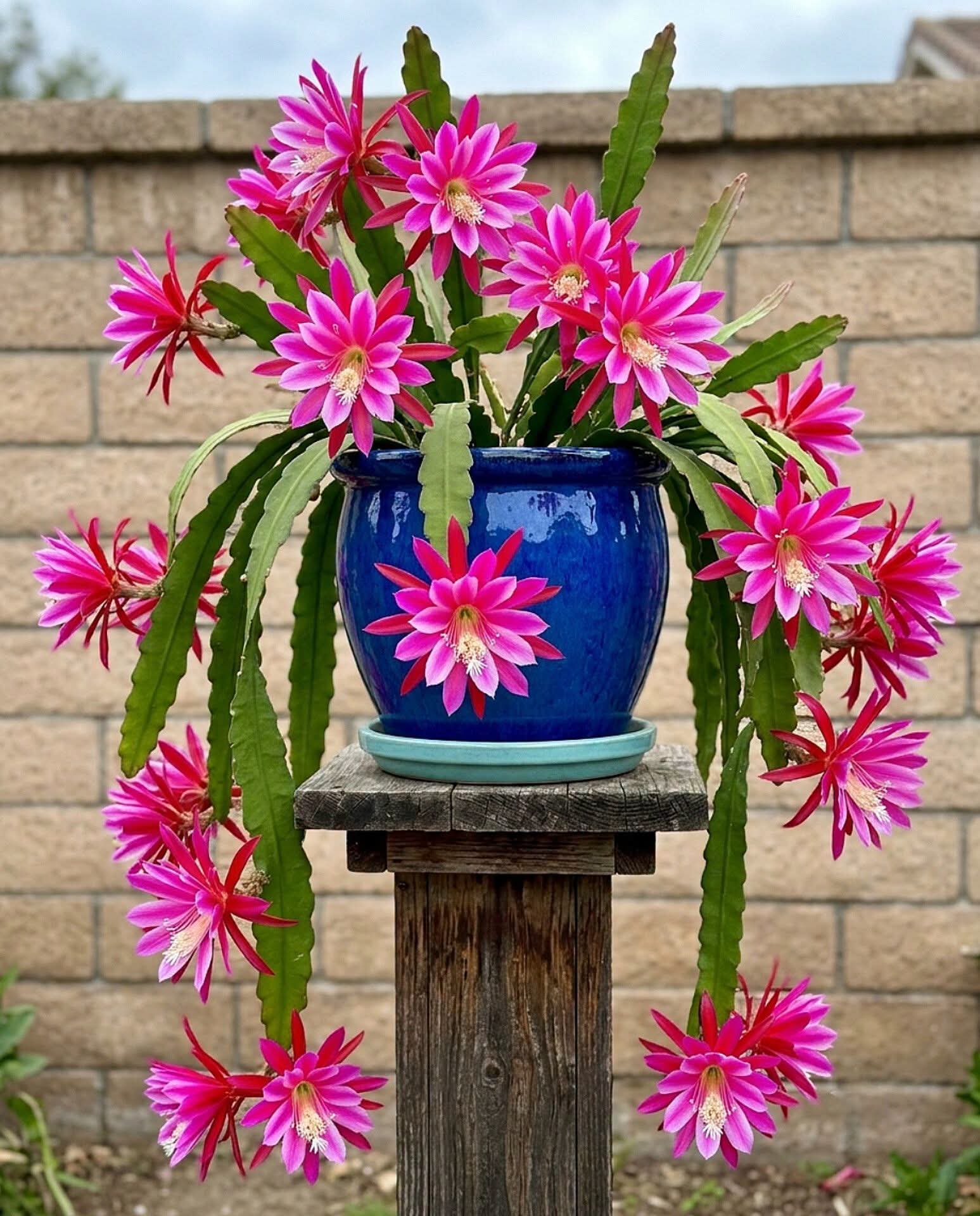
Cultivating spectacular Orchid Cacti (Disocactus / Epiphyllum) brimming with vibrant magenta-pink starburst flowers, delicate white-tipped stamens, and cascading scalloped green stems brings show-stopping tropical luxury directly into your home space 🏠🌺. Displayed in a glossy cobalt blue ceramic pot set upon a rustic wooden stand against a warm brick courtyard backdrop, well-nourished forest succulents transform patios, balconies, and indoor sunrooms into breathtaking floral havens 🪴✨.
While many plant lovers struggle with non-blooming Epiphyllum specimens or limp, sluggish flattened stems, applying a balanced organic liquid amendment—such as steeped potato peel tea, organic banana peel extract, or diluted rice water—delivers essential potassium, bio-available starch, trace minerals, and gentle natural sugars 🔬🌱. Enhancing stem cellular rigidity and supporting subterranean feeder roots guarantees continuous floral bud initiation, vibrant petal pigmentation, and heavy cascading blooms year after year 🧪⚠️.
In this ultimate Orchid Cactus restoration and care guide, we will explore the botanical science behind triggering massive floral bursts, compare top natural feeding routines side-by-side, detail step-by-step preparation and application instructions, and share essential long-term secrets for keeping your cacti flourishing continuously 📝👇🛡️!
🌺 The Botanical Science Behind Orchid Cactus Blooming & Stem Health 🧪✨
Nourishing epiphytic Epiphyllum forest cacti with nutrient-dense organic liquid amendments relies on stem energy storage, stem-node activation, and cellular turgor expansion 🔬🧬.
Core Botanical Factors for Explosive Flower Bursts:
- Potassium Fueling for Floral Initiation 🌸: Bio-available potassium (K) supplied by natural fruit and vegetable peel teas acts as the primary catalyst for flower bud differentiation along scalloped stem margins.
- Starch & Carbohydrate Root Storage 🥔: Complex carbohydrates derived from organic infusions feed soil micro-organisms and store energy within flattened photosynthetic stems (cladodes), ensuring abundant bloom strength.
- Stem Wall Rigidity & Cuticle Thickness 🌿: Micronutrients like magnesium and calcium fortify long, pendulous stems, enabling them to arch gracefully under the heavy weight of massive 6\text{-inch} starburst blossoms without snapping.
- Epiphytic Root Oxygenation & Drainage 🪨: Unlike desert cacti, tropical forest orchids thrive in aerated, moisture-retentive substrate mixes that absorb organic liquid nutrients quickly without triggering stem base rot.
📊 Comprehensive Comparison: Popular Natural Feeds for Orchid Cacti
To help you choose the best feeding routine for your potted forest succulents, compare these effective natural care techniques side-by-side 📋👇:
| Care Method / Natural Feed 🛡️ | Primary Base & Kitchen Ingredient 🎯 | Main Botanical Advantage ✨ | Application Schedule 🗓️ |
|---|---|---|---|
| Steeped Potato Peel Extract 🥔 | Fresh Potato Peels & Filtered Water | High starch, potassium & iron for massive bud counts 🛡️ | Every 2 to 3 weeks in early spring/summer ⏱️ |
| Steeped Banana Peel Drench 🍌 | Fermented Banana Peels & Water | Delivers concentrated potassium for rich petal color ✨ | Every 3 weeks during active growth 🗓️ |
| Fermented Rice Water Wash 🌾 | Starchy Rice Rinse Water | Feeds beneficial soil bacteria & boosts root mass 🌿 | Every 3 to 4 weeks seasonally ⏱️ |
| Diluted Onion Peel Tea 🧅 | Dry Onion Skins & Boiled Water | Provides natural bio-flavonoids & pest resistance 🪴 | Once |
🛡️ Key Benefits of Natural Bio-Feeds for Orchid Cacti 🌺✨
1. 100% Gentle & Chemical-Free Plant Nutrition 🛡️✨
Eliminates harsh synthetic fertilizer burn! Forest cacti have delicate epiphytic roots that easily scorch under heavy chemical salts; organic infusions release mild nutrients safely.
2. Triggers Multi-Bud Cascades Along Stem Margins ✨
Encourages multiple flower buds to burst simultaneously along every scalloped notch, transforming single stems into cascading curtains of brilliant pink petals.
3. Enhances Flower Size & Color Intensity 🏠🪙
Rich trace minerals heighten natural betalain pigments, creating deeply saturated magenta-pink hues with shimmering iridescent central highlights.
4. Eco-Friendly & Sustainable Home Care 🪴✨
Repurposes everyday kitchen food scraps into high-performance organic plant food, making expert tropical cactus care easy, affordable, and zero-waste!
📝 Step-by-Step Guide: How to Prepare & Apply Bio-Nutrient Feed 🏺🧪
Pro-Tip: Always strain your natural peel tea through a fine mesh sieve before watering to prevent organic pulp from attracting fungus gnats or clogging well-drained substrate!
1. Prepare Fresh Potato Peel Infusion 🥣💧
- Save peels from 3\text{ to }4\text{ clean, raw organic potatoes}.
- Place peels in a glass jar or pot, pour 4\text{ cups} (1\text{ liter}) of boiling filtered water over them, and cover tightly.
- Allow the peels to steep at room temperature for 24\text{ to }48\text{ hours} until the liquid turns a pale golden-amber color.
2. Strain & Dilute Solution 🏺🚿
- Pour the steeped liquid through a fine mesh strainer into a clean pouring pitcher, discarding the solids.
- Dilute 1\text{ part} potato peel concentrate with 1\text{ part} clean room-temperature filtered water.
3. Apply as a Soil & Root Drench 🟢💧
- Pour the diluted liquid drench slowly around the base of the plant directly onto the potting mix, targeting the central root system.
- Continue pouring until liquid drips freely from the pot’s bottom drainage holes into the saucer beneath.
- Allow the gritty Orchid Cactus substrate to absorb the nutrients for 15\text{ minutes}.
- Empty all excess runoff water from the saucer underneath; never allow forest cactus roots to sit in stagnant water.
4. Position in Ideal Bright Indirect Light ☀️🌸
- Place your Epiphyllum in a warm, sheltered spot receiving bright, indirect sunlight or dappled outdoor morning sun (18^\circ\text{C} to 28^\circ\text{C}).
- Maintain consistent moisture during active spring blooming and repeat this application once every 2 to 3 weeks!
🗓️ Essential Rules for Long-Term Orchid Cactus Blooming 💡🛡️
Following proper winter dormancy, light exposure, and watering cycles guarantees breathtaking annual floral displays 🌟:
- Provide a Cool Winter Rest Period 🚫: Reduce watering and keep the plant in a cool room (10^\circ\text{C} to 15^\circ\text{C}) for 6 to 8 weeks in late winter; this cool rest period is mandatory for setting spring flower buds!
- Never Over-Water Epiphytic Cacti 💧: Allow the top 1\text{-inch} (2.5\text{-cm}) of soil mix to dry out slightly between waterings to protect tender feeder roots from rotting.
- Protect From Harsh Direct Midday Sun ☀️: Direct summer sun burns scalloped stems yellow or purple; keep under bright, indirect canopy light or shade cloth.
- Never Move the Pot Once Buds Form 🛑: Avoid turning or relocating your Orchid Cactus after small flower buds appear, as sudden changes in light orientation cause buds to drop off!
🌟 Final Thoughts
Cultivating Orchid Cacti with natural potato peel infusions and proper seasonal care is a simple, highly effective, and foolproof secret for achieving explosive pink blooms 🌺🌵✨. By mastering cool winter resting, gentle root feeding, and bright indirect lighting, you guarantee long-lasting botanical luxury that elevates your outdoor patio or indoor living area 🏠🛡️. Try this easy plant care secret today and watch your cactus bloom! 🚀