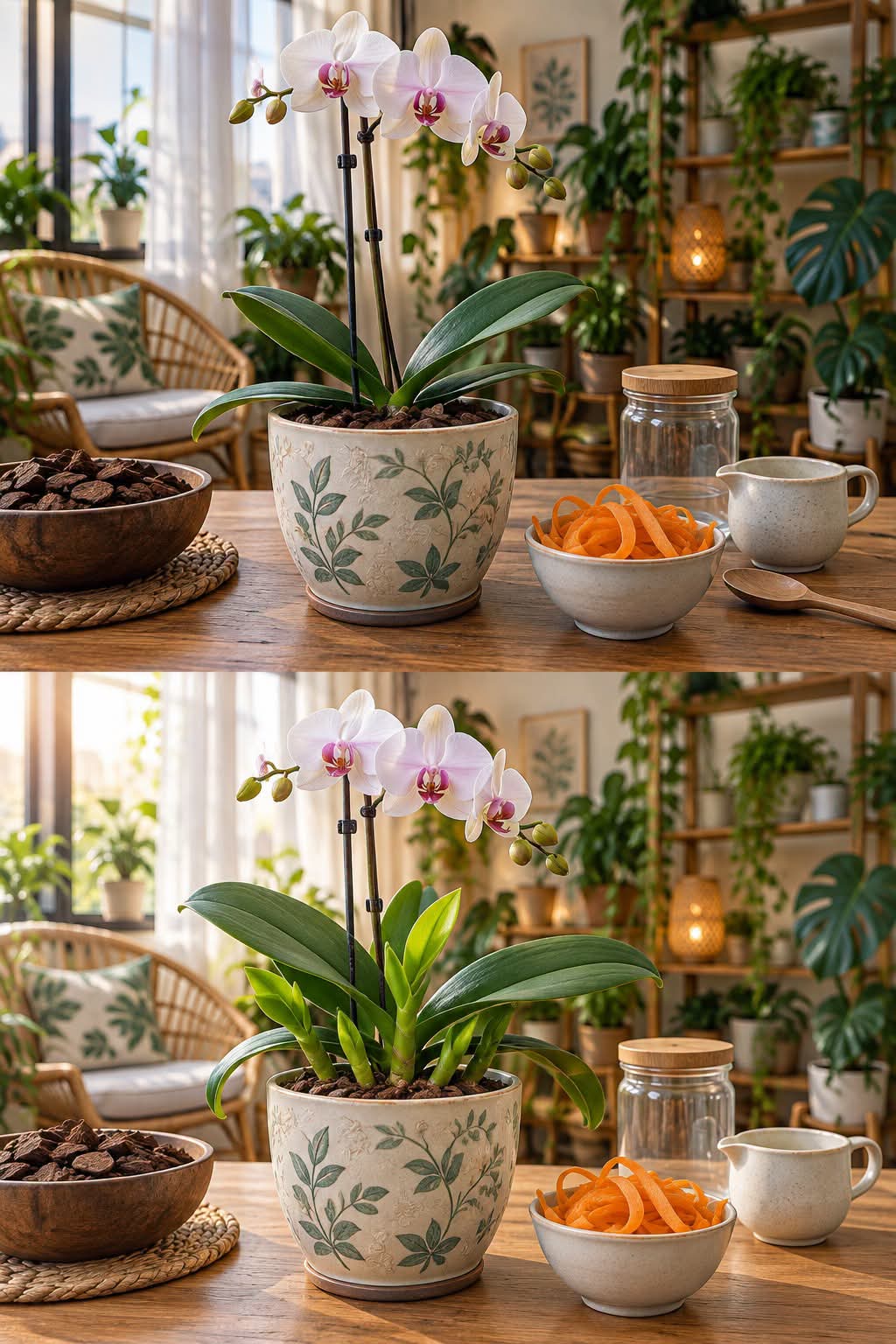
Cultivating healthy moth orchids (Phalaenopsis) with glossy emerald leaves, sturdy aerial roots, and tall flower spikes packed with elegant pink-and-white blossoms brings incredible botanical luxury, vibrant color, and serene natural beauty straight into your indoor living space 🏠🌸. Displayed in decorative ceramic planters filled with coarse fir bark substrate alongside kitchen bowls of shredded natural peels and steeped liquid jars, well-nourished orchids transform any wooden dining table or windowsill into a lush indoor garden sanctuary 🪴✨.
While many houseplant lovers struggle with reluctant orchids that remain dormant or drop flower buds prematurely, supplying gentle natural organic liquid feeds made from household kitchen ingredients like carrot peel extract or rice water delivers vital vitamins, potassium, beta-carotene, and trace minerals 🔬🌱. Applying a mild organic liquid drench to the root zone regularly stimulates root cell expansion, accelerates new leaf growth, and encourages long-lasting flower spikes 🧪⚠️.
In this ultimate orchid care guide, we will explore the botanical science behind natural organic feeding, compare top household plant fertilizers side-by-side, detail step-by-step preparation and application instructions, and share essential long-term maintenance secrets for keeping orchids blooming year after year 📝👇🛡️!
🌸 The Botanical Science Behind Organic Orchid Fertilization 🧪✨
Nourishing epiphytic orchids with natural kitchen extracts relies on Velamen root absorption, organic beta-carotene synthesis, and balanced mineral transport 🔬🧬.
Core Botanical Factors for Thriving Moth Orchids:
- Velamen Layer & Root Nutrient Absorption 🌿: Epiphytic orchid roots feature a specialized spongy outer tissue layer called velamen. Velamen rapidly drinks up liquid moisture, starches, and bio-available organic compounds directly from mild liquid feeds.
- Beta-Carotene & Potassium Translocation 🥕: Natural carrot peel extracts release potassium, phosphorus, calcium, and beta-carotene antioxidants, which fortify plant immunity and support vigorous stem and bud development.
- Fir Bark Substrate Airflow & Substrate Life 🪵: Applying mild liquid amendments feeds beneficial micro-organisms residing inside the fir bark substrate without suffocating delicate aerial roots or clogging air pockets.
- Chlorophyll & Root Photosynthesis ✨: Both orchid leaf blades and green-tipped aerial roots actively photosynthesize. Gentle organic nutrition keeps root tips vibrant green and foliage thick, firm, and glossy.
📊 Comprehensive Comparison: Popular Natural Orchid Care Methods
To help you choose the best feeding routine for your potted orchids, compare these effective natural care techniques side-by-side 📋👇:
| Care Method / Natural Feed 🛡️ | Primary Base & Kitchen Ingredient 🎯 | Main Botanical Advantage ✨ | Application Schedule 🗓️ |
|---|---|---|---|
| Natural Kitchen Peel Extract 🥕 | Shredded Carrot Peels / Water Infusion | Boosts root strength, growth & flower spike vigor 🛡️ | Every 2 to 3 weeks in spring/summer ⏱️ |
| Fermented Rice Water Drench 🥛 | Starchy Rice Water Infusion | Supplies essential trace minerals & starch energy ✨ | Every 2 weeks during active growth 🗓️ |
| Crushed Powdered Eggshell Tea 🥚 | Dried Powdered Eggshell Solution | Delivers bio-available calcium for strong leaves 🌿 | Once per month seasonally ⏱️ |
| Diluted Banana Peel Extract 🍌 | Fermented Potassium Liquid | Enhances flower bud density & bloom longevity 🪴 | Every |
🛡️ Key Benefits of Using Natural Kitchen Extracts for Orchids 🌸✨
1. 100% Gentle & Chemical-Free Plant Nutrition 🛡️✨
Eliminates synthetic chemical fertilizers that cause salt accumulation, leaf scorch, or burned root tips on sensitive epiphytic orchids!
2. Triggers Rapid Root Growth & Double Flower Spikes ✨
Delivers mild, natural organic minerals that encourage dormant crowns to push out multiple flower spikes and fresh green root tips.
3. Sustainable & Budget-Friendly Home Recycling 🏠🪙
Repurposes everyday leftover kitchen peels into nutrient-dense plant food, making expert orchid care effortless and economical.
4. Maintains Vibrant Floral Color & Thick Foliage 🪴✨
Enriches soil nutrients to ensure flower petals retain deep pink hues while keeping central foliage upright, firm, and dark green.
📝 Step-by-Step Guide: How to Prepare & Apply Kitchen Peel Feed 🏺🧪
Pro-Tip: Always allow homemade organic extracts to cool completely to room temperature before applying to plant roots, and strain thoroughly to remove solid debris!
1. Prepare Natural Peel Extract Solution 🥣💧
- Place 1\text{ cup} of fresh shredded carrot peels (or mixed organic kitchen scraps) into a heat-proof jar or pot.
- Pour 4\text{ cups} (1\text{ liter}) of boiling filtered water over the peels and allow to steep covered for 4\text{ to }6\text{ hours} (or overnight).
- Strain the liquid through a fine mesh sieve to remove all solid pulp, leaving a clear, nutrient-rich amber liquid.
2. Dilute & Fill Pouring Vessel 🏺🚿
- Mix 1\text{ cup} of the concentrated peel liquid with 2\text{ cups} of clean, room-temperature distilled or filtered water.
- Pour the diluted liquid into a clean narrow-spout watering pitcher or glass jar.
3. Apply as a Soil & Root Drench 🟢💧
- Slowly pour the organic liquid around the inner rim of the ceramic planter onto the fir bark medium, avoiding the central crown and leaves.
- Allow the bark substrate and roots to absorb the liquid for 10\text{ to }15\text{ minutes}.
- Ensure excess liquid drains fully out of the bottom drainage holes; never leave roots sitting in stagnant water.
4. Place in Optimal Bright Indirect Sunlight ☀️🌸
- Set your orchid in a bright location near an east or south-facing window receiving bright, indirect sunlight.
- Maintain stable room temperatures (18^\circ\text{C} to 24^\circ\text{C}) to support continuous flowering cycles!
🗓️ Essential Rules for Long-Term Orchid Blooming Success 💡🛡️
Following proper light exposure, temperature shifts, and watering rules guarantees healthy blooms year after year 🌟:
- Never Pour Water directly into the Leaf Crown 🚫: Liquid trapped inside central leaf joints leads to crown rot. Wipe wet leaves dry immediately using a soft napkin.
- Provide Cool Autumn Night Temperature Drops 🌡️: A slight drop in night temperature (3^\circ\text{C} to 5^\circ\text{C} cooler at night) in early autumn signals the crown to produce new flower spikes.
- Use Coarse Ventilated Substrates 🪵: Always keep orchids in coarse fir bark chips, coconut husk chunks, or charcoal to ensure maximum root oxygenation.
- Stake Arching Flower Spikes Gently 🥢: As flower spikes grow taller and form heavy buds, clip them loosely to slender bamboo stakes to prevent bending or breaking!
🌟 Final Thoughts
Feeding Moth Orchids with natural kitchen peel extracts is a simple, highly rewarding, and foolproof care secret for achieving spectacular, long-lasting blooms 🌸🥕✨. By mastering gentle root drenches, ensuring complete substrate drainage, and providing bright indirect light, you guarantee healthy aerial roots and breathtaking pink-and-white blossoms that brighten your home 🏠🛡️. Try this easy natural orchid feeding secret today and watch your plants flourish! 🚀