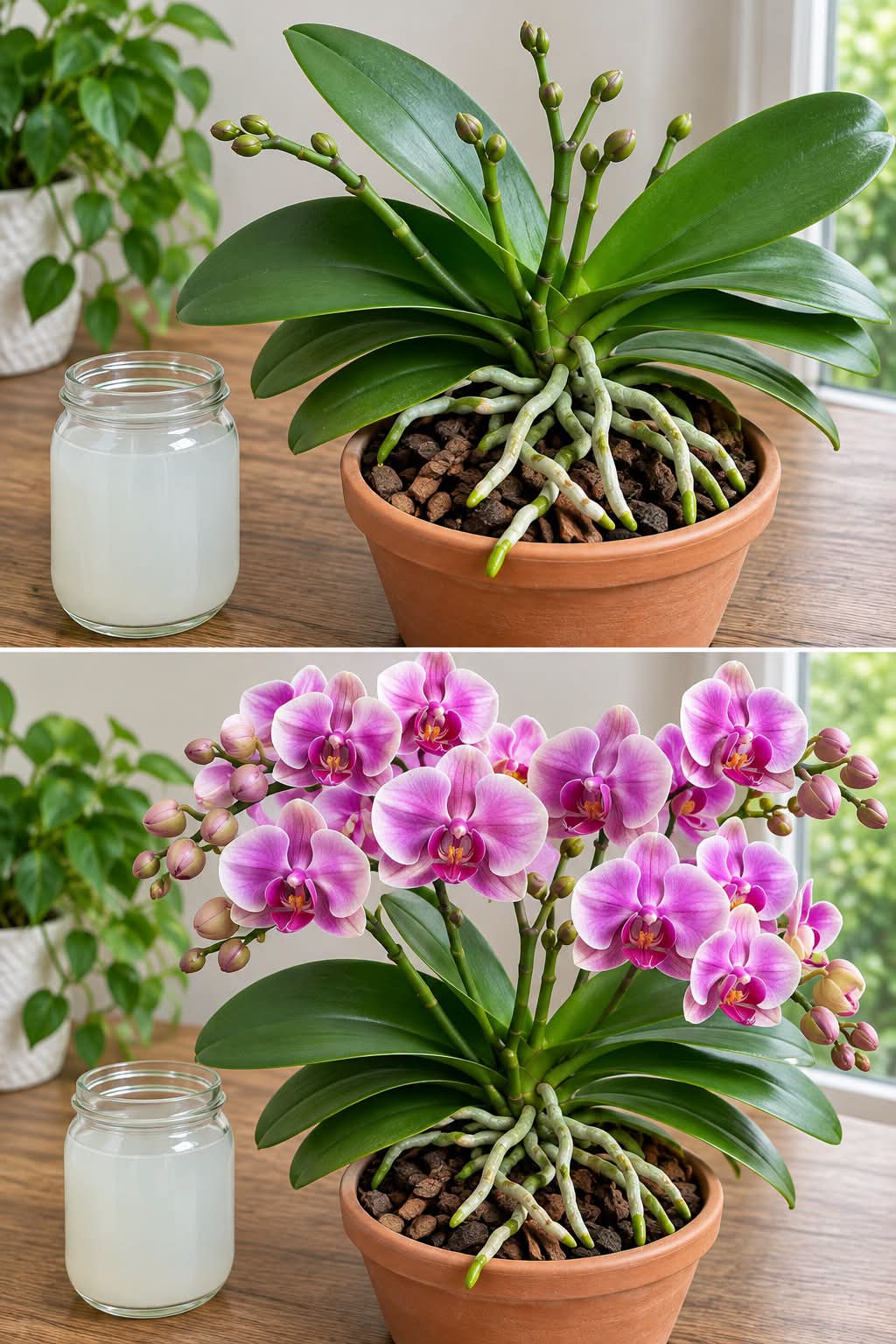
Cultivating stunning moth orchids (Phalaenopsis) with healthy aerial roots, thick emerald-green leaves, and tall flower spikes packed with vibrant pink blossoms brings incredible botanical elegance, natural luxury, and tropical beauty straight into your home living space 🏠🌸. Displayed in terracotta clay pots filled with bark medium alongside a jar of organic liquid feed, well-nourished orchids transform from plain foliage into breathtaking cascades of long-lasting flowers 🪴✨.
While many plant enthusiasts struggle with stubborn orchids that produce leaves but fail to rebloom, feeding your plants with gentle organic liquid nourishment like rice water or organic liquid amendments provides essential trace minerals, starches, and beneficial nutrients 🔬🌱. Applying a mild organic liquid feed regularly encourages strong aerial root development, stimulates flower spike growth, and sustains vibrant blooming cycles for months 🧪⚠️.
In this ultimate orchid care guide, we will explore the botanical science behind organic liquid fertilization for orchids, compare top natural feeding methods side-by-side, detail step-by-step application instructions, and share essential long-term secrets for keeping orchids blooming year after year 📝👇🛡️!
🌸 The Botanical Science Behind Organic Orchid Care 🧪✨
Feeding epiphytic orchids with natural liquid fertilizers like fermented rice water or organic liquid amendments relies on Velamen root absorption, mineral starch synthesis, and orchid photoperiod dynamics 🔬🧬.
Core Botanical Factors for Thriving Moth Orchids:
- Velamen Root Layer & Absorption 🌿: Epiphytic orchid roots are coated in a spongy white-and-green layer called velamen. Velamen rapidly absorbs moisture, starches, and dissolved bio-available nutrients directly from liquid feeds.
- Trace Micronutrients & Starch Energy 🌾: Fermented starch liquid delivers trace amounts of nitrogen, phosphorus, potassium, magnesium, and vitamin B, which fuel cellular energy production and stimulate robust flower spikes.
- Bark Substrate Aeration & Microbial Life 🪵: Applying mild organic liquids feeds beneficial microorganisms within the fir bark substrate, breaking down organic matter without suffocating delicate roots.
- Foliar Chlorophyll & Root Photosynthesis ✨: Both orchid leaves and green-tipped aerial roots undergo photosynthesis. Balanced liquid feeding keeps roots firm, plump, and emerald green.
📊 Comprehensive Comparison: Popular Natural Orchid Care Methods
To help you choose the best feeding routine for your potted orchids, compare these effective natural care techniques side-by-side 📋👇:
| Orchid Care Method / Feeding Style 🛡️ | Primary Ingredients & Base 🎯 | Main Botanical Advantage ✨ | Application Schedule 🗓️ |
|---|---|---|---|
| Fermented Organic Liquid Feed 🥛 | Rice Water / Organic Feed | Boosts aerial root growth & spike formation 🛡️ | Every 2 weeks during growth ⏱️ |
| Crushed Eggshell Tea 🥚 | Dried Eggshell Water | Delivers vital calcium for strong leaf cells ✨ | Once per month 🗓️ |
| Diluted Banana Peel Drench 🍌 | Fermented Banana Peel Water | High potassium content for abundant blooms 🌿 | Every 3 to 4 weeks ⏱️ |
| Garlic Water Root Soaking 🧄 | Infused Garlic Water | Natural antibacterial & pest deterrent 🪴 | Once |
🛡️ Key Benefits of Using Organic Liquid Feed for Orchids 🌸✨
1. 100% Gentle & Chemical-Free Plant Nutrition 🛡️✨
Eliminates synthetic chemical fertilizers that cause chemical salt buildup, root burn, or shriveled aerial roots on sensitive epiphytic orchids!
2. Triggers Multiple Flower Spikes & Massive Blooms ✨
Supplies steady, low-dose organic minerals that encourage dormant orchid crowns to push out new flower spikes filled with abundant buds.
3. Sustainable & Economical Household Recycling 🏠🪙
Repurposes everyday kitchen rice water into valuable plant food, making high-end orchid care accessible and budget-friendly.
4. Strengthens Aerial Roots & Leaf Health 🪴✨
Keeps aerial roots plump, firm, and green while maintaining thick, glossy, deep-green foliage resistant to dehydration.
📝 Step-by-Step Guide: How to Apply Organic Liquid Feed to Orchids 🏺🧪
Pro-Tip: Always feed orchids using the “weakly, weekly” method—dilute your organic liquid thoroughly to ensure roots absorb nutrients smoothly without overloading the bark substrate!
1. Prepare & Dilute Organic Liquid Feed 🥛🌾
- Collect water from soaking or rinsing uncooked organic rice (or prepare a mild liquid organic amendment).
- Allow the liquid to sit for 24\text{ hours} at room temperature to initiate light fermentation and activate beneficial nutrients.
- Dilute 1\text{ cup} of organic feed with 2\text{ cups} of clean, room-temperature distilled or filtered water.
2. Soak the Orchid Pot (Bottom-Watering Method) 🏺💧
- Place the terracotta clay pot inside a wider bowl or container.
- Pour the diluted organic liquid around the inner rim of the pot onto the fir bark medium, avoiding the central leaf crown.
- Allow the bark and roots to soak in the liquid for 10\text{ to }15\text{ minutes} so the velamen layer turns bright green.
3. Drain Excess Liquid Completely 🪵🛑
- Lift the orchid pot out of the soaking bowl and let all excess liquid drain thoroughly through the bottom drainage holes.
- Epiphytic roots must never sit in standing water, as stagnant moisture causes severe root rot.
4. Place in Optimal Bright Indirect Light ☀️🌸
- Set your orchid near an east or south-facing window receiving bright, indirect sunlight.
- Maintain regular room temperatures (18^\circ\text{C} to 24^\circ\text{C}) and enjoy continuous flower spikes and vibrant pink blooms!
🗓️ Essential Rules for Long-Term Orchid Blooming Success 💡🛡️
Following proper light exposure, temperature shifts, and watering rules guarantees healthy blooms year after year 🌟:
- Never Pour Water into the Central Leaf Crown 🚫: Water trapped between central leaves causes crown rot, which can permanently damage the plant. Always water directly onto the bark substrate.
- Provide Cool Night Temperature Drop 🌡️: A slight drop in night temperature (3^\circ\text{C} to 5^\circ\text{C} cooler at night) in autumn triggers the plant to initiate new flower spikes.
- Use Coarse Bark Medium 🪵: Grow orchids in coarse fir bark or coconut husk chips rather than standard soil to ensure maximum airflow around roots.
- Prune Faded Flower Spikes ✂️: Trim spent flower stalks just above a healthy node using sterilized shears to encourage secondary bloom branching!
🌟 Final Thoughts
Feeding Moth Orchids with gentle organic liquid solutions is a simple, highly rewarding, and foolproof care secret for achieving spectacular indoor blooms 🌸🥛✨. By mastering gentle root soaking, ensuring complete bark drainage, and providing bright indirect light, you guarantee healthy aerial roots and stunning pink blossoms that elevate your home decor 🏠🛡️. Try this easy natural orchid feeding routine today and watch your plants thrive! 🚀🟢💛