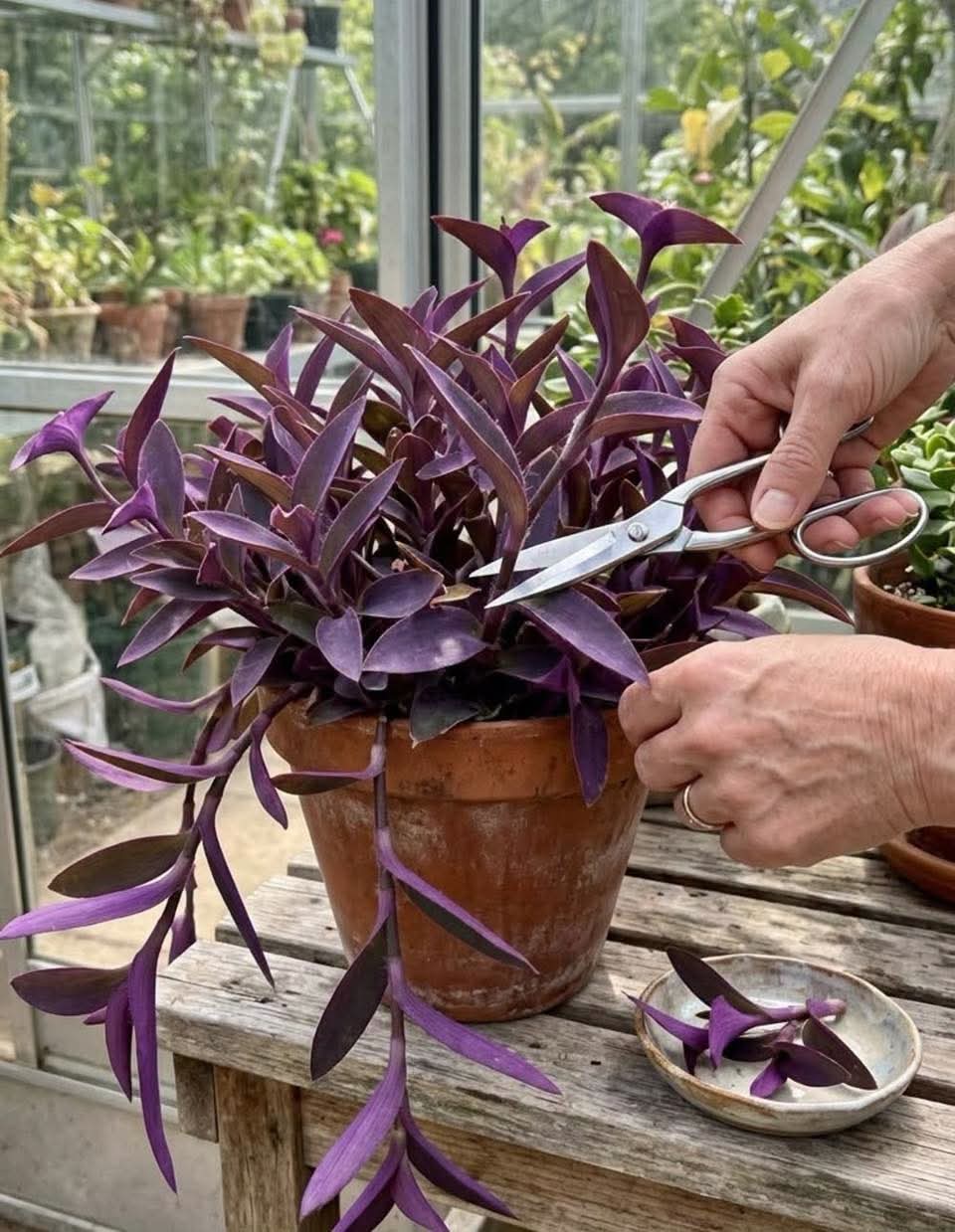
Are you tired of watching your favorite purple houseplants grow leggy, thin, and sparse as the seasons change? 😩 You water them regularly, keep them in bright spots, and wipe away dust, yet long stems stretch out awkwardly with sparse leaves at the base! 🪴💔 Don’t worry, indoor gardening enthusiasts! You are definitely not alone in this botanical struggle. Thousands of plant parents struggle to keep trailing purple varieties like Tradescantia pallida (Purple Heart) looking full, bushy, and richly colored! 🌿🏡
The fantastic news? You do NOT need expensive commercial growth boosters or complex chemical feeds to double your plant’s volume! 🚫🧪 Right in your hands lies the power of strategic pruning and propagation! ✂️✨
By making clean, targeted cuts just above leaf nodes, you can trigger dormant auxiliary buds, eliminate leggy growth, and encourage a explosion of deep violet leaves! 💜 Lush foliage, sturdy trailing vines, and endless fresh plantlets are just a simple trim away! 🎉👇
🌟 Why Do Purple Houseplants Become Leggy and Sparse? 🤔💭
Before picking up your shears, understanding why vibrant trailing plants develop long, leggy stems in home environments is essential:
- Apical Dominance 🌿: Plants naturally concentrate growth energy into the tip of each stem. Without pruning, main shoots keep growing longer while side branches remain dormant.
- Light Searching Behavior ☀️: When light levels dip slightly indoors, stems stretch rapidly toward light sources, creating wide spaces between leaf nodes.
- Aging Vine Stems 🥀: Over time, older leaf bases near the pot center naturally drop leaves, leaving bare stems at the crown while tips keep extending.
- Nutritional Imbalance 🧪: Excessive nitrogen fertilizers can push fast, weak stem growth rather than dense, compact foliage growth.
🧪 The Science Behind Strategic Pruning and Pinching 🔬✨
What makes pruning so incredibly effective for transforming leggy houseplants into dense, rounded masterpieces? It comes down to plant hormone redirection! 🧬🌱
- Suppressing Auxin Hormones ✂️: The tip of a plant stem produces auxin, a hormone that prevents lateral buds from growing. Cutting off stem tips removes auxin suppression instantly!
- Activating Cytokinins for Bushiness ⚡: With auxin removed, cytokinins take over, signaling lower dormant nodes along the stem to shoot out two or three brand new branches!
- Maximizing Photosynthetic Density 🍃: Trimming encourages dense leaf growth near the soil line, allowing more surface area to catch bright light and keep rich purple pigmentation strong!
📊 Standard Maintenance vs. Strategic Pruning Routine 📑💡
To help optimize your pruning schedule, review this structured comparison guide contrasting basic care with our specialized pruning and propagation method! 🌺👇
| Care Aspect 📋 | Basic Unpruned Care 🪴 | Strategic Pruning & Propagation Method ✂️✨ |
|---|---|---|
| Primary Goal | Natural unchecked stem growth | Maximum bushiness & vibrant foliage density |
| Stem Structure | Long, sparse, & leggy vines | Compact, multi-branched, & lush crown |
| Color Intensity | Can fade to green-purple | Deep, saturated violet foliage 💜 |
| Growth Habit | Single trailing vines | Cascading waterfall of side shoots |
| Plant Multiplication | None (single parent pot) | Free new plants from rooted cuttings! 🎉 |
| Best Execution Time | Any time | Spring |
📝 Step-by-Step Guide: How to Prune for Maximum Volume 🪴✨
Transforming a thin, leggy purple plant into a dense, show-stopping centerpiece is super easy! Follow these step-by-step instructions to trim like a pro:
Step 1: Sanitize Your Cutting Shears ✂️🧼
- Wipe down sharp pruning shears or garden scissors with isopropyl alcohol to prevent transferring plant bacteria or fungi.
Step 2: Identify Strategic Cut Points 🔍🌿
- Look along long trailing vines for healthy leaf nodes (the small joint where leaves attach to the main stem).
- Select stems that look sparse or leggy near the pot’s base.
Step 3: Make Clean Angle Cuts ✂️💜
- Make a clean cut roughly 1/4 inch above a leaf node at a 45-degree angle.
- Cut back up to one-third of the total stem length to encourage vigorous side branching!
Step 4: Propagate Your Stem Cuttings 🏺💧
- Strip leaves from the bottom 2 inches of trimmed stem cuttings.
- Insert cuttings back into the main pot’s soil to fill empty spots, or root them in water to create completely new plant collections! 🌸✨
🌺 Pro-Tips for Maintaining Rich Purple Pigmentation 🎁✨
Keep these expert tips in mind to ensure your pruned plant produces vibrant purple foliage year-round:
- Provide High Indirect Light ☀️: Purple foliage requires plenty of bright, indirect sunlight to maintain deep violet colors! In low light, leaves turn dull green.
- Water Moderately 💧: Allow the top 1 to 2 inches of soil to dry out between waterings. Terra cotta pots help drain excess moisture and protect stems from rot.
- Rotate the Pot Weekly 🔄: Turn your pot every few days so all side branches receive equal light, preventing uneven growth toward window sills!
🌟 Enjoy a Stunning, Lush Indoor Jungle! 🏡💖
With just a pair of sharp shears and strategic cuts, you can turn a leggy houseplant into a thick, cascading display of deep purple foliage! 🌸✨ Say goodbye to sparse stems and hello to a vibrant, multi-branched masterpiece that brightens up your entire living space! 😍🙌
Have you tried pruning your trailing houseplants to boost bushiness? What is your favorite purple plant variety in your collection? Share your thoughts, questions, and plant photos in the comments below! 📸👇 Happy Gardening! 🌿💖🎉