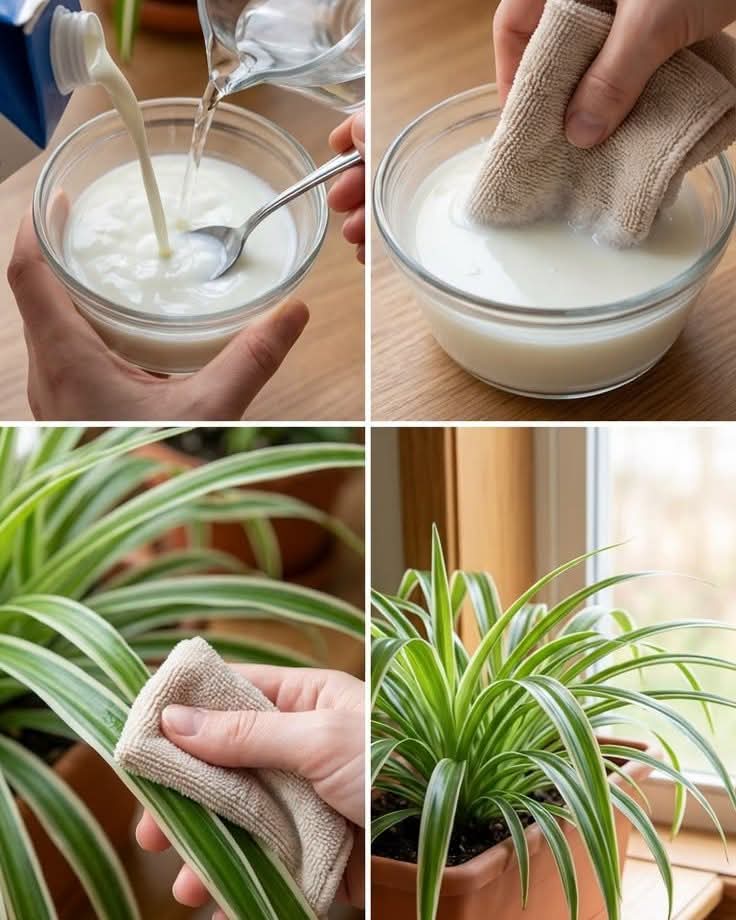
Cultivating healthy spider plants (Chlorophytum comosum) featuring arches of long, arching variegated leaves brings fresh botanical elegance, natural air purification, and vibrant green energy into any living room or indoor garden setup 🏠🌿. Planted in terracotta pots along sunny window sills, these iconic tropical perennials are cherished worldwide for their low-maintenance nature, rapid leaf expansion, and prolific growth of dangling plantlets 🪴✨.
While spider plants are famously resilient, keeping their long variegated leaves dust-free, preventing brown leaf tips, and enhancing natural leaf shine requires regular gentle maintenance 🔬🌱. Applying a diluted natural protein wipe—made by mixing dairy or plant-based milk with fresh water—serves as an organic leaf cleanser and mild foliar feed that removes dust particles, delivers bio-available calcium, and creates a protective natural barrier against pests 🧪⚠️.
In this ultimate houseplant care guide, we will explore the botanical science behind foliar leaf cleaning and gentle protein feeding, compare top organic plant care methods side-by-side, detail step-by-step application instructions, and share essential long-term secrets for thriving spider plants 📝👇🛡️!
🌿 The Botanical Science Behind Foliar Milk Wiping for Spider Plants 🧪✨
Wiping arching spider plant foliage with a diluted liquid milk mixture optimizes photosynthetic efficiency while delivering key trace macronutrients straight to leaf stomata 🔬🧬.
Core Factors for Vibrant Variegated Leaves & Rapid Growth:
- Stomata Unblocking & Photosynthetic Enhancement 🧽: Dust accumulation on long arching leaves blocks microscopic stomatal pores, reducing carbon dioxide uptake and slowing growth. Gently wiping leaves clears debris and optimizes light absorption.
- Foliar Calcium Absorption & Cellular Integrity 🥛: Milk is rich in bio-available calcium (\text{Ca}), which is absorbed directly through leaf pores to strengthen cell walls, reducing brittle leaf edges and brown leaf tips.
- Natural Sheen & Protective Barrier ✨: Proteins (casein and whey) present in milk create a light, non-clogging protective film over variegated leaves, giving foliage a brilliant natural shine without synthetic chemicals.
- Mild Antifungal Protection & Pest Deterrence 🛡️: Lactic acid and beneficial microflora in diluted milk help prevent fungal spore germination on leaf surfaces while deterring small pests like spider mites and aphids.
📊 Comprehensive Comparison: Indoor Foliar Care & Feeding Methods
To help you choose the best maintenance strategy for your potted spider plants, compare these natural care approaches side-by-side 📋👇:
| Care Method / Cleaning Style 🛡️ | Active Component Focus 🎯 | Primary Botanical Benefit ✨ | Application Frequency 🗓️ |
|---|---|---|---|
| Diluted Milk Foliar Wipe 🥛 | Calcium, Casein Protein & Lactic Acid | Cleans dust, boosts natural shine & prevents rot 🛡️ | Every 3 to 4 weeks ⏱️ |
| Filtered Water Sponge Cleaning 🧽 | Pure Neutral Hydration | Removes physical dust without adding nutrients ✨ | Bi-weekly leaf maintenance 🗓️ |
| Diluted Rice Water Soil Drench 🌾 | Soluble Starch, B-Vitamins & NPK | Stimulates underground roots & offshoots 🌿 | Monthly soil drench ⏱️ |
| Epsom Salt Foliar Spray ⚪ | Soluble Magnesium & Sulfur Ions | Enhances chlorophyll & brightens pale foliage 🪴 | Applied |
🛡️ Key Benefits of Natural Foliar Wiping for Spider Plants 🌿✨
1. 100% Gentle & Non-Toxic Leaf Cleansing 🛡️✨
Using a diluted milk solution provides a safe, organic method to clean indoor foliage without harsh chemical shine sprays that clog stomatal pores.
2. Eliminates Brown Tips & Enhances Color Contrast 💚✨
Supplying calcium and trace minerals directly through leaves reduces tip burn while sharpening the color contrast between deep green borders and white central stripes!
3. Delivers a Lasting Natural Leaf Sheen ✨✨
Leaves broad arching foliage with a smooth, glossy finish that repels dust and keeps your indoor plant display looking immaculate.
4. Simple, Budget-Friendly Household Solution 🏠🪙
Uses basic kitchen ingredients—milk, water, and a soft microfiber cloth—to transform dusty houseplants into vibrant indoor showpieces at zero added cost!
📝 Step-by-Step Guide: How to Prepare & Apply Liquid Leaf Wipe 🏺🧪
Pro-Tip: Always use a 1:1 or 1:2 ratio of milk to water and ensure the solution is completely fresh to avoid any sour odors on your indoor plants!
1. Prepare Liquid Solution in a Bowl 🥣🥛
- Pour 1 part fresh milk (1/2\text{ cup}) into a clean glass bowl or container.
- Add 1 to 2 parts lukewarm filtered water (1/2\text{ to }1\text{ cup}).
- Stir thoroughly with a spoon until the liquid is evenly blended into a pale, uniform solution.
2. Soak & Wring Out a Microfiber Cloth 🧽💧
- Dip a clean, soft microfiber cloth or sponge into the bowl until fully saturated.
- Wring out all excess liquid so the cloth is damp rather than dripping wet.
3. Support & Wipe Each Leaf Carefully 🌿🤲
- Gently support the underside of a long spider plant leaf with one hand.
- Wipe the top surface of the leaf in a smooth motion from the central base out to the leaf tip, removing all built-up dust and grime.
- Repeat for all major arching leaves, re-dipping and wringing out the cloth as needed.
4. Place in Bright Indirect Sunlight ☀️🌾
- Position your cleaned spider plant in a warm area (18^\circ\text{C} to 26^\circ\text{C}) receiving bright, indirect sunlight to encourage rapid drying and active photosynthesis.
🗓️ Essential Care Rules for Flourishing Spider Plants 💡🛡️
Following proper watering, lighting, and potting guidelines guarantees rapid growth, healthy leaves, and dozens of baby plantlets 🌟:
- Provide Bright Indirect Sunlight ☀️: Spider plants thrive in bright, filtered light near east or south-facing windows. Direct hot sun scorches variegated leaves, while deep shade causes limp foliage.
- Follow Proper Watering Habits 💧: Water thoroughly when the top 1\text{ to }2\text{ inches} of soil feel dry. Avoid waterlogged pots to prevent root rot.
- Use Well-Draining Potting Soil 🪴: Plant in a porous substrate composed of 70% potting soil and 30% perlite or coarse sand to ensure fast drainage away from roots.
- Trim Brown Tips with Clean Shears ✂️: If leaf tips brown due to dry air or tap water fluoride, trim them off using clean scissors following the natural leaf angle.
🌟 Final Thoughts
Maintaining your Spider Plants with Diluted Natural Leaf Wipes is an easy, highly effective, and satisfying care habit for keeping foliage dust-free, bright, and ultra-glossy 🌿🌱✨. By removing dust barriers, supplying leaf-level nutrients, and providing proper indirect light, you ensure a classic, air-purifying houseplant that brings lasting beauty to your home 🏠🛡️. Try this easy organic cleaning hack today and watch your spider plant thrive! 🚀