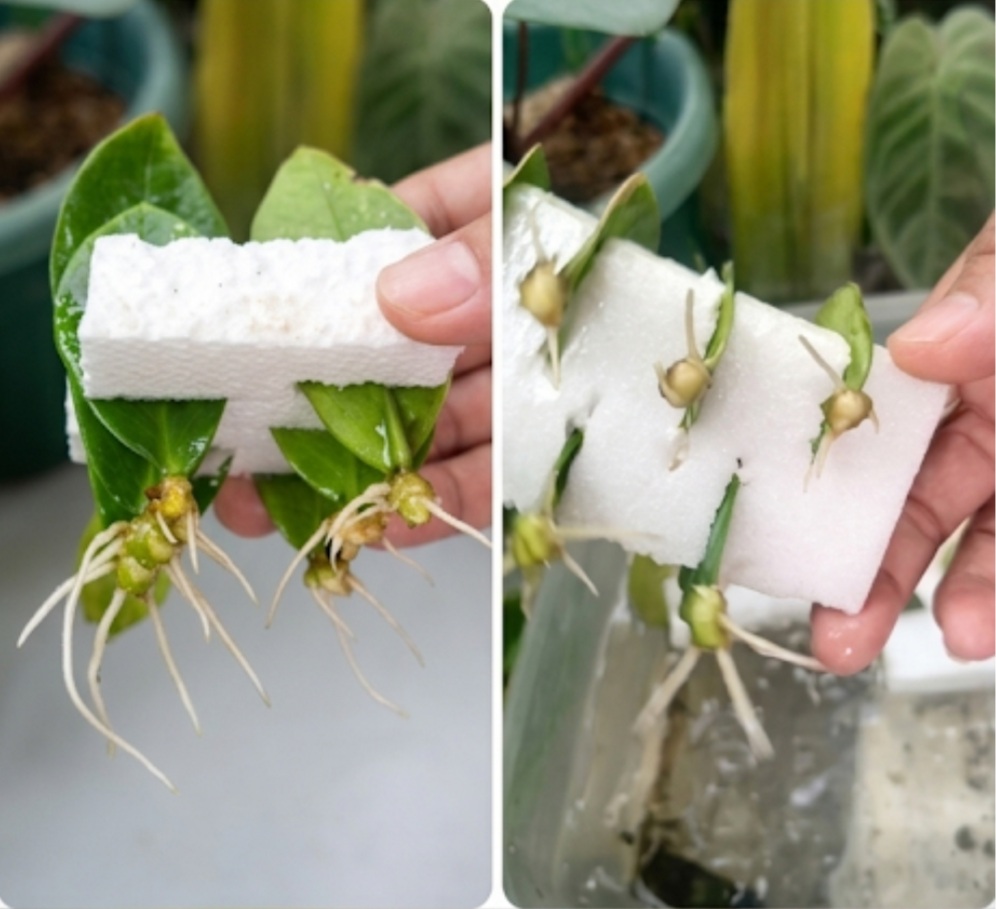
Propagating indoor houseplants like ZZ plants (Zamioculcas zamiifolia) or Peperomia from single leaf cuttings is one of the most clever, cost-effective methods for multiplying your green collection 🏠🌿. By inserting leaf stems into small slits cut into lightweight styrofoam blocks or foam sheets, you create a floating raft that suspends leaf stems in water while keeping upper foliage perfectly dry 🪴✨.
While traditional water propagation often leads to leaf rot when petiole bases submerge too deeply or sink to the bottom, the floating foam raft technique maintains precise water contact, continuous aeration, and ideal moisture levels 🔬🌱. This encourages rapid tuber formation, adventitious swelling, and strong white root systems ready for potting 🧪⚠️.
In this master propagation guide, we will explore the botanical science behind floating foam leaf propagation, compare top rooting methods side-by-side, detail step-by-step raft assembly instructions, and share essential secrets for transplanting rooted cuttings 📝👇🛡️!
🌿 The Botanical Science Behind Floating Foam Raft Propagation 🧪✨
Propagating leafy indoor plants from individual leaf blades relies on inducing meristematic root growth at the base of the petiole while protecting green tissues from oxygen deprivation 🔬🧬.
Core Factors for Floating Foam Rooting Success:
- Floating Elevation & Anti-Rot Suspension 🪵: Styrofoam acts as a buoyant platform, holding green leaf blades safely above the water surface while keeping only the base submerged, preventing leaf rot.
- Continuous Oxygen Access & Root Aeration 🫧: Roots require dissolved oxygen to form and elongate. Floating rafts keep petioles right near the air-water boundary where oxygen concentration is highest.
- Tuber & Rhizome Swelling Initiation 🧅: Plant species like ZZ plants form small nutrient-storing tubers (rhizomes) at the petiole base before producing roots. Suspended water propagation accelerates tuber formation.
- Constant Moisture Supply Without Submersion Stress 💧: Water level fluctuations in standard jars can cause cuttings to dry out or sink. Foam rafts automatically rise and fall with the water level!
📊 Comprehensive Comparison: Indoor Leaf Propagation Methods
To help you select the most reliable method for rooting leaf cuttings at home, compare these techniques side-by-side 📋👇:
| Propagation Method 🛡️ | Moisture Stability 🎯 | Risk of Leaf Rot ⚠️ | Rooting Speed 🗓️ | Success Rate ✨ |
|---|---|---|---|---|
| Floating Foam Raft 🪵 | Exceptional (Auto-Adjusts) | Very Low 🛡️ | 2\text{ to }4\text{ weeks} ⏱️ | 95\% High 🌟 |
| Standard Water Jar 🫙 | Variable (Requires Refilling) | High (Leaf Sinking) | 3\text{ to }5\text{ weeks} 🗓️ | 65\% Moderate 🌿 |
| Moist Peat & Perlite 🪵 | Moderate (Needs Monitoring) | Low-Moderate | 4\text{ to }6\text{ weeks} ✨ | 80\% Good 🪴 |
| Pure Sphagnum Moss 🟩 | High (Requires Squeezing) | Low-Moderate | 3\text{ to }5\text{ weeks} ⏱️ | 85\% Good 🌸 |
🛡️ Key Benefits of Floating Foam Leaf Propagation 🌿✨
1. 100% Prevention of Leaf Rot & Submersion Decay 🛡️✨
Elevating leaf blades above the water line prevents fungal rot and soft bacterial decay from destroying your cuttings before roots form.
2. Triggers Rapid Tuber & Root Development 🍃✨
Keeping petioles suspended in oxygen-rich surface water accelerates tuber development and produces thick, healthy white roots within weeks.
3. Space-Efficient & Multi-Cutting Capacity 🪴✨
A single foam raft floating in a shallow water container can hold dozens of leaf cuttings simultaneously, maximizing propagation space on bright windowsills.
4. Eco-Friendly & Reusable Household Tool 🏠🪙
Repurposes leftover styrofoam packing material into a high-performance propagation tray that can be washed and reused indefinitely!
📝 Step-by-Step Guide: Building a Floating Foam Propagation Raft 🏺🧪
Pro-Tip: Use sharp, sterilized shears when taking leaf cuttings to ensure clean petiole ends that absorb water cleanly!
1. Select & Cut Healthy Leaves ✂️🌿
- Choose mature, firm, unblemished leaves from a healthy parent plant.
- Snip each leaf at the petiole base, leaving approximately 0.5\text{ to }1\text{ inch} of stem attached.
2. Prepare the Floating Foam Block 🪵🔪
- Cut a clean piece of styrofoam sheet or dense foam block to fit inside your water container.
- Cut small vertical slits or punch tiny holes through the foam sheet spaced 1\text{ inch} apart using a craft knife or nail.
3. Insert Leaf Cuttings into the Foam Raft 🪴🥽
- Carefully slide the stem end of each leaf cutting through a slit in the foam sheet until the base protrudes 0.5\text{ inches} below the underside.
- Ensure the upper green leaf blade rests firmly above the top foam surface.
4. Float in Water & Place in Indirect Sunlight 💧☀️
- Fill a shallow plastic or glass tray with fresh, room-temperature filtered water (20^\circ\text{C} to 24^\circ\text{C}).
- Place the loaded foam raft onto the water surface, ensuring petiole bases are submerged while the raft floats freely.
- Position the container in a warm area receiving bright, indirect sunlight.
🗓️ Essential Care Rules for Rooted Leaf Cuttings 💡🛡️
Following proper water maintenance and transplanting practices guarantees high survival rates when moving cuttings into soil 🌟:
- Weekly Water Refreshing 💧: Replace the container water every 5 to 7 days to prevent algae formation and maintain high dissolved oxygen levels.
- Bright Indirect Sunlight ☀️: Keep propagation trays near bright windows with indirect light. Avoid direct harsh sun, which can heat water and scorch leaves!
- Transplant at Ideal Root Length 🏺: Wait until roots grow 1.5\text{ to }2\text{ inches} long and form visible tubers before carefully sliding cuttings out of the foam raft.
- Light Potting Soil Transition 🪴: Pot rooted cuttings into small pots filled with porous, well-draining potting soil mixed with perlite and peat moss. Keep soil lightly moist for the first 2 weeks.
🌟 Final Thoughts
Propagating houseplants using Floating Foam Rafts is a simple, highly effective, and genius botanical technique for multiplying your plant collection at home 🌿🌱✨. By keeping leaf blades elevated and petioles continuously hydrated in aerated water, you can trigger rapid tuber formation and robust root growth without rot risks 🏠🛡️. Try this easy floating propagation hack today and watch your indoor forest grow! 🚀🟢💛